
Product
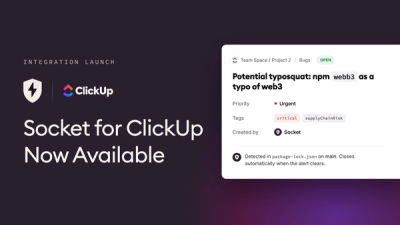
Socket for ClickUp Is Now Available
Create ClickUp tasks from Socket alerts, automate ticketing with custom rules, and keep alert and task status synchronized.
By Jeppe Hasseriis - Aug 26, 2026
@moshcoder/moshpit-name
Advanced tools
The Moshpit namespace rules: what is a valid ending, what a name parses to, which namespace wins, and what things cost. Pure, dependency-free, runs anywhere.
The Moshpit namespace rules: what is a valid ending, what a name parses to, which namespace wins, and what things cost.
Pure and dependency-free. No database, no network, no node: builtins — so the
same code runs on a server, in a browser extension, and in CI.
npm i @moshcoder/moshpit-name
import { parseMoshpitName, tldRejection, parseTldList } from "@moshcoder/moshpit-name";

parseMoshpitName("blue.420");   // { label: "blue", tld: "420" }
parseMoshpitName("1.420");      // null — both halves numeric reads as an IPv4 literal
tldRejection("bank");           // "that name is reserved"
These rules were written three times: once in the registry, once in TronBrowser's TypeScript resolver, and once as a hand port of that into the extension — with a test asserting the last two agree. A test that exists to catch drift between two copies is a good sign the copies should be one thing.
moshpit-name check <ending>     can this ending be claimed, and if not why
moshpit-name parse <name>       split a name into its label and ending
moshpit-name list [-]           parse a pasted list; - reads stdin
moshpit-name prices             what an ending and a name cost
$ moshpit-name check .420
.420 — claimable

$ moshpit-name parse 1.420
1.420 — not a Moshpit name (one label and one ending; both numeric reads as an address)

$ printf '.toplevel .redirect $2.00USD\neggs, yeah\n' | moshpit-name list -
.toplevel  → .redirect  $2
.eggs
.yeah
Shape. One label and one ending. a.b.c is malformed, not a subdomain.
Either half may be all digits — .420 is an ending people want — but both
being numeric reads as an abbreviated IPv4 literal, so 1.420 is refused where
blue.420 is not.
Reserved names. Endings that trade on trust in money, a company, or an institution cannot be claimed.
Precedence. clearnet mode lets the real internet win and Moshpit fill
gaps; moshpit mode lets a registered name beat a clearnet answer. Which one
applies is the resolver operator's call, and through them the user's.
Prices. An ending is $5/year; a name under one is $2/year, set by that
ending's operator. Whole dollars — the trailing cent in a .99 buys nothing
and every number here is one a person has to reason about.
Pasted lists. Newlines, commas and semicolons separate; a line may carry a
price and an ending to point at. .187 is an ending, bare 187 is a price.
MIT.
FAQs
The Moshpit namespace rules: what is a valid ending, what a name parses to, which namespace wins, and what things cost. Pure, dependency-free, runs anywhere.
The npm package @moshcoder/moshpit-name receives a total of 25 weekly downloads. As such, @moshcoder/moshpit-name popularity was classified as not popular.
We found that @moshcoder/moshpit-name demonstrated a healthy version release cadence and project activity because the last version was released less than a year ago. It has 1 open source maintainer collaborating on the project.
Product
Create ClickUp tasks from Socket alerts, automate ticketing with custom rules, and keep alert and task status synchronized.
Product
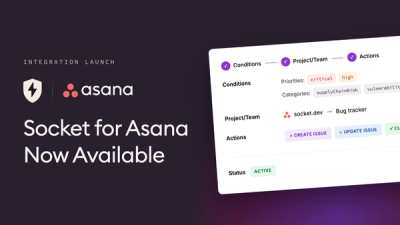
Create and manage Asana tasks directly from Socket alerts, with manual task creation, automated ticketing rules, and two-way sync.

Security News
Open VSX has removed three extension IDs from its malicious-extension list as the legitimate publishers they impersonated move to claim the names for themselves.