Research
/Security News
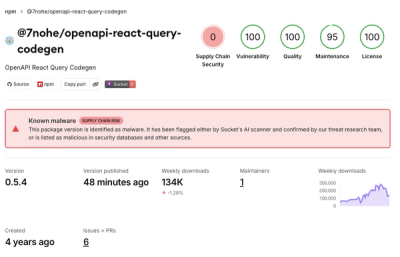
OpenAPI React Query Codegen Compromised in Mini Shai-Hulud npm Supply Chain Attack
Ten malicious OpenAPI React Query Codegen versions were published to npm in the Mini Shai-Hulud attack, all with valid provenance.
@next/env
Advanced tools
@next/envNext.js' util for loading dotenv files in with the proper priorities
Dotenv is a popular npm package that loads environment variables from a .env file into `process.env`. Similar to @next/env, it helps in managing application configurations across different environments. However, dotenv is not specifically tailored for Next.js applications and can be used in any Node.js project.
Cross-env allows you to set and use environment variables across different operating systems in a Node.js project. Unlike @next/env, which is focused on loading environment variables from files, cross-env is useful for setting environment variables directly in npm scripts in a cross-platform compatible way.
Env-cmd is another npm package that supports loading environment variables from a file into Node.js applications. It is similar to @next/env in its purpose but offers more flexibility in specifying different environment files for different environments (e.g., .env.production, .env.development) directly from the command line or scripts.
FAQs
Next.js dotenv file loading
The npm package @next/env receives a total of 51,030,031 weekly downloads. As such, @next/env popularity was classified as popular.
We found that @next/env demonstrated a healthy version release cadence and project activity because the last version was released less than a year ago. It has 2 open source maintainers collaborating on the project.

Research
/Security News
Ten malicious OpenAPI React Query Codegen versions were published to npm in the Mini Shai-Hulud attack, all with valid provenance.

Security News
Socket joins more than 100 technology, cybersecurity, and financial organizations calling for a global surge in cyber defense.

Product
Enterprise security teams can now detect malware, credential theft, suspicious network activity, and risky updates across Microsoft Edge extensions.