
Product
Socket Now Protects the Microsoft Edge Extension Ecosystem
Enterprise security teams can now detect malware, credential theft, suspicious network activity, and risky updates across Microsoft Edge extensions.
By John Tuckner - Aug 28, 2026
@nimbus-dev/sdk
Advanced tools
[](https://www.npmjs.com/package/@nimbus-dev/sdk) [](./LICENSE)


The MIT-licensed, dependency-free TypeScript authoring contract for Nimbus MCP (Model Context Protocol) connectors and extensions. It ships types, small pure helpers, and test utilities — no runtime dependencies, no I/O, no credentials.
The gateway, Vault, HITL (human-in-the-loop) gate, and connector sandbox all live in the Nimbus monorepo. This package is just the stable surface you compile against.
npm install @nimbus-dev/sdk # or: bun add @nimbus-dev/sdk
Scaffold a connector that performs the contract-version handshake and then serves MCP tools over the same two streams. Full walkthrough: quickstart-typescript.md (or quickstart-python.md).
npm create @nimbus-dev/connector@latest weather-connector
Usage: npx @nimbus-dev/create-connector@latest <name> [--lang ts|python] [--dir <path>]

  <name>          lowercase kebab-case, starting with a letter (e.g. weather-connector)
  --lang          ts (default) or python
  --dir           where to write it (default: ./<name>)
<name> has to be an npm package name, a Python module name, and a directory name at
once, so the CLI takes the intersection of all three: lowercase kebab-case starting with
a letter. my_connector, MyConnector and 2fa-connector are refused rather than
quietly rewritten. Then:
cd ~/src/weather-connector
npm install
npm test     # typechecks, builds, then runs unit + acceptance tests
npm start    # node dist/main.js
You get ten files, five of them source. manifest.ts is the contract the gateway reads:
import type { ExtensionManifest } from "@nimbus-dev/sdk";

export const manifest: ExtensionManifest = {
  id: "nimbus-quickstart-connector",
  displayName: "Nimbus Quickstart Connector",
  version: "0.1.0",
  description: "A Nimbus connector that echoes what it is given.",
  author: "you",
  entrypoint: "./dist/main.js",
  runtime: "node",
  permissions: ["read"],
  hitlRequired: [],
  // …
  contractVersions: ["1"],
  minNimbusVersion: "0.1.0",
};

export const TOOLS = [{ name: "echo", description: "Echoes its input" }] as const;
handlers.ts holds your logic and imports no protocol. main.ts is the only file that
knows a protocol exists — it handshakes, then serves MCP over what the handshake did not
consume. It is shown here as plain text, not as a checked snippet: it imports
@modelcontextprotocol/sdk and zod, which this dependency-free repository does not
install, so nothing here could compile it. The generated project is where it is
typechecked, built and executed, on every CI run.
import { Readable } from "node:stream";
import { McpServer } from "@modelcontextprotocol/sdk/server/mcp.js";
import { StdioServerTransport } from "@modelcontextprotocol/sdk/server/stdio.js";
import { CONTRACT_HANDSHAKE_EXIT } from "@nimbus-dev/sdk";
import { createRegisterSimpleTool, mcpJsonResult } from "@nimbus-dev/sdk/connector-kit";
import { NdjsonLineReader, performHandshake } from "@nimbus-dev/sdk/ipc";
import { z } from "zod";

import { echo } from "./handlers.js";
import { manifest, TOOLS } from "./manifest.js";

// …

async function run(): Promise<void> {
  const reader = new NdjsonLineReader();
  const result = await performHandshake(
    {
      read: readChunk,
      write: async (chunk) => {
        process.stdout.write(chunk);
      },
    },
    { localVersions: manifest.contractVersions ?? ["1"], reader },
  );

  if (!result.ok) {
    process.stderr.write(`handshake refused: ${result.reason}\n`);
    process.exitCode = CONTRACT_HANDSHAKE_EXIT;
    // Release stdin so the process can exit on its own. `process.exit()` here would risk
    // truncating the hello we just wrote to a pipe.
    await stdinChunks.return?.(undefined);
    return;
  }

  // …

  const replay = Readable.from(
    (async function* stream(): AsyncGenerator<Uint8Array> {
      for (const frame of result.pending) {
        yield frameOf(frame);
      }
      for (;;) {
        const next = await stdinChunks.next();
        if (next.done === true) {
          break;
        }
        for (const frame of reader.push(new Uint8Array(next.value))) {
          yield frameOf(frame);
        }
      }
      for (const frame of reader.flushFrames().frames) {
        yield frameOf(frame);
      }
    })(),
    { objectMode: false },
  );

  await connectTransport(createMcpServer(), replay);
}
The transport is deliberately not given process.stdin. Both peers announce
unprompted, so the gateway's hello and its first MCP request routinely arrive in one
read: performHandshake returns the complete frames it read past the hello as
result.pending, and leaves a half-written one inside the NdjsonLineReader it was
given. Serving on raw stdin drops both, silently. The generated main.test.ts guards
each half with its own test — keep them.
exports map)@nimbus-dev/sdk — the main contract: NimbusExtensionServer, the plugin
API types, ExtensionManifest / NimbusItem, HITL requests, distribution-channel
resolution, the scoped audit logger (its free-form payload is @deprecated in favor
of @nimbus-dev/sdk/diagnostics below), iCalendar + JMAP helpers, and the
crypto / data-profile / agents helper modules.@nimbus-dev/sdk/testing — MockGateway + contract-test / sandbox-probe
utilities for connector test suites.@nimbus-dev/sdk/ipc — the NDJSON line-reader + IPC framing helpers.@nimbus-dev/sdk/connector-kit — helpers for hand-rolled MCP connectors:
createRegisterSimpleTool / registerZodTool for Zod-validated tool registration,
mcpJsonResult and friends for MCP tool results, and makeRestFetcher — a Bearer-auth
JSON fetcher with origin-locked URL resolution. Still dependency-free: ZodObjectSchema
is a structural type, not an import of zod. This is the entry point the generated
main.ts above imports from.@nimbus-dev/sdk/diagnostics — the diagnostics / telemetry contract v0:
encodeDiagnostic / parseDiagnostic / isDiagnosticEvent / meetsLevel, the
closed DiagnosticEvent envelope, and createEmitter for building a sink-backed
DiagnosticEmitter. Validated rather than trusted — a fields member holds only
numbers and booleans, so there is nowhere in a fields value for a secret or a row
of user data to go. That guarantee covers fields, not every string on the
envelope: extensionId, event, and error.code are still caller-controlled
strings this contract does not length-bound (spec §8). The redaction-safe
replacement for the scoped audit logger's free-form payload above.Changing an exported type is a semver-relevant change.
ExtensionManifest / NimbusItem and the language-neutral
conformance fixtures every binding validates against.See CONTRIBUTING.md.
In short: Bun v1.2+, TypeScript strict,
Biome, no any, and no runtime dependencies — the published surface stays
dependency-free.
MIT © Nimbus Contributors
FAQs
[](https://www.npmjs.com/package/@nimbus-dev/sdk) [](./LICENSE)
The npm package @nimbus-dev/sdk receives a total of 1,948 weekly downloads. As such, @nimbus-dev/sdk popularity was classified as popular.
We found that @nimbus-dev/sdk demonstrated a healthy version release cadence and project activity because the last version was released less than a year ago. It has 1 open source maintainer collaborating on the project.
Product
Enterprise security teams can now detect malware, credential theft, suspicious network activity, and risky updates across Microsoft Edge extensions.

Research
/Security News
Socket researchers found 18 Chrome extensions and one Edge extension delivering a wallet drainer, credential theft, and other malicious payloads.
Product
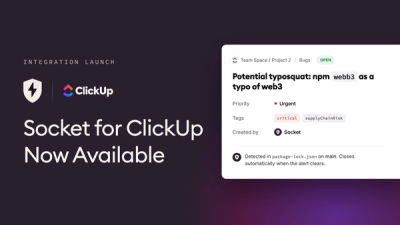
Create ClickUp tasks from Socket alerts, automate ticketing with custom rules, and keep alert and task status synchronized.