Security News
Feross on TBPN: Socket's Series C and the State of Software Supply Chain Security
Feross Aboukhadijeh joins TBPN to discuss Socket's $60M Series C, 500%+ ARR growth, AI's impact on open source, and the rise in supply chain attacks.
@opentelemetry/sdk-metrics
Advanced tools
This module contains the Metrics SDK of opentelemetry-js.
Used standalone, this module provides methods for manual instrumentation of code, offering full control over recording metrics for client-side JavaScript (browser) and Node.js.
It does not provide automated instrumentation of known libraries or host environment metrics out-of-the-box.
npm install --save @opentelemetry/api
npm install --save @opentelemetry/sdk-metrics
The basic setup of the SDK can be seen as followings:
const opentelemetry = require('@opentelemetry/api');
const { MeterProvider } = require('@opentelemetry/sdk-metrics');
// To create an instrument, you first need to initialize the Meter provider.
// NOTE: The default OpenTelemetry meter provider does not record any metric instruments.
// Registering a working meter provider allows the API methods to record instruments.
opentelemetry.metrics.setGlobalMeterProvider(new MeterProvider());
// To record a metric event, we used the global singleton meter to create an instrument.
const counter = opentelemetry.metrics.getMeter('default').createCounter('foo');
// record a metric event.
counter.add(1, { attributeKey: 'attribute-value' });
In conditions, we may need to setup an async instrument to observe costly events:
// Creating an async instrument, similar to synchronous instruments
const observableCounter = opentelemetry.metrics.getMeter('default')
.createObservableCounter('observable-counter');
// Register a single-instrument callback to the async instrument.
observableCounter.addCallback(async (observableResult) => {
// ... do async stuff
observableResult.observe(1, { attributeKey: 'attribute-value' });
});
// Register a multi-instrument callback and associate it with a set of async instruments.
opentelemetry.metrics.getMeter('default')
.addBatchObservableCallback(batchObservableCallback, [ observableCounter ]);
async function batchObservableCallback(batchObservableResult) {
// ... do async stuff
batchObservableResult.observe(observableCounter, 1, { attributeKey: 'attribute-value' });
}
Views can be registered when instantiating a MeterProvider:
const meterProvider = new MeterProvider({
views: [
// override the bucket boundaries on `my.histogram` to [0, 50, 100]
{
aggregation: {
type: AggregationType.EXPLICIT_BUCKET_HISTOGRAM,
options: {
boundaries: [0, 50, 100]
}
},
instrumentName: 'my.histogram'
},
// rename 'my.counter' to 'my.renamed.counter'
{ name: 'my.renamed.counter', instrumentName: 'my.counter'}
]
})
See examples/prometheus for an end-to-end example, including exporting metrics.
Apache 2.0 - See LICENSE for more information.
The prom-client package is a Prometheus client for Node.js that supports the creation, collection, and exposition of metrics data. It is similar to @opentelemetry/sdk-metrics in that it provides a way to collect metrics from your application, but it is specifically designed to work with Prometheus.
The metrics package provides a set of tools for collecting and reporting various types of metrics from your Node.js applications. It is similar to @opentelemetry/sdk-metrics but has a different API and does not integrate with the OpenTelemetry ecosystem.
Appmetrics is a package for monitoring and reporting runtime and performance metrics in Node.js applications. It offers functionality similar to @opentelemetry/sdk-metrics but is focused on providing built-in probes for various Node.js modules and runtime statistics.
FAQs
OpenTelemetry metrics SDK
The npm package @opentelemetry/sdk-metrics receives a total of 35,528,384 weekly downloads. As such, @opentelemetry/sdk-metrics popularity was classified as popular.
We found that @opentelemetry/sdk-metrics demonstrated a healthy version release cadence and project activity because the last version was released less than a year ago. It has 4 open source maintainers collaborating on the project.
Did you know?

Socket for GitHub automatically highlights issues in each pull request and monitors the health of all your open source dependencies. Discover the contents of your packages and block harmful activity before you install or update your dependencies.

Security News
Feross Aboukhadijeh joins TBPN to discuss Socket's $60M Series C, 500%+ ARR growth, AI's impact on open source, and the rise in supply chain attacks.

Security News
OSV withdrew 157 OSV malware reports after automated false positives incorrectly flagged trusted npm and PyPI packages, sending bad records into tools that rely on OSV data.

Research
/Security News
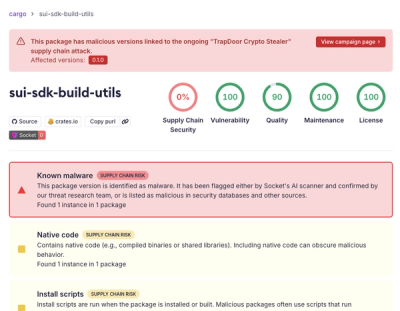
TrapDoor crypto stealer hits 36 malicious packages across npm, PyPI, and Crates.io, targeting crypto, DeFi, AI, and security developers.