
Product
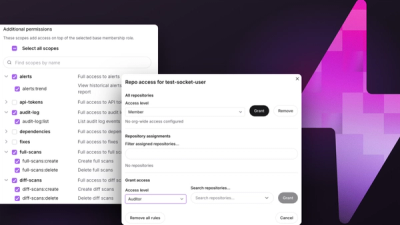
Introducing Repository Access Permissions and Custom Roles
Socket now supports Custom Roles and Repository Access Permissions so organizations can control who can access specific repositories and actions.
By Joe Werle - Jun 19, 2026
@openthomas/thomas
Advanced tools
Give vision-blind coding models eyes (DeepSeek + Qwen3.6, any agent). See cost per task, not per model. The dynamic harness for your agent fleet — Free for See; Control + Govern paid.
Get Thomas on the wire.
The dynamic harness for your agent fleet.
v0.5 is the first agent harness to:
DeepSeek codes well but can't see. Qwen3.6 sees images and video but codes poorly. Thomas combines them as one virtual model: any agent that hands it an image — Claude Code, Claude Desktop, OpenClaw, Codex, Hermes — gets a routed pipeline where the vision model describes the image and the coding model acts on the description. Two strategies ship in v0.5:
view_image — the coding model is given a tool it can
call to ask focused questions about a referenced image; a bounded
agentic loop services each call against the vision model. More
interactive — the coder can zoom in on a region or re-ask.Configured once per route in ~/.thomas/routes.json. Works across
every agent on your machine because Thomas wraps the wire, not the
agent.
Every other tool rolls cost up by model or by agent. Useful for finance; useless for figuring out what last night's autonomous run actually bought you. Thomas tracks every model call back to the task that triggered it. The Tasks view shows you, run by run, the three pricing buckets — cached-in / fresh-in / out tokens — live $-cost, and the full action graph that produced them. Filter by agent, sort by spend, find the run that cost too much, replay it to see what it was doing.
Your agent fleet is only as reliable as its harness.
2025 was the year of agents. 2026 is the year of harnesses — the scaffolding around a model (tools, context, guardrails, the loop, the verify step) that decides whether it is reliable. Claude Code is a harness for one model. Your fleet of agents — Claude Code, Codex, OpenClaw, Hermes, all running in parallel while you sleep — has no harness around it. Thomas is that harness.
It is generated on the fly: thomas wire detects what you run and
wraps it — no rewrites, no framework. Thomas wraps the wire, not
the agent, so it works even on agents it does not own.
| Verb | What the harness does | Edition |
|---|---|---|
| See | Capture, decode, replay every action; score outcomes with the T metric | Free, forever |
| Control | Enforce on your own agents — approval gates, blocking, policy, budgets | Personal · Solo |
| Govern | Enforce across a team's agents — BYOA, RBAC, audit, compliance | Team · Enterprise |
See is free and complete — capture, decode, view, replay, and score every agent action forever, locally, without paying a cent. Control and Govern are paid (see Pricing below): the same binary, gated by a cloud license token.
Thomas computes a single dimensionless KPI from everything it captures:
        Σ human-equivalent value of outcomes (USD)
  T  =  ──────────────────────────────────────────
                total AI cost (USD)
A T = 47 means: every $1 of AI spend produced $47 of human-equivalent
labor. Higher is better. The companion T_verified (v1.1) restricts the
numerator to outcomes whose tool_result indicated success — so 19 failed
attempts on a vulnerability search don't get scored as 19 wins. Token
spend on failures still hits the cost basis.
Run thomas thomas to see yours. Full spec at
openthomas.com/thomas (v1.1, MIT). The
spec is frozen for 12 months so the number means the same thing across
operators and time.
npm install -g @openthomas/thomas

thomas wire                  # detect agents, install taps, start daemon
# …run your agent as usual…
thomas thomas                # see your T (outcome / AI cost)
thomas                       # open the dashboard at http://localhost:9877
thomas wire is byte-exact reversible: thomas unwire restores every
file it touched. No accounts, no telemetry, no cloud — your traces
stay on your machine. Read PRIVACY.md for the precise
list of every file Thomas writes and the only place it sends data
(forwarding your own agent's traffic to the model provider your agent
already calls — and nowhere else).
Anthropic's Founder's Playbook names four stages every AI-native startup moves through. AI compresses each — and introduces new failure modes the playbook explicitly warns about. Thomas is the harness that lets the orchestrator see, control, and govern what their fleet does, at every stage.
| Stage | Where you are | See — free — gives | Natural upgrade |
|---|---|---|---|
| Idea | Ten hypotheses, ten Claude bills running in parallel | Cost X-ray per agent, per project, per day | Personal: budget caps so rabbit holes can't drain credits |
| MVP | Agentic coding, unattended runs. "Code that works is not code that is secure." — playbook | Full action trace, risk flags (destructive shell, secret leak, retry storm), mock replay | Personal: approval gates, budget caps, model routing |
| Launch | Real users on the line. The playbook prescribes "the observability layer that makes SLAs actually enforceable." | Audit trail per run, shareable post-mortem reports | Personal: live blocking + alerts. Solo: multi-project workspaces, CI replay, eval suites built from real production traces |
| Scale | First hires, multiple machines, enterprise procurement asking for proof you are "a dependable infrastructure partner." | (free keeps recording) | Team: RBAC, SSO, shared policies, fleet management, audit log for compliance |
Same job, new instruments. The playbook closes with "Same job, new rules" — the founder's work hasn't changed, only the path. Thomas is one of the instruments that makes the new path navigable.
Thomas Free is See — the legible harness, complete on its own. Paid editions turn the harness from read-only to enforcing. They divide by who the harness answers to: self-harness (you enforce on your own agents) and governed-harness (an authority enforces across a group's agents, including ones each member brings — BYOA).
| Free | Personal | Solo | Team | Enterprise | |
|---|---|---|---|---|---|
| Verb | See | Control | Control | Govern | Govern |
| Capture, decode, timeline, replay | ✅ | ✅ | ✅ | ✅ | ✅ |
| T metric + cost X-ray + risk flags | ✅ | ✅ | ✅ | ✅ | ✅ |
| Approval gates, blocking, policy | — | ✅ | ✅ | ✅ | ✅ |
| Budget caps, model routing, sync | — | ✅ | ✅ | ✅ | ✅ |
| Multi-project, CI replay, evals | — | — | ✅ | ✅ | ✅ |
| BYOA — govern agents you don't own | — | — | — | ✅ | ✅ |
| RBAC, SSO, fleet view, audit log | — | — | — | ✅ | ✅ |
| Compliance pack, on-prem, custom SLA | — | — | — | — | ✅ |
| Price | $0 | $19/mo | $99/mo+ | $499/mo+ | Custom |
Thomas Family — the governed harness for the household (a parent governing a child's AI) — is sequenced separately; no date yet.
Every edition is the same binary, gated by a cloud-issued license token — no plugins, no separate CLI. The free package never calls cloud, never phones home, stays complete forever. The protection is structural: the cloud rejects un-licensed requests, and replicating the cloud service is the actual product moat.
Run thomas upgrade for the in-product comparison, or visit
http://localhost:9877/#/pricing while the daemon is running.
Today (v0.5): free only — the See edition. Personal and the other paid editions land in later releases.
$ thomas thomas
Your Thomas · last 24h · spec v1.1

          25.0          $13.8K      solo founder with reasonable hygiene
      T              verified outcomes

$553.71 of AI spend → $13,821 of verified human-equivalent labour
1,093 actions · 129 verified outcomes · 322.9M tokens
  tokens by pricing bucket: 287.4M cached-in (cache hit) · 31.2M fresh-in (non-cache-hit) · 4.3M out
action_rate: 3.39 a/Mtok   outcome_rate: 11.8%
Outcomes: 47 commits · 44 files edited · 27 files created · 9 CI passed
$ thomas list
ID            STARTED              AGENT        STATUS  DUR     ACT  COST     CACHED/FRESH/OUT
────────────  ───────────────────  ───────────  ──────  ──────  ───  ───────  ────────────────
ru_aBc1xYz9   2026-05-16 14:23:11  claude-code  done    1.4s    1    $0.0024  0/120/45
ru_fOj6Ce1H   2026-05-16 14:22:18  hermes       done    7.8s    1    $0.97    565K/6K/396
$ thomas tail
14:42:49  claude-code   mcp_call    → filesystem  tools/list
14:42:49  claude-code   mcp_call    ← filesystem  tools/list
14:43:21  claude-code   model_call  claude-opus-4-7  200  6/8  $0.0007
!  14:44:02  hermes        model_call  Xiangxin-2XL-Chat  200  1/1547  $1.367
rm -rf, curl | sh), possible
secret leak (keys, tokens, bearer creds), cost spikes, retry storms.
Read-only labels in the trace. You decide what to do.Those tools watch model calls. Thomas watches agent runtimes — the full execution graph including tool calls, MCP, file ops, and inter-agent traffic.
If you've ever asked what did my agent actually do?, that's the gap.
| Agent | Auto-wire | Notes |
|---|---|---|
| Claude Code | ✅ | via ~/.claude/settings.json env block + MCP wrap |
| OpenClaw | ✅ | restarts the launchd daemon on wire |
| Hermes | ✅ | paste /model <name> --global to apply live |
| OpenCode | ✅ | |
| Codex | ✅ | rewrites [model_providers.openai] in ~/.codex/config.toml (Responses API) |
| Cursor | ⓘ manual | |
| Gemini CLI | ⓘ manual |
Custom agent? Point its base URL at
http://localhost:9877/wire/<your-name>/<provider> and Thomas will
record everything.
Thomas runs as a single always-on Node.js daemon, installed via
launchd on macOS or systemd on Linux. Four layers: capture (HTTP
reverse proxy + MCP stdio tap) → decode (Anthropic SSE, OpenAI
chat, MCP JSON-RPC per-protocol decoders) → store (local
SQLite) → present (Hono REST + SSE + React UI on
localhost:9877). All data stays on disk under ~/.thomas/. Source:
github.com/openthomas-com/thomas.
v0.5 — the fleet-harness cut. v0.4 was the first public NPM release
(legible-harness pipeline: capture · decode · score). v0.5 adds the
control surface: per-route failover chains with error/budget/token
switch rules, per-route capabilities (vision pre-describe, web_search
emulation), and a thomas-tools MCP that gives the routed model
search/fetch when its upstream can't. Solo-built and used daily by the
author; tested against real Claude Code / Claude Desktop / OpenClaw /
Codex / Hermes traffic. Bug reports and PRs welcome.
Thomas is MIT licensed. All code that runs on your machine — including
the implementations of paid commands — is open source. The free tier
never calls cloud, never phones home, never sends telemetry. See
PRIVACY.md for the load-bearing privacy contract,
which lists every file Thomas writes and the only place it sends data
(your own agent's traffic, to the model provider your agent already
calls).
Paid tiers ship in the same MIT-licensed binary. They activate when a
cloud license token is placed at ~/.thomas/license.json; without one,
the cloud rejects requests. We are open-source on the client and
proprietary on the cloud — the same model as Sentry, PostHog, Cal.com,
Tailscale, and Stripe CLI.
FAQs
Give vision-blind coding models eyes (DeepSeek + Qwen3.6, any agent). See cost per task, not per model. The dynamic harness for your agent fleet — Free for See; Control + Govern paid.
The npm package @openthomas/thomas receives a total of 15 weekly downloads. As such, @openthomas/thomas popularity was classified as not popular.
We found that @openthomas/thomas demonstrated a healthy version release cadence and project activity because the last version was released less than a year ago. It has 1 open source maintainer collaborating on the project.
Did you know?

Socket for GitHub automatically highlights issues in each pull request and monitors the health of all your open source dependencies. Discover the contents of your packages and block harmful activity before you install or update your dependencies.
Product
Socket now supports Custom Roles and Repository Access Permissions so organizations can control who can access specific repositories and actions.
Product
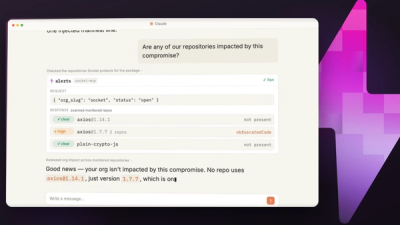
Socket MCP now lets AI assistants review org alerts, investigate threats using the Socket threat feed, and inspect package files in addition to dependency scoring.
Product
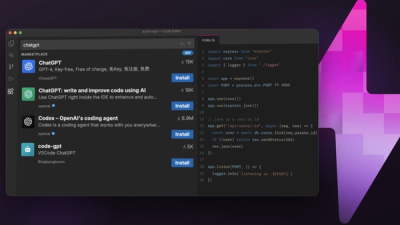
Socket Firewall blocks malicious VS Code and Open VSX extensions before install, protecting developers from compromised editor marketplaces.