

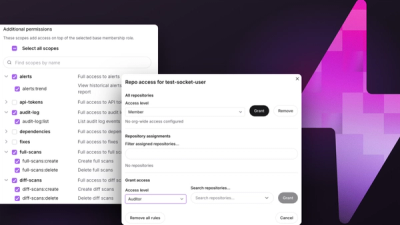
Product
Introducing Repository Access Permissions and Custom Roles
Socket now supports Custom Roles and Repository Access Permissions so organizations can control who can access specific repositories and actions.
By Joe Werle - Jun 19, 2026
@powforge/identity
Advanced tools
Depth-of-Identity SDK for Nostr. Measures accumulated irreversible work across five dimensions. Try it live at powforge.dev/explorer.


Try it live: powforge.dev/explorer — connect your Nostr profile with NIP-07, see your depth score, rank your peers, and look up any npub. Self-lookup is free and runs client-side.
Agent-payable signed scores: POST https://identity.powforge.dev/l402/identity-score returns a schnorr-signed score JSON for 2 sats via Lightning HTTP 402.
Depth-of-Identity SDK for Nostr. Measures accumulated irreversible work across five dimensions to produce a single identity weight score.
Not human vs bot. Invested vs uninvested. It is about measuring intentions.
npm install @powforge/identity
const { getIdentityDepth } = require('@powforge/identity');

const report = await getIdentityDepth(pubkey, {
  relays: ['wss://relay.powforge.dev'],
});

console.log(report.weight);      // total identity depth score
console.log(report.dimensions);  // breakdown by dimension
Five dimensions of identity depth:
| Dimension | What It Scores | Event Kinds |
|---|---|---|
| Spatial | Cyberspace movement proofs, unique regions explored | kind:3333 |
| Social | Notes published, reactions given, unique peers interacted with | kind:1, kind:7 |
| Access | NIP-13 proof-of-work accumulated across all events | nonce tags |
| Vouch | Inbound vouches from other identities, weighted by voucher depth with sqrt dilution | kind:33335 |
getIdentityDepth(pubkey, options?)Returns a full identity report for a hex pubkey.
Options:
| Option | Default | Description |
|---|---|---|
relays | ['ws://localhost:3088'] | Array of relay WebSocket URLs to query |
timeout | 5000 | Query timeout per relay in ms |
dimensions | ['spatial', 'social', 'access', 'vouch'] | Which dimensions to score |
Returns:
{
  "pubkey": "93da4435...",
  "totalEvents": 3,
  "weight": 24,
  "activeDimensions": 2,
  "dimensionMultiplier": 1.2,
  "dimensions": {
    "spatial": { "events": 3, "uniqueRegions": 3, "proofsVerified": 3, "score": 21 },
    "social": { "notes": 0, "reactions": 0, "uniquePeers": 0, "score": 0 },
    "access": { "totalEvents": 3, "totalPowBits": 0, "maxDifficulty": 0, "score": 3 },
    "vouch": { "inboundVouches": 0, "uniqueVouchers": 0, "totalWeight": 0, "score": 0 }
  },
  "firstActivity": "2026-04-12T17:25:47.000Z",
  "lastActivity": "2026-04-13T21:01:16.000Z",
  "relaysQueried": 1
}
queryRelay(relayUrl, filters, timeout?)Low-level function to query a single relay for events matching NIP-01 filters.
Each dimension uses log2 scaling to prevent grinding attacks. You can't just spam events to inflate your score -- each additional unit of work yields diminishing returns, just like real proof-of-work.
log2(events+1) * 2 + log2(uniqueRegions+1) * 5log2(notes+1) * 3 + log2(reactions+1) + log2(bidirectionalPeers+1) * 15 + log2(unidirectionalPeers+1) * 5totalPowBits * 2 + log2(powEvents+1) (PoW bits are already exponential, so they stay linear)log2(totalWeight+1) * 3 + log2(uniqueVouchers+1) * 20 (sqrt dilution prevents vouch farming)A dimension multiplier rewards spreading across dimensions: having depth in 2 dimensions gives 1.2x, 3 gives 1.4x, all 4 gives 1.6x. One-trick ponies get no bonus.
The total weight is the sum of all dimension scores times the multiplier. Higher weight means more accumulated, irreversible work.
Follower counts are trivially faked. This SDK measures things that cost real resources to produce: computation (PoW), time (event history), movement (spatial proofs), and social commitment (vouches backed by depth). Every dimension requires irreversible expenditure to increase.
Starting in 0.7.0-beta.1, the SDK ships an optional Bitcoin chain-tip anchor
you can attach to a signed DoI score. The field is experimental, opt-in, and
backwards-compatible. Scores without it still verify exactly as before.
What it adds: { height, hash, observed_at } under the signer's payload, where
height and hash come from the current Bitcoin tip and observed_at is the
ISO-8601 time of the fetch. Honest claim: block height plus hash as a freshness
anchor, verifiable against any public Bitcoin node. This is not SPV, not a
Merkle proof, and not a timestamp service. It tells a consumer "this score was
measured after block N" — nothing more.
const { getChaintip, signWithChaintip } = require('@powforge/identity');

// Fetch the current tip directly.
const tip = await getChaintip();
// => { height: 946252, hash: '00000000...', observed_at: '2026-04-23T...' }

// Or wrap any signer to fold the tip into the signed payload.
const { payload, signature } = await signWithChaintip(
  scorePayload,
  (p) => mySigner(p),
  { includeChaintip: true },
);
On the hosted oracle, pass ?chaintip=1 on any score endpoint:
curl -s -X POST 'https://identity.powforge.dev/l402/identity-score?chaintip=1' \
  -H 'Content-Type: application/json' \
  -d '{"pubkey":"<64-hex>"}'
bitcoin_tip_error instead of bitcoin_tip so callers can retry.When self-hosted Bitcoin RPC credentials are wired up, the mempool.space fetch
swaps for a direct bitcoind JSON-RPC getblockchaininfo call. The public SDK
surface does not change. See the TODO(bitcoind-rpc) marker in
src/chaintip.js for the exact hook point.
MIT
FAQs
Depth-of-Identity SDK for Nostr. Measures accumulated irreversible work across four dimensions of irreversible work (social, access, vouch, economic). Try it live at powforge.dev/explorer.
The npm package @powforge/identity receives a total of 24 weekly downloads. As such, @powforge/identity popularity was classified as not popular.
We found that @powforge/identity demonstrated a healthy version release cadence and project activity because the last version was released less than a year ago. It has 1 open source maintainer collaborating on the project.
Did you know?

Socket for GitHub automatically highlights issues in each pull request and monitors the health of all your open source dependencies. Discover the contents of your packages and block harmful activity before you install or update your dependencies.
Product
Socket now supports Custom Roles and Repository Access Permissions so organizations can control who can access specific repositories and actions.
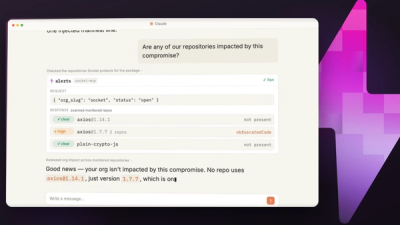
Product
Socket MCP now lets AI assistants review org alerts, investigate threats using the Socket threat feed, and inspect package files in addition to dependency scoring.
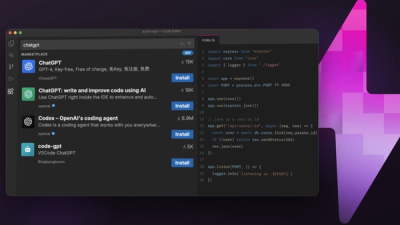
Product
Socket Firewall blocks malicious VS Code and Open VSX extensions before install, protecting developers from compromised editor marketplaces.