
Product
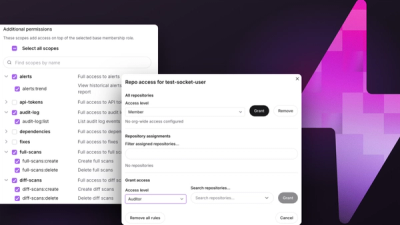
Introducing Repository Access Permissions and Custom Roles
Socket now supports Custom Roles and Repository Access Permissions so organizations can control who can access specific repositories and actions.
By Joe Werle - Jun 19, 2026
@prisma-next/contract
Advanced tools
Data contract type definitions and JSON schema for Prisma Next.
This package provides TypeScript type definitions and JSON Schemas for Prisma Next data contracts. The data contract is the canonical description of an application's data model and storage layout, independent of any specific query language or database target.
ContractBase, Source) that are shared across all target familiesDocumentContract)isDocumentContract)TargetFamilyHook, ValidationContext, TypesImportSpec) that are shared between emitter and control planeThe contract supports document target families:
DocumentContract, ContractMarkerRecord, and related typesTargetFamilyHook, ValidationContext, TypesImportSpec)contract.json files in IDEs and tooling
data-contract-document-v1.json (Document family)Import contract types in your TypeScript code:
import type {
  ContractMarkerRecord,
  DocumentContract,
  TargetFamilyHook,
  TypesImportSpec,
  ValidationContext,
} from '@prisma-next/contract/types';
import { isDocumentContract } from '@prisma-next/contract/types';

// Use type guards to narrow the contract type
function processContract(contract: DocumentContract) {
  if (isDocumentContract(contract)) {
    // contract is DocumentContract
    console.log(contract.storage.document.collections);
  }
}

// Use ContractMarkerRecord for database marker operations
function processMarker(marker: ContractMarkerRecord) {
  console.log(marker.coreHash, marker.profileHash);
}

// Use emitter types for implementing family hooks
const myFamilyHook: TargetFamilyHook = {
  id: 'my-family',
  validateTypes: (ir, ctx: ValidationContext) => {
    // Validation logic
  },
  validateStructure: (ir) => {
    // Structure validation
  },
  generateContractTypes: (ir, codecTypeImports: TypesImportSpec[], operationTypeImports: TypesImportSpec[]) => {
    // Type generation
    return '// Generated types...';
  },
};
Reference the appropriate JSON schema in your contract.json files to enable IDE validation and autocomplete.
For document targets (MongoDB, Firestore, etc.):
{
  "$schema": "node_modules/@prisma-next/contract/schemas/data-contract-document-v1.json",
  "schemaVersion": "1",
  "target": "mongodb",
  "targetFamily": "document",
  "coreHash": "sha256:...",
  "storage": {
    "document": {
      "collections": {
        "users": {
          "name": "users",
          "fields": {
            "id": { "type": "objectId", "nullable": false },
            "email": { "type": "string", "nullable": false }
          }
        }
      }
    }
  }
}
Note: For SQL contracts, use @prisma-next/sql-query/schema-sql instead:
{
  "$schema": "node_modules/@prisma-next/sql-query/schemas/data-contract-sql-v1.json",
  "schemaVersion": "1",
  "target": "postgres",
  "targetFamily": "sql",
  "coreHash": "sha256:...",
  "storage": {
    "tables": {
      "user": {
        "columns": {
          "id": { "type": "int4", "nullable": false },
          "email": { "type": "text", "nullable": false }
        },
        "primaryKey": {
          "columns": ["id"],
          "name": "user_pkey"
        }
      }
    }
  }
}
After installing this package, IDEs like VS Code will automatically:
All contracts share these common fields:
schemaVersion (required): Contract schema version (currently "1")target (required): Database target identifier (e.g., "postgres", "mongo", "firestore")targetFamily (required): Target family classification ("document" for document contracts)coreHash (required): SHA-256 hash of the core schema structureprofileHash (optional): SHA-256 hash of the capability profilecapabilities (optional): Capability flags declared by the contractextensions (optional): Extension packs and their configurationmeta (optional): Non-semantic metadata (excluded from hashing)sources (optional): Read-only sources (views, etc.) available for queryingstorage.document.collections: Object mapping collection names to collection definitions
name: Logical collection nameid (optional): ID generation strategy (auto, client, uuid, cuid, objectId)fields: Field definitions using FieldType (supports nested objects and arrays)indexes (optional): Array of index definitions with keys and optional predicatesreadOnly (optional): Whether mutations are disallowedUse type guards to narrow the contract type:
import { isDocumentContract } from '@prisma-next/contract/types';

if (isDocumentContract(contract)) {
  // TypeScript knows contract is DocumentContract
  const collections = contract.storage.document.collections;
}
./types: TypeScript type definitions and type guards./schema-document: Document family JSON Schema (schemas/data-contract-document-v1.json)flowchart TD
subgraph "Contract Package"
TYPES[Type Definitions]
SCHEMA[JSON Schemas]
GUARDS[Type Guards]
end
subgraph "Consumers"
EMITTER[Emitter]
RUNTIME[Runtime]
QUERY[Query Builder]
end
TYPES --> EMITTER
TYPES --> RUNTIME
TYPES --> QUERY
SCHEMA --> EMITTER
GUARDS --> RUNTIME
GUARDS --> QUERY
@prisma-next/operations: For OperationRegistry type used in ValidationContext and TargetFamilyHook@prisma-next/operations, but @prisma-next/operations does not depend on this package (no cycle). The OperationRegistry type is used in emitter SPI types that are shared between migration-plane and shared-plane packages.Dependents:
@prisma-next/contract-authoring: Uses core contract types for authoring@prisma-next/sql-contract: Extends core contract types for SQL family@prisma-next/emitter: Uses contract types for emission@prisma-next/runtime: Uses contract types for runtime execution@prisma-next/sql-query: Uses contract types for query building@prisma-next/sql-query: SQL query builder and plan types@prisma-next/runtime: Runtime execution engine that consumes contractsFAQs
Data contract type definitions and JSON schema for Prisma Next
The npm package @prisma-next/contract receives a total of 26,242 weekly downloads. As such, @prisma-next/contract popularity was classified as popular.
We found that @prisma-next/contract demonstrated a healthy version release cadence and project activity because the last version was released less than a year ago. It has 3 open source maintainers collaborating on the project.
Did you know?

Socket for GitHub automatically highlights issues in each pull request and monitors the health of all your open source dependencies. Discover the contents of your packages and block harmful activity before you install or update your dependencies.
Product
Socket now supports Custom Roles and Repository Access Permissions so organizations can control who can access specific repositories and actions.
Product
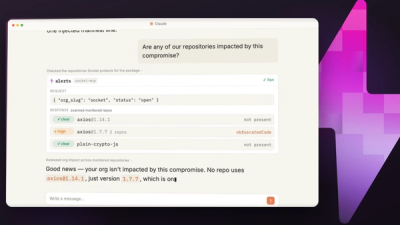
Socket MCP now lets AI assistants review org alerts, investigate threats using the Socket threat feed, and inspect package files in addition to dependency scoring.
Product
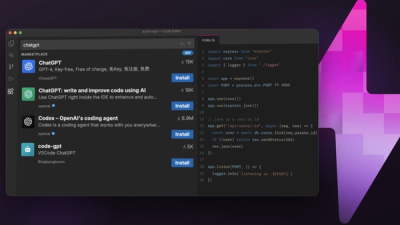
Socket Firewall blocks malicious VS Code and Open VSX extensions before install, protecting developers from compromised editor marketplaces.