
Product
Socket Now Protects the Microsoft Edge Extension Ecosystem
Enterprise security teams can now detect malware, credential theft, suspicious network activity, and risky updates across Microsoft Edge extensions.
By John Tuckner - Aug 28, 2026
@rnaga/wp-node-cli
Advanced tools
👉 **[View Full Documentation at rnaga.github.io/wp-node →](https://rnaga.github.io/wp-node/)**
👉 View Full Documentation at rnaga.github.io/wp-node →
WP-Node is a Node.js project written in TypeScript that mirrors the WordPress database schema and functionality. It enables developers to build scalable, modern backends on top of existing WordPress data.
Key benefits include:
posts, users, terms, etc.)PostUtil, TermUtil, and MetaUtil, enabling clean separation of concerns and easier testingdo_action, apply_filters), and supports implementation as async-compatible functionsWP-Node is ideal for scenarios where you need direct access to WordPress database without relying on the full WordPress stack. Example use cases include:
WP-Node Core is designed specifically to interact with the WordPress database. It does not support traditional WordPress features such as:
Its scope is intentionally limited to providing a type-safe, programmatic interface to WordPress data — not replicating the full behavior of the WordPress runtime.
>=22.0.0To spin up a sample environment with WordPress and database in Docker:
docker network inspect wpnet >/dev/null 2>&1 || docker network create wpnet && \
docker run -d --name wpdb --network wpnet -p 33306:3306 \
  -e MYSQL_ROOT_PASSWORD=example \
  -e MYSQL_DATABASE=wordpress \
  -e MYSQL_USER=wp \
  -e MYSQL_PASSWORD=wp \
  mariadb && \
docker run -d --name wp --network wpnet -p 8080:80 \
  -e WORDPRESS_DB_HOST=wpdb:3306 \
  -e WORDPRESS_DB_USER=wp \
  -e WORDPRESS_DB_PASSWORD=wp \
  -e WORDPRESS_DB_NAME=wordpress \
  wordpress
Create your config:
npx @rnaga/wp-node-cli -- config
It will prompt for database settings and generate:
_wp/
  └── config/wp.json
.env
You can configure additional settings such as:
staticAssetsPath: Path for media referencesmultisite.enabled: Enable or disable multisite supportInstall CLI tools:
npm i -S @rnaga/wp-node-cli -- -h
Basic command to list posts:
npx @rnaga/wp-node-cli -- post list
Develop your own commands using decorators:
@command("page", { description: "Page commands" })
export class PageCli extends Cli {
  @subcommand("list", { description: "List pages" })
  async list() {
    const context = await Application.getContext();
    const posts = await context.postUtil.findByType("page");
    console.log(posts);
  }
}
WP-Node uses a custom @component() decorator to support DI scopes:
@component({ scope: Scope.Transient })
export class Post {
  constructor(
    public meta: Meta,
    private logger: Logger,
    private queryUtil: QueryUtil,
    ...
  ) {}
}
apply_filters)do_action equivalent)Feel free to fork, open issues, or suggest improvements. This project is in active development.
MIT License.
FAQs
👉 **[View Full Documentation at rnaga.github.io/wp-node →](https://rnaga.github.io/wp-node/)**
The npm package @rnaga/wp-node-cli receives a total of 40 weekly downloads. As such, @rnaga/wp-node-cli popularity was classified as not popular.
We found that @rnaga/wp-node-cli demonstrated a healthy version release cadence and project activity because the last version was released less than a year ago. It has 1 open source maintainer collaborating on the project.
Product
Enterprise security teams can now detect malware, credential theft, suspicious network activity, and risky updates across Microsoft Edge extensions.

Research
/Security News
Socket researchers found 18 Chrome extensions and one Edge extension delivering a wallet drainer, credential theft, and other malicious payloads.
Product
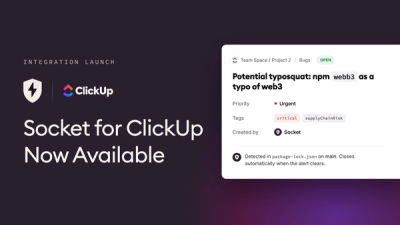
Create ClickUp tasks from Socket alerts, automate ticketing with custom rules, and keep alert and task status synchronized.