


Security News
Crates.io Users Targeted by Phishing Emails
The Rust Security Response WG is warning of phishing emails from rustfoundation.dev targeting crates.io users.
By Sarah Gooding - Sep 12, 2025
@rsksmart/rif-marketplace-cache
Advanced tools







API server that caches different metrics from blockchain across RIF services
Warning: This project is in alpha state. There might (and most probably will) be changes in the future to its API and working. Also, no guarantees can be made about its stability, efficiency, and security at this stage.
See what "Lead Maintainer" means here.
This is a backend service that caches different metrics from blockchain for the RIF services. It is build using FeathersJS and hence inherits lot of its features and properties.
It supports both REST access and SocketIO WS connectivity. It is recommended to use Feathers Client for consuming services of this project.
For querying the endpoints remember that you have available Querying schema by FeathersJS.
For RIF Storage there is cached information about Pinning Contract and current Storage Offers.
GET: /storage/v0/offers
Returns JSON that represents currently active and available Offers that customers can use to contract their pinning requests.
It has the following schema:
[
  {
    "provider": "string", // Hash, serves as ID
    "peerId": "string?", // Optional PeerId of the Provider's node
    "totalCapacity": "number",
    "utilizedCapacity": "number",
    "acceptedCurrencies": "string[]", // ['rbtc', 'rif']
    "availableCapacity": "number",
    "avgBillingPrice": "number", // on a monthly basis
    "totalStakedUSD": "number",
    "createdAt": "Date",
    "updatedAt": "Date",
    "plans": [
      {
        "id": "number",
        "period": "number",
        "amount": "number",
        "offerId": "string",
        "createdAt": "Date",
        "updatedAt": "Date"
      }
    ],
    "agreements": [
      {
        "numberOfPrepaidPeriods": "number",
        "periodsSinceLastPayout": "number",
        "toBePayedOut": "number",
        "hasSufficientFunds": "boolean",
        "agreementReference": "string",
        "dataReference": "string",
        "consumer": "string",
        "size": "number",
        "isActive": "boolean", // False when agreement is stopped
        "tokenAddress": "string", // billing plan token address
        "billingPeriod": "number",
        "billingPrice": "number",
        "availableFunds": "number",
        "lastPayout": "Date",
        "offerId": "string"
      }
    ]
  }
]
GET: /storage/v0/agreements
Returns JSON that represent currently active Agreements.
It has the following schema:
[
   {
     "numberOfPrepaidPeriods": "number",
     "periodsSinceLastPayout": "number",
     "toBePayedOut": "number",
     "hasSufficientFunds": "boolean",
     "agreementReference": "string",
     "dataReference": "string",
     "consumer": "string",
     "size": "number",
     "isActive": "boolean", // False when agreement is stopped
     "tokenAddress": "string", // billing plan token address
     "billingPeriod": "number",
     "billingPrice": "number",
     "availableFunds": "number",
     "lastPayout": "Date",
     "offerId": "string"
   }
]
GET: /storage/v0/stakes'
Returns JSON that represent all stakes for each account.
It has the following schema:
[
   {
     "total": "number",
     "symbol": "string", // token symbol
     "token": "string", // token address
     "account": "string",
   }
]
GET: /storage/v0/avgBillingPrice
Returns min/max average billing price per month converted to USD.
It has the following schema:
{
  min: 'number',
  max: 'number'
}
GET: /storage/v0/availableCapacity
Returns min/max available capacity comparing all available offers.
It has the following schema:
{
  min: 'number',
  max: 'number'
}
API that caches conversion rates currently for RBTC and RIF Token.
GET: /rates/v0/
Returns (example)
[
  {
    "token": "rif",
    "usd": 0.053091,
    "eur": 0.04936646,
    "btc": 0.00000703,
    "ars": 3.52,
    "cny": 0.375896,
    "krw": 65.56,
    "jpy": 5.72,
    "createdAt": "2020-04-24T07:50:06.340Z",
    "updatedAt": "2020-04-24T09:13:31.370Z"
  },
  {
    "token": "rbtc",
    "usd": 7436.63,
    "eur": 6914.89,
    "btc": 0.98511161,
    "ars": 492732,
    "cny": 52653,
    "krw": 9183042,
    "jpy": 800942,
    "createdAt": "2020-04-24T07:50:06.367Z",
    "updatedAt": "2020-04-24T09:13:31.390Z"
  }
]
API that caches several parts of the RNS and Domain Sail contracts. Supported routes are:
/rns/v0/offers - List active Domain Offers/rns/v0/:ownerAddress/sold - List sold domains for specific :ownerAddress/rns/v0/:ownerAddress/domains - List domains that are owned by the :ownerAddressAPI for getting information about confirmation status of transactions related to Marketplace.
Confirmed events (eq. confirmations >= targetConfirmaiton) are retained for a configured amount of blocks, in order
for the consumer of this API has enough time to detect that confirmation happened. See waitBlockCountBeforeConfirmationRemoved
in Config interface
GET: /confirmations
Returns (example)
[
  {
    "event": "ExpirationChanged",
    "transactionHash": "0x78a9f1912e8bf590e30a43f919f405924c168f55dad6efd298e8bc4ccfd4438d",
    "confirmations": 1,
    "targetConfirmation": 2
  },
  ...
]
There are also two events emitted for WebSocket connections.
newConfirmation eventEmitted when new confirmation was available. It is emitted with an object that has same
structured as presented above for the GET /confirmations route. confirmations can be higher then targetConfirmation.
Once event reaches confirmations >= targetConfirmations once, then it is emitted one last time and from then point on ignored.
{
  "event": "ExpirationChanged",
  "transactionHash": "0x78a9f1912e8bf590e30a43f919f405924c168f55dad6efd298e8bc4ccfd4438d",
  "confirmations": 1,
  "targetConfirmation": 2
}
invalidConfirmationEmitted when a block with the transaction was dropped from blockchain and hence won't become ever confirmed.
It is emitted with the object containing property transactionHash that contains the hash of the transaction dropped out.
{
  "transactionHash": "0x78a9f1912e8bf590e30a43f919f405924c168f55dad6efd298e8bc4ccfd4438d"
}
Required reading: node-config docs
There are several ways how to configure this application:
To run this caching server there is minimum configuration needed, which is supported with all the configuration ways mentioned above:
For general overview of complete configuration options see Config interface
that describe configuration object's properties. If you need advanced configuration you can build your own JSON configuration
file and load that either using the --config CLI parameter or using environment variable RIFM_CONFIG.
RIFM_DATA_DIR (string/path): directory where all the persistent data will be placed by defaultRIFM_JWT_SECRET (string): Secret using for JTW tokens (not used for auth purpose)RIFM_PORT (number): port on which the server should listen toRIFM_DB (string): database connection URIRIFM_PROVIDER (string): blockchain connection URIRIFM_COMMS_STRATEGY (api, libp2p) - Defines the strategy for communicationRIFM_COMMS_LISTEN (array) - Defines an array of multiaddress that the Pinner's libp2p node will listen on. Same as libp2p config's address.listen property.RIFM_COMMS_BOOTSTRAP_ENABLED (true/false) - Defines if bootstrap should be used. Same as libp2p config's bootstrap.enabled property.RIFM_COMMS_BOOTSTRAP_LIST (array) - Defines an array of multiaddress that the Pinner's libp2p node will use to bootstrap its connectivity. Same as libp2p config's bootstrap.list property.RIFM_CORS_ORIGIN (boolean | string | regexp): Configures the Access-Control-Allow-Origin CORS headerRIFM_CORS_METHODS (string) Configures the Access-Control-Allow-Methods CORS headerRIFM_STORAGE_CONTRACT_ADDR (string): address of deployed storage contractRIFM_STORAGE_STARTING_BLOCK (number | string): block from which the caching service should process eventsRIFM_RNS_OWNER_CONTRACT_ADDR (string): address of deployed storage contractRIFM_RNS_OWNER_STARTING_BLOCK (number | string): block from which the caching service should process eventsRIFM_RNS_REVERSE_CONTRACT_ADDR (string): address of deployed storage contractRIFM_RNS_REVERSE_STARTING_BLOCK (number | string): block from which the caching service should process eventsRIFM_RNS_REVERSE_CONTRACT_ADDR (string): address of deployed storage contractRIFM_RNS_REVERSE_STARTING_BLOCK (number | string): block from which the caching service should process eventsLOG_LEVEL (string)LOG_FILTER (string)LOG_PATH (string)LOG_NO_COLORS (boolean) - if set the output won't be colorizedSupported DB engine is only SQLite. You can configure the location of the DB file using either CLI flag --db or environment variable RIFM_DB
which should be in format sqlite://<path to the file>.
Connection to RSK blockchain is needed, therefore you have to configure provider so the caching server can listen
for the events. You can configure this connection either using CLI flag --provideror environment variable RIFM_PROVIDER.
Preferable it should be web-socket enabled connection.
There is support for extensive logging inside of the application. By default the logs are outputted to stdout.
You can configure logging using configs placed in config/, using CLI parameters or environment variables.
Configuration is placed in property log which supports following properties:
log.level (string; ENV: LOG_LEVEL) - sets minimal logging level that will be output to logs. Default: 'info'log.filter (string; ENV: LOG_FILTER) - sets filtering based on components. See bellow for syntax. Default: '*'log.path (string; ENV: LOG_PATH) - sets path to log file where logs will be written to. Default: undefinedBest to explain with examples:
watcher: log only watcher service entries-db: log everything except db's service entrieswatch*: log entries of services that starts with watch-watch*: log entries of every service except those which starts with watchwatcher, db: log entries of only services watcher and db.watcher*, -watcher:fs: log every entry of watcher only except of those starting with watcher:fs.$ npm install -g @rsksmart/rif-marketplace-cache
// Connection to your database
$ export RIFM_DB=postgres://user:pass@localhost/db
// Database migrations
$ rif-marketplace-cache db-migration --up
// Connection to your blockchain provider
$ export RIFM_PROVIDER=ws://localhost:8545
// Prefetch all the data from the network
$ rif-marketplace-cache precache all
// Start the server
$ rif-marketplace-cache start --port 8000
// Start the server listening for testnet configuration
$ NODE_ENV=rsktestnet rif-marketplace-cache start --port 8000
For some more details on how to deploy this server please see Deployment guide.
rif-marketplace-cache db-migrationrif-marketplace-cache precache [SERVICE]rif-marketplace-cache purge [SERVICE]rif-marketplace-cache startrif-marketplace-cache db-migrationsynchronize database schema
USAGE
  $ rif-marketplace-cache db-migration

OPTIONS
  -d, --down                           Undo db migrations
  -d, --generate=generate              Generate migrations using template [--generate=migration_name]
  -m, --migration=migration            Migration file
  -t, --to=to                          Migrate to
  -u, --up                             Migrate DB
  --config=config                      path to JSON config file to load
  --db=db                              database connection URI
  --log=error|warn|info|verbose|debug  [default: warn] what level of information to log
  --log-filter=log-filter              what components should be logged (+-, chars allowed)
  --log-path=log-path                  log to file, default is STDOUT

EXAMPLES
  $ rif-marketplace-cache db --up
  $ rif-marketplace-cache db --down
  $ rif-marketplace-cache db --up --to 0-test
  $ rif-marketplace-cache --up --migrations 01-test --migrations 02-test
  $ rif-marketplace-cache --up --db ./test.sqlite --to 09-test
  $ rif-marketplace-cache --down --db ./test.sqlite --to 09-test
  $ rif-pinning db --generate my_first_migration
rif-marketplace-cache precache [SERVICE]precache past data for a service
USAGE
  $ rif-marketplace-cache precache [SERVICE]

OPTIONS
  --config=config              path to JSON config file to load
  --log=error|warn|info|debug  [default: error] what level of information to log
  --log-filter=log-filter      what components should be logged (+-, chars allowed)
  --log-path=log-path          log to file, default is STDOUT

DESCRIPTION
  Command will fetch data from blockchain and process them prior turning on the API server.
  Currently supported services:
    - all
    - storage
    - rns
    - rates

EXAMPLES
  $ rif-marketplace-cache precache all
  $ rif-marketplace-cache precache storage rns
rif-marketplace-cache purge [SERVICE]purge cached data
USAGE
  $ rif-marketplace-cache purge [SERVICE]

OPTIONS
  --config=config              path to JSON config file to load
  --log=error|warn|info|debug  [default: error] what level of information to log
  --log-filter=log-filter      what components should be logged (+-, chars allowed)
  --log-path=log-path          log to file, default is STDOUT

DESCRIPTION
  Can purge all data or for specific service.
  Currently supported services:
    - all
    - storage
    - rns
    - rates

EXAMPLES
  $ rif-marketplace-cache purge all
  $ rif-marketplace-cache purge storage rns
rif-marketplace-cache startstart the caching server
USAGE
  $ rif-marketplace-cache start

OPTIONS
  -d, --disable=disable        disable specific service
  -e, --enable=enable          enable specific service
  -p, --port=port              port to attach the server to
  --config=config              path to JSON config file to load
  --db=db                      database connection URI
  --log=error|warn|info|debug  [default: error] what level of information to log
  --log-filter=log-filter      what components should be logged (+-, chars allowed)
  --log-path=log-path          log to file, default is STDOUT
  --provider=provider          blockchain provider connection URI

DESCRIPTION
  Currently supported services:
    - storage
    - rns
    - rates

EXAMPLE
  $ rif-marketplace-cache start --disable service1 --disable service2 --enable service3
The server mainly consists of three parts:
This caching server has support for caching multiple services. All service related function should be placed in
service specific folder in /src, like for example /src/storage.
For implementing new service, it is recommended to have knowledge of the libraries used and study already implemented services.
For listening on blockchain events use the listeners in /src/blockchain/events module.
There are some ways you can make this module better:
Some tips for development:
npm run bin -- <cmd> <...args/flags>You might have some problems during development, here are few pointers about what could be wrong.
#### No events from Blockchain:
VERBOSE mode, you should see the whole Config logged). If they are, make sure you emit empty blocks to get enough confirmations.DEBUG (you can filter out database logging with log filter -db) and see if events are incoming to Cacheoclif.manifest.json, if so delete it. (It is cached information about available commands and their help pages)FAQs
Caching server for RIF Marketplace
We found that @rsksmart/rif-marketplace-cache demonstrated a not healthy version release cadence and project activity because the last version was released a year ago. It has 1 open source maintainer collaborating on the project.
Did you know?

Socket for GitHub automatically highlights issues in each pull request and monitors the health of all your open source dependencies. Discover the contents of your packages and block harmful activity before you install or update your dependencies.
Security News
The Rust Security Response WG is warning of phishing emails from rustfoundation.dev targeting crates.io users.
Product
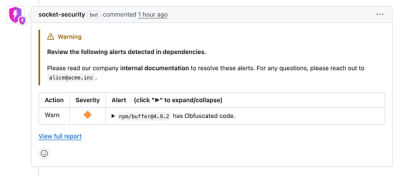
Socket now lets you customize pull request alert headers, helping security teams share clear guidance right in PRs to speed reviews and reduce back-and-forth.
Product
Socket's Rust support is moving to Beta: all users can scan Cargo projects and generate SBOMs, including Cargo.toml-only crates, with Rust-aware supply chain checks.