
Product
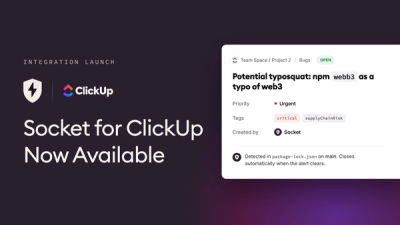
Socket for ClickUp Is Now Available
Create ClickUp tasks from Socket alerts, automate ticketing with custom rules, and keep alert and task status synchronized.
By Jeppe Hasseriis - Aug 26, 2026
@saihm/mcp-server
Advanced tools
Sovereign, encrypted, persistent memory for AI agents. Eight MCP tools — remember, recall, forget (GDPR Art. 17 erasure), share, governance. Anchored on COTI V2 mainnet. Apache-2.0.
Sovereign, encrypted, sharable, persistent memory protocol for AI agents.
v0.3.1 · Apache-2.0 · COTI V2 mainnet
A Model Context Protocol server that exposes eight tools any MCP-capable AI agent (Claude Code, Claude Desktop, custom agents) can call to gain a persistent, encrypted memory layer the user owns:
saihm_remember — store an encrypted memory cellsaihm_recall — retrieve and decrypt your memoriessaihm_forget — true cryptographic erasure (GDPR Art. 17)saihm_status — your protocol-runtime stats and storage tier dashboardsaihm_share / saihm_revoke_share — selectively share a memory with another agent or usersaihm_governance_propose / saihm_governance_vote — protocol governance via gSAIHMEach tool forwards to a SAIHM operator endpoint that runs the full protocol stack on COTI V2 mainnet. The server itself holds no crypto, no storage, and no protocol runtime — those live behind the operator endpoint.
npm install @saihm/mcp-server
# or run directly without install:
npx @saihm/mcp-server
The server needs two env vars:
SAIHM_ENDPOINT_URL=https://operator.example.com/mcp
SAIHM_AUTH_HEADER=Bearer <token-issued-by-your-operator>
SAIHM_ENDPOINT_URL — the SAIHM operator endpoint. Operators publish
their endpoint URLs at https://saihm.coti.global.SAIHM_AUTH_HEADER — the Authorization header value the operator
expects (typically a Bearer <token> issued to you after key-bound
enrolment). The server is authentication-agnostic and never transmits
raw private keys; the operator's enrolment flow keeps your
signing key on your machine.Place these in a .env file alongside the server (the .gitignore excludes
all .env* files from any future repo).
{
  "mcpServers": {
    "saihm": {
      "command": "npx",
      "args": ["@saihm/mcp-server"],
      "env": {
        "SAIHM_ENDPOINT_URL": "https://operator.example.com/mcp",
        "SAIHM_AUTH_HEADER": "Bearer <token>"
      }
    }
  }
}
The server itself persists nothing. The operator endpoint runs the full protocol stack: cells are encrypted under a per-cell DEK, sealed by a per-agent KEK, persisted to Filecoin, and audited on COTI V2 mainnet. See the operator's documentation for tier details.
A reporting library is bundled as a sub-export, so operators can compose the eight MCP calls into bespoke reports with their own tooling (no extra dependency, no extra service):
import {
  validateBespokeTemplate,
  registerTemplate,
  generateRegistryAttestation,
  StubPublicRegistry,
  InMemoryReportingRuntime,
  GDPR_ART15_FIELDS,
  REGISTRY_ATTESTATION_FIELDS,
  type BespokeReportTemplate,
} from "@saihm/mcp-server/reporting";
FIELD_UNIVERSE) — 280 fields (262 framework + 18 ledger). Templates that project a field outside this set are rejected at validation.public / self / operator-self / operator-for-downstream.report_generated / report_rejected / template_registered / template_superseded / erasure_chain_broken / rate_limit_exceeded) under a stable HKDF receipt domain.registry-attestation (public auth) for end-to-end plumbing verification.fieldProjections[] entry MUST be in FIELD_UNIVERSE.scope.customerIdHashes 64-hex; max 10,000 per template.scope.timeRange window ≤ 366 days.fieldProjections length 1–200.framework ∈ {gdpr-art-15, gdpr-art-17, soc2-t1, soc2-t2, iso27001, aml, audit-export, billing-history, registry-attestation}.format ∈ {pdfa3, json, csv}.const template: BespokeReportTemplate = {
templateId: "acme-q1-summary",
templateVersion: 1,
operatorIdHash: "ab".repeat(32),
scope: {
customerIdHashes: ["cd".repeat(32)],
timeRange: { from: "2026-01-01T00:00:00Z", to: "2026-04-01T00:00:00Z" },
},
framework: "gdpr-art-15",
fieldProjections: [GDPR_ART15_FIELDS[0], GDPR_ART15_FIELDS[1]],
format: "pdfa3",
};
const v = validateBespokeTemplate(template);
if (!v.valid) throw new Error(v.errors.join(", "));
const runtime = new InMemoryReportingRuntime(); // replace with your audit-ledger runtime
const reg = await registerTemplate(template, runtime);
if (reg.ok) console.log("registered:", reg.templateHash);
In production, replace InMemoryReportingRuntime with a runtime that persists audit payloads to your operator's audit ledger. Operators who inject signature verifiers should use pure-crypto libraries (@noble/curves for EIP-712, @noble/post-quantum for FIPS 204 ML-DSA) — the package itself bundles no EVM tooling.
The server enforces a small set of defaults so misconfiguration cannot leak the Authorization header in transit:
SAIHM_ENDPOINT_URL must use https://. Plain http:// is rejected at construction time, except for 127.0.0.1 and localhost (so a local operator endpoint works during development).AbortController that aborts after 30s, preventing a hung endpoint from starving the MCP server.Content-Length exceeds 16 MB are rejected before deserialisation.Authorization is never included in thrown error messages or stdout.ethers, no eth_*, no Solidity. If operators inject signature verifiers via AuthVerifiers, they should use pure-crypto libraries (@noble/curves, @noble/post-quantum).Trust model: this client trusts whatever endpoint the operator configures. Cell IDs, audit anchors, and report receipts returned from that endpoint are surfaced to the agent verbatim — operators are the authority for content shown via saihm_recall. Verifying receipts against COTI V2 mainnet anchors is out of scope for this server; consume the cellId and auditCellId fields and verify against your own SAIHM mainnet read path.
For distribution integrity, each release carries the npm registry signature; verify with npm audit signatures (and inspect npm view @saihm/mcp-server --json | jq .dist).
The published npm package has a minimal runtime surface:
| Dependency | License | Role |
|---|---|---|
| Node.js (≥ 20.x) | MIT | Runtime |
@modelcontextprotocol/sdk | MIT | MCP SDK; binds the eight-tool surface |
| TypeScript | Apache-2.0 | Build-time only |
tsx | MIT | TypeScript runner for tests + CLI |
No copyleft, no proprietary dependencies. Cryptographic primitives at the
operator-endpoint layer (ML-DSA-65 / HKDF / Ed25519) are not bundled into
this MCP server; operators implementing the protocol stack are recommended
to use @noble/post-quantum and @noble/curves (MIT) rather than rolling
custom code.
draft-saihm-memory-protocol-00
accepted into pipeline (2026-05-18).
https://datatracker.ietf.org/doc/draft-saihm-memory-protocol/@saihm/mcp-server@0.3.2 published (2026-06-22),
correcting the documented operator-endpoint path to /mcp (the
canonical SAIHM_ENDPOINT_URL path) across the README and client
comments. 0.3.1 (2026-05-28) was a metadata patch that sources the
MCP serverInfo.version from package.json (was hardcoded
"0.1.0" from 0.1.0 through 0.3.0).
0.3.0 (also 2026-05-28) aligned the saihm_status response shape
with draft-saihm-memory-protocol-01 §3.4 (full eight-field
schema: prs, bfsi, bfsi_window_start_ts, bfsi_R,
bfsi_M, shards, contracts, governance). 0.2.0 (also
2026-05-28) aligned the cell-tuple response shape with §2.1;
0.1.3 was the OpenSSF Best Practices Passing badge release
(2026-05-19).A 12-month roadmap is maintained in the project's AAIF proposal and will be mirrored to https://saihm.coti.global/roadmap with the v0.2.x release. Near-term tracks:
Apache-2.0 — see LICENSE.
SECURITY.md for private vulnerability
disclosureCONTRIBUTING.md and
CODE_OF_CONDUCT.mdGOVERNANCE.mdCHANGELOG.mdFAQs
The open MCP client for SAIHM sovereign agent memory — eight tools (remember · recall · forget · share · govern) any MCP agent uses to reach a SAIHM operator endpoint. Implements the publicly documented SAIHM memory protocol (specified in an Internet-Draf
The npm package @saihm/mcp-server receives a total of 80 weekly downloads. As such, @saihm/mcp-server popularity was classified as not popular.
We found that @saihm/mcp-server demonstrated a healthy version release cadence and project activity because the last version was released less than a year ago. It has 1 open source maintainer collaborating on the project.
Product
Create ClickUp tasks from Socket alerts, automate ticketing with custom rules, and keep alert and task status synchronized.
Product
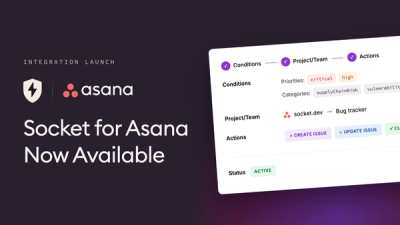
Create and manage Asana tasks directly from Socket alerts, with manual task creation, automated ticketing rules, and two-way sync.

Security News
Open VSX has removed three extension IDs from its malicious-extension list as the legitimate publishers they impersonated move to claim the names for themselves.