
Product
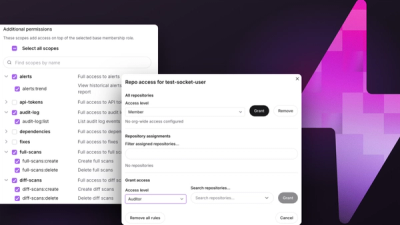
Introducing Repository Access Permissions and Custom Roles
Socket now supports Custom Roles and Repository Access Permissions so organizations can control who can access specific repositories and actions.
By Joe Werle - Jun 19, 2026
@shadowob/cloud
Advanced tools
Deploy AI agents to Kubernetes with a single command.
shadowob-cloud init --template gstack-buddy
shadowob-cloud validate
shadowob-cloud up
npm install -g @shadowob/cloud
# or
pnpm add -g @shadowob/cloud
Verify:
shadowob-cloud --version
shadowob-cloud doctor      # checks kubectl, docker, pulumi
shadowob-cloud init                          # interactive — creates shadowob-cloud.json
shadowob-cloud init --template gstack-buddy  # from a preset template
shadowob-cloud init --list                   # list all available templates
Templates use ${env:VAR_NAME} to reference secrets. Set the required keys before deploying:
export ANTHROPIC_API_KEY="sk-ant-..."
export OPENAI_API_KEY="sk-..."
shadowob-cloud validate                   # schema + security + template ref checks
shadowob-cloud validate --strict          # also fails on unresolvable env vars
shadowob-cloud up                         # deploy to your current kubectl context
shadowob-cloud up --local                 # spin up a local Kind cluster first
shadowob-cloud status                     # deployments & pods overview
shadowob-cloud logs <agent-id>            # stream agent logs
shadowob-cloud dashboard                  # open the web dashboard
shadowob-cloud scale <agent-id> --replicas 3
shadowob-cloud down                       # tear down all resources
Pre-built agent team templates:
| Template | Agents | Description |
|---|---|---|
gstack-buddy | 1 | Product strategy, office hours, CEO review, retros |
google-workspace-buddy | 1 | Gmail, Calendar, Drive, Docs, and Sheets operations through gws |
superpowers-buddy | 1 | Specs, TDD, planning, subagent execution, code review |
everything-claude-code-buddy | 1 | Broad engineering harness with skills, commands, agents, hooks |
marketingskills-buddy | 1 | CRO, copy, SEO, paid, email, and growth skills |
seomachine-buddy | 1 | Keyword research, content briefs, on-page audits |
scientific-skills-buddy | 1 | Scientific research, data analysis, and writing skills |
Write your own — see Config Reference below.
| Command | Description |
|---|---|
shadowob-cloud init | Generate an shadowob-cloud.json config |
shadowob-cloud validate | Validate config (schema, security, refs) |
shadowob-cloud up | Deploy agents to Kubernetes |
shadowob-cloud down | Destroy all deployed resources |
shadowob-cloud status | Show deployment & pod status |
shadowob-cloud logs <id> | Stream agent logs |
shadowob-cloud scale <id> | Scale agent replicas |
shadowob-cloud dashboard | Open web dashboard |
shadowob-cloud serve | Start API server + dashboard |
shadowob-cloud generate manifests | Export K8s manifests (offline) |
shadowob-cloud generate openclaw-config | Export OpenClaw configs (debug) |
shadowob-cloud doctor | Check prerequisites |
shadowob-cloud build | Build Docker images for Git agents |
shadowob-cloud images | Manage runner images |
shadowob-cloud cluster init | Bootstrap k3s on bare servers |
shadowob-cloud cluster import | Register an existing kubeconfig locally |
shadowob-cloud cluster status | Check SSH + k3s health on all nodes |
shadowob-cloud cluster list | List all registered clusters |
shadowob-cloud cluster kubeconfig <name> | Print kubeconfig path |
shadowob-cloud cluster destroy | Uninstall k3s and remove local files |
Deploy to cloud servers (Ubuntu/Debian) over SSH with a single command — no existing K8s required.
cluster init — SSH into each server, install k3s, form the cluster, store kubeconfig at ~/.shadow-cloud/clusters/<name>.yamlup --cluster <name> — Pulumi uses the stored kubeconfig to deploy agents to that cluster{
"name": "prod",
"install": {
"k3sVersion": "v1.35.4+k3s1",
"k3sMirror": "cn",
"systemDefaultRegistry": "registry.cn-hangzhou.aliyuncs.com",
"pauseImage": "registry.cn-hangzhou.aliyuncs.com/google_containers/pause:3.6"
},
"features": {
"sandbox": {
"enabled": true,
"version": "v0.4.5",
// Optional: use your mirrored image when registry.k8s.io is unreachable.
"controllerImage": "registry.example.cn/agent-sandbox/agent-sandbox-controller:v0.4.5",
"runtimeClassName": "shadow-runc",
"createRuntimeClass": true,
"runtimeClassHandler": "runc",
"nodeSelector": { "shadowob.com/sandbox-ready": "true" },
"smokeTest": false
}
},
"nodes": [
{
"role": "master",
"host": "1.2.3.4",
"user": "root",
"sshKeyPath": "~/.ssh/id_rsa",
"sshKeyPassphrase": "${env:SSH_KEY_PASSPHRASE}"
},
{
"role": "worker",
"host": "1.2.3.5",
"user": "root",
"sshAgent": true,
"install": {
"k3sMirror": "cn",
"systemDefaultRegistry": "registry.cn-hangzhou.aliyuncs.com"
},
"region": "cn",
"features": { "sandbox": true },
"labels": { "shadowob.com/region": "cn" }
}
]
}
Credentials never stored on disk. Use ${env:VAR} for passwords and key passphrases. For encrypted
keys already loaded into ssh-agent, set "sshAgent": true; if the agent socket is mounted at a
custom path, set "sshAgent": "/path/to/agent.sock" or "${env:SSH_AUTH_SOCK}".
install is optional. Set it at the cluster level for shared defaults, or on an individual node to
override those defaults. Node-level overrides are useful for mixed-region clusters where, for
example, China nodes need domestic mirrors while overseas nodes can use the upstream defaults.
| Field | Meaning |
|---|---|
k3sVersion | Pins the k3s release. With Rancher's China mirror, v1.35.4+k3s1 is normalized to the mirror's v1.35.4-k3s1 path. |
k3sMirror | Shortcut mirror name. cn maps to https://rancher-mirror.rancher.cn/k3s. |
k3sArtifactUrl | Full artifact URL prefix passed to INSTALL_K3S_ARTIFACT_URL. |
k3sChannel / k3sChannelUrl | Channel lookup settings for the official installer when not pinning a version. |
systemDefaultRegistry | Registry prefix passed as --system-default-registry for bundled k3s system images. If omitted with k3sMirror: "cn", Shadow uses registry.cn-hangzhou.aliyuncs.com. |
pauseImage | k3s sandbox pause image passed as --pause-image. If omitted with k3sMirror: "cn", Shadow uses registry.cn-hangzhou.aliyuncs.com/google_containers/pause:3.6 so Pod sandbox creation does not depend on Docker Hub. |
features.sandbox makes agent-sandbox a managed cluster capability. true is shorthand for the
default pinned install. During cluster init and cluster apply, Shadow applies the upstream
agent-sandbox core and extensions manifests, optionally rewrites the controller image to a private
or domestic registry, creates/verifies the configured RuntimeClass, waits for the CRDs/controller,
labels Kubernetes nodes with shadowob.com/sandbox-ready, optionally runs a real
SandboxTemplate/SandboxClaim smoke test, and stores the capability plus a cluster config hash in
~/.shadow-cloud/clusters/<name>.json.
By default the managed RuntimeClass is shadow-runc with handler runc, so a vanilla k3s node can
run sandbox workloads immediately. For stronger isolation, install gVisor/runsc on the nodes and set
runtimeClassName: "gvisor", createRuntimeClass: false if the class already exists, or
runtimeClassHandler: "runsc" if Shadow should create it. For restricted networks, mirror
https://github.com/kubernetes-sigs/agent-sandbox/releases/download/v0.4.5/manifest.yaml and
extensions.yaml, then set manifestUrls to the mirrored URLs.
For workload registry mirrors, add install.registries; Shadow writes it to k3s
/etc/rancher/k3s/registries.yaml on every configured node before install/apply:
{
  "install": {
    "registries": {
      "mirrors": {
        "docker.io": { "endpoint": ["https://docker.mirror.example.cn"] },
        "registry.k8s.io": { "endpoint": ["https://registry-k8s.mirror.example.cn"] }
      },
      "configs": {
        "registry.example.cn": {
          "auth": {
            "username": "${env:REGISTRY_USER}",
            "password": "${env:REGISTRY_PASSWORD}"
          }
        }
      }
    }
  }
}
Environment variables override the same installer settings:
INSTALL_K3S_VERSION, INSTALL_K3S_ARTIFACT_URL, INSTALL_K3S_CHANNEL, and
INSTALL_K3S_CHANNEL_URL. INSTALL_K3S_MIRROR=cn is also accepted for local testing.
Use INSTALL_K3S_PAUSE_IMAGE or K3S_PAUSE_IMAGE to override the pause image, and
INSTALL_K3S_SYSTEM_DEFAULT_REGISTRY or K3S_SYSTEM_DEFAULT_REGISTRY to override the system image
registry.
shadowob-cloud cluster init                        # default: reads cluster.json
shadowob-cloud cluster init --config my-cluster.json
shadowob-cloud cluster apply --config cluster.json # same idempotent apply path
shadowob-cloud cluster init --force                # reinstall k3s even if already present
Re-initializing safely: If k3s is already installed on a node, init/apply skips that node by
default. To expand a cluster, add the new worker to nodes, keep the existing master in the file,
and run shadowob-cloud cluster apply --config cluster.json. Shadow reads the existing master token,
installs k3s only on newly listed workers, joins them to the cluster, and refreshes the registered
kubeconfig metadata. Pass --force only when you intentionally want to reinstall listed nodes.
shadowob-cloud up --cluster prod
shadowob-cloud up --cluster prod --stack prod      # use a named Pulumi stack
shadowob-cloud up --cluster prod --skip-provision  # skip Shadow resource provisioning
shadowob-cloud cluster status                      # SSH health + k3s version on each node
shadowob-cloud cluster list                        # list all registered clusters
shadowob-cloud cluster kubeconfig prod             # print kubeconfig path (use with kubectl)

export KUBECONFIG=$(shadowob-cloud cluster kubeconfig prod)
kubectl get pods -n my-team
Another developer on a different machine can register the same cluster without running init again:
# On any machine that has the kubeconfig file:
shadowob-cloud cluster import --name prod --file ./prod.yaml
shadowob-cloud up --cluster prod
shadowob-cloud cluster destroy                     # confirms prompt
shadowob-cloud cluster destroy --yes               # skip confirmation
Runs k3s-uninstall.sh (master) and k3s-agent-uninstall.sh (workers) over SSH, then removes ~/.shadow-cloud/clusters/prod.*.
cluster.json With Web SaaSThe Web SaaS UI in apps/web deploys through apps/server. By default, those deployments use the
server process's ambient Kubernetes target (KUBECONFIG). You can now point the server at the same
cluster.json used by the CLI:
shadowob-cloud cluster init --config cluster.json
# or, if another machine already bootstrapped it:
shadowob-cloud cluster import --name prod --file ./prod.yaml
KUBECONFIG_HOST_PATH=/absolute/host/path/to/prod.yaml
KUBECONFIG_CONTAINER_PATH=/home/node/.shadow-cloud/clusters/prod.yaml
KUBECONFIG_CONTEXT=
CLOUD_SAAS_CLUSTER_CONFIG_HOST_PATH=/absolute/host/path/to/cluster.json
CLOUD_SAAS_CLUSTER_CONFIG=/app/cluster.json
CLOUD_SAAS_CLUSTER_KUBECONFIG_HOST_PATH=/absolute/host/path/to/prod.yaml
CLOUD_SAAS_CLUSTER_KUBECONFIG=/home/node/.shadow-cloud/clusters/prod.yaml
CLOUD_SAAS_WORKLOAD_BACKEND=auto
SHADOW_AGENT_SERVER_URL=https://shadow.example.com
SHADOWOB_OPENCLAW_RUNNER_IMAGE=ghcr.io/buggyblues/openclaw-runner:latest
PULUMI_CONFIG_PASSPHRASE=change-me
On startup, apps/server reads CLOUD_SAAS_CLUSTER_CONFIG, resolves the cluster name to the stored
kubeconfig, sets KUBECONFIG for the embedded Cloud deployment processor, and fails fast if the
kubeconfig is missing.
When running the production compose stack as the non-root node user, the mounted files must be
readable by UID 1000 inside the container. For root-owned host files, use either chown 1000:1000
with chmod 600, or chmod 644 for non-secret cluster metadata. Do not mount a missing host file:
Docker will create a directory at the target path, which later fails as EISDIR: illegal operation on a directory, read.
The server container must be able to reach the Kubernetes API in the kubeconfig. For a remote k3s
node, open TCP 6443 from the Shadow server host, or use an SSH tunnel and set the kubeconfig
server to the tunnel endpoint with tls-server-name pointing at the original API hostname/IP.
SHADOW_AGENT_SERVER_URL is the URL injected into pods. It must be reachable from the k3s nodes and
from the workload pods. http://host.lima.internal:3002 is only valid for local Lima/Rancher
Desktop style development; remote clusters should use the public Shadow origin, for example
https://shadowob.com. Keep SHADOW_SERVER_URL=http://server:3002 for server-side provisioning in
Docker Compose if the server container can reach itself through the compose network.
Official Cloud SaaS model-provider deployments use SHADOW_AGENT_SERVER_URL as the base URL for the
Shadow model proxy (/api/ai/v1). If only an internal Docker/Lima address is configured, deployment
creation fails fast with a SHADOW_AGENT_SERVER_URL configuration error instead of writing an
unreachable proxy URL into the workload ConfigMap.
For China-based worker nodes, k3s system images and workload images are separate concerns:
install.k3sMirror: "cn", systemDefaultRegistry, and pauseImage for k3s system images.SHADOWOB_OPENCLAW_RUNNER_IMAGE points to an image reachable by the worker nodes, or
pre-load the image into containerd and use a local tag such as shadowob/openclaw-runner:local.With the production compose file, the effective update flow is:
docker-compose -f docker-compose.prod.yml pull server web admin
docker-compose -f docker-compose.prod.yml up -d --remove-orphans
After changing .env, run at least docker-compose -f docker-compose.prod.yml up -d server so the
server process picks up the new Kubernetes and pod-facing URL settings.
This config controls where the server deploys workloads. If a template's agent needs Kubernetes
access at runtime, still provide KUBECONFIG_B64 through the Cloud SaaS env var flow.
CLOUD_SAAS_WORKLOAD_BACKEND=auto lets cluster.json decide the default backend: if
features.sandbox is enabled, Web SaaS injects deployments.backend=agent-sandbox plus the
configured sandbox RuntimeClass and node selector; otherwise it injects deployment as the fallback.
Deployments then run a real preflight before Pulumi applies resources. Set
CLOUD_SAAS_WORKLOAD_BACKEND=deployment only as an emergency override.
Cloud configs can make fallback behavior explicit with deployments.backendPolicy:
sandbox-required: fail fast if CRDs/controller/RuntimeClass are not ready.sandbox-preferred: use sandbox when preflight passes, otherwise fall back to Deployment.deployment-only: always use Deployment.For Docker Compose, mount both files into the server container:
services:
  server:
    environment:
      KUBECONFIG: /home/node/.shadow-cloud/clusters/prod.yaml
      CLOUD_SAAS_CLUSTER_CONFIG: /app/cluster.json
      CLOUD_SAAS_CLUSTER_KUBECONFIG: /home/node/.shadow-cloud/clusters/prod.yaml
      CLOUD_SAAS_WORKLOAD_BACKEND: auto
      SHADOWOB_OPENCLAW_RUNNER_IMAGE: ghcr.io/buggyblues/openclaw-runner:latest
    volumes:
      - ./cluster.json:/app/cluster.json:ro
      - ~/.shadow-cloud/clusters/prod.yaml:/home/node/.shadow-cloud/clusters/prod.yaml:ro
Then start the product stack and deploy from Web at /app/cloud.
To add a new node, edit the same cluster.json mounted into the server and add a new worker entry
under nodes. Keep the existing master entry in the file, then apply it from a machine/container
that can SSH to every node:
shadowob-cloud cluster apply --config /workspace/shadow/ops/prod-cn-cluster.json
apply skips nodes where k3s is already installed, reads the master token, installs k3s only on new
workers, joins them to the cluster, and refreshes the stored kubeconfig metadata.
If you run the CLI from a Docker image and your SSH key is encrypted, either pass
sshKeyPassphrase: "${env:SSH_KEY_PASSPHRASE}" in the node config, or use sshAgent: true and mount
the agent socket:
docker run --rm --user root --network host \
  -e SSH_AUTH_SOCK=/ssh-agent \
  -v "$SSH_AUTH_SOCK:/ssh-agent" \
  -v /root/.shadow-cloud:/root/.shadow-cloud \
  -v /workspace/shadow/ops/prod-cn-cluster.json:/cluster.json:ro \
  ghcr.io/buggyblues/shadow-server:latest \
  node /app/apps/cloud/dist/cli.js cluster apply --config /cluster.json
shadowob-cloud dashboard # builds (if needed) and opens the web UI
Pages: Templates (browse & one-click deploy), Overview (deployment status), Settings (API keys & cluster config). Deploy progress is streamed in real-time via SSE.
{
  "version": "1",
  "name": "My Agent Team",
  "description": "What this team does",

  // Shadow server/channel/buddy config
  "plugins": {
    "shadowob": {
      "servers": [{ "id": "srv1", "name": "Server" }],
      "buddies": [{ "id": "bot1", "name": "Bot" }],
      "bindings": [{
        "targetId": "bot1",
        "targetType": "buddy",
        "servers": ["srv1"],
        "channels": ["ch1"],
        "agentId": "my-agent"
      }]
    }
  },

  // AI provider registry
  "registry": {
    "providers": [{
      "id": "anthropic",
      "api": "anthropic",
      "baseUrl": "https://api.anthropic.com",
      "apiKey": "${env:ANTHROPIC_API_KEY}",
      "models": [{ "id": "claude-sonnet-4-5" }]
    }],
    "configurations": [{
      "id": "base",
      "openclaw": { "tools": [{ "name": "search", "enabled": true }] }
    }]
  },

  // Agent deployments
  "deployments": {
    "namespace": "my-team",
    "agents": [{
      "id": "my-agent",
      "runtime": "openclaw",
      "identity": {
        "name": "Agent Name",
        "systemPrompt": "You are a helpful agent."
      },
      "configuration": { "extends": "base" },
      "resources": {
        "requests": { "cpu": "100m", "memory": "256Mi" },
        "limits": { "cpu": "500m", "memory": "512Mi" }
      }
    }]
  }
}
| Syntax | Description |
|---|---|
${env:VAR_NAME} | Environment variable |
${secret:k8s/secret-name/key} | Kubernetes Secret reference |
| Config value | Normalized to |
|---|---|
anthropic | anthropic-messages |
openai | openai-completions |
google | google-generative-ai |
bedrock | bedrock-converse-stream |
{
  "configuration": {
    "extends": "base",           // inherits from registry.configurations[id="base"]
    "openclaw": {                // deep-merged (arrays replaced, not appended)
      "tools": [{ "name": "extra-tool", "enabled": true }]
    }
  }
}
Each agent can reference a named vault, generating isolated K8s Secrets:
{
  "vaults": {
    "default": {
      "providers": { "anthropic": { "apiKey": "${env:ANTHROPIC_API_KEY}" } },
      "secrets": { "github-token": "${env:GITHUB_TOKEN}" }
    },
    "restricted": {
      "providers": { "anthropic": { "apiKey": "${env:RESTRICTED_KEY}" } }
    }
  },
  "deployments": {
    "agents": [
      { "id": "main-agent", "vault": "default", ... },
      { "id": "sandboxed", "vault": "restricted", ... }
    ]
  }
}
Control which tools auto-execute vs. require human approval:
{
  "permissions": {
    "default": "approve-reads",
    "tools": {
      "bash": "always-ask",
      "web-fetch": "always-allow",
      "mcp-*": "always-ask"
    },
    "nonInteractive": "deny"
  }
}
Levels: always-allow | approve-reads | always-ask | deny-all
Each agent gets its own K8s NetworkPolicy:
{
  "networking": {
    "type": "limited",          // "unrestricted" | "limited" | "deny-all"
    "allowedHosts": ["api.anthropic.com"],
    "allowMcpServers": true,
    "allowPackageManagers": false
  }
}
Version annotations on K8s Deployments for rollback tracking:
{
  "id": "my-agent",
  "version": "1.2.0",
  "changelog": "Added web search tool"
}
Generates: shadowob-cloud/agent-version, shadowob-cloud/deployed-at, shadowob-cloud/changelog annotations.
All pods are hardened by default:
runAsUser: 1000, runAsNonRoot: true/tmp, /home/node/.openclaw, /var/log/openclawdrop: ["ALL"], no privilege escalationRuntimeDefault profileshadowob-cloud validate rejects configs with hardcoded API keys ┌──────────────────────────────────────┐
│ Interface Layer │
│ ┌──────────┐ ┌──────────────┐ │
│ │ CLI │ │ HTTP/REST │ │
│ │ commands │ │ + Dashboard │ │
│ └────┬─────┘ └──────┬───────┘ │
└────────┼─────────────────┼──────────┘
│ │
┌────────▼─────────────────▼──────────┐
│ Service Layer (IoC) │
│ ┌────────┐ ┌──────────┐ ┌───────┐ │
│ │ Config │ │ Manifest │ │Deploy │ │
│ │Service │ │ Service │ │Service│ │
│ ├────────┤ ├──────────┤ ├───────┤ │
│ │Provis- │ │ Template │ │ K8s │ │
│ │ioning │ │ Service │ │Service│ │
│ └────────┘ └──────────┘ └───────┘ │
└─────────────────────────────────────┘
│
┌───────────────▼─────────────────────┐
│ Core Modules │
│ config/ infra/ runtimes/ utils/ │
└─────────────────────────────────────┘
The service layer can be used as a programmatic SDK:
import { createContainer } from '@shadowob/cloud'

const container = createContainer()
const config = container.config.parseFile('shadowob-cloud.json')
const resolved = container.config.resolve(config)
const manifests = container.manifest.build({ config: resolved, namespace: 'shadowob-cloud' })
await container.deploy.up({ filePath: 'shadowob-cloud.json' })
pnpm install
pnpm --filter @shadowob/cloud build             # build CLI
pnpm --filter @shadowob/cloud console:build      # build dashboard
pnpm --filter @shadowob/cloud test               # unit tests
pnpm --filter @shadowob/cloud test:e2e:cli       # CLI E2E tests
See LICENSE.
FAQs
shadowob-cloud — deploy AI agents to Kubernetes
The npm package @shadowob/cloud receives a total of 668 weekly downloads. As such, @shadowob/cloud popularity was classified as not popular.
We found that @shadowob/cloud demonstrated a healthy version release cadence and project activity because the last version was released less than a year ago. It has 1 open source maintainer collaborating on the project.
Did you know?

Socket for GitHub automatically highlights issues in each pull request and monitors the health of all your open source dependencies. Discover the contents of your packages and block harmful activity before you install or update your dependencies.
Product
Socket now supports Custom Roles and Repository Access Permissions so organizations can control who can access specific repositories and actions.
Product
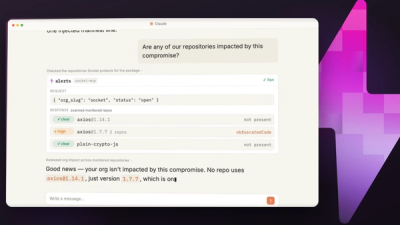
Socket MCP now lets AI assistants review org alerts, investigate threats using the Socket threat feed, and inspect package files in addition to dependency scoring.
Product
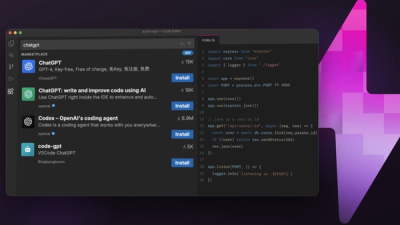
Socket Firewall blocks malicious VS Code and Open VSX extensions before install, protecting developers from compromised editor marketplaces.