
Product
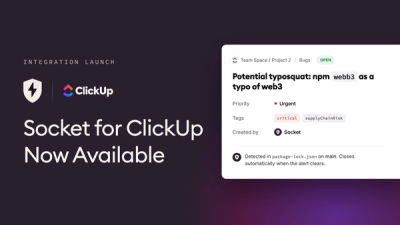
Socket for ClickUp Is Now Available
Create ClickUp tasks from Socket alerts, automate ticketing with custom rules, and keep alert and task status synchronized.
By Jeppe Hasseriis - Aug 26, 2026
@silvanexum/sdk
Advanced tools
Official TypeScript/JavaScript SDK for Silvanexum — the spend-control plane for AI agents. Meter, attribute, cap, and audit agent spend across a multi-agent mesh, on any model or rail. Types generated from the API's Zod contracts.
Official TypeScript/JavaScript SDK for Silvanexum — the spend-control plane for AI agents. Meter, attribute, cap, and audit what every agent spends across your whole agent-to-agent mesh, on any model or rail. Types are generated from the API's Zod contracts, so they never drift from the live API.
📚 Full docs: https://docs.silvanexum.com
npm install @silvanexum/sdk
# pnpm add @silvanexum/sdk · yarn add @silvanexum/sdk · bun add @silvanexum/sdk
Requires Node ≥ 20 (uses the built-in fetch). Ships dual ESM + CJS with
bundled types.
import { Silvanexum } from "@silvanexum/sdk";

const sx = new Silvanexum({ apiKey: process.env.SILVANEXUM_API_KEY });

// Cap runaway spend — a run or mesh hop that would breach the budget is
// rejected server-side (HTTP 402). "Spent" is computed from real run telemetry.
await sx.budgets.create({
  name: "support-team",
  scopeType: "agent",
  scopeId: "agt_123",
  periodType: "monthly",
  limitCredits: 50_000,
  enforcement: "block",
});

// Attribute cost across the mesh — which agent / project / model actually spent.
const rows = await sx.spending.summary({ groupBy: "agent" });
console.table(rows);
Point your OpenAI client's baseURL at the gateway and use your Silvanexum key.
Every call is metered on your own provider key and counts toward budgets — with
no change to your agent code:
import OpenAI from "openai";

const openai = new OpenAI({
  baseURL: sx.gateway.openaiBaseUrl(),
  apiKey: process.env.SILVANEXUM_API_KEY,
  // pass a trace id to stitch a call into a multi-hop mesh graph:
  defaultHeaders: { "x-silvanexum-trace": traceId },
});
| Resource | What it does |
|---|---|
sx.spending | Cost attribution — summary / trends / meshTrace (by agent, project, model, provider) |
sx.budgets | Spend caps with off / alert / block enforcement + live status |
sx.gateway | Zero-code OpenAI-compatible capture + usage |
sx.fleet | Cost, latency, drift, and alert observability |
sx.runs · sx.agents | Run agents; read signed, replayable traces |
sx.security | Hash-chained audit log + compliance export |
…plus marketplace, wallet, routing, connectors, team, and more. Full
reference: https://docs.silvanexum.com/docs/sdk-reference/typescript.
Every failure throws a typed SilvanexumError subclass:
import { RateLimitError, InsufficientCreditsError } from "@silvanexum/sdk";

try {
  await sx.runs.create({ agentId: "agt_123", prompt: "…" });
} catch (err) {
  if (err instanceof InsufficientCreditsError) {
    // budget/credits exhausted (HTTP 402) — top up or raise the cap
  } else if (err instanceof RateLimitError) {
    // the client already retried with backoff; surface to the user
  }
}
new Silvanexum({
  apiKey: "sx_live_...",        // or env SILVANEXUM_API_KEY
  baseUrl: "https://api.silvanexum.com", // or env SILVANEXUM_BASE_URL
  timeoutMs: 60_000,
  maxRetries: 2,                // retries 429 / 5xx / connection errors
});
Licensed Apache-2.0.
FAQs
Official TypeScript/JavaScript SDK for Silvanexum — the spend-control plane for AI agents. Meter, attribute, cap, and audit agent spend across a multi-agent mesh, on any model or rail. Types generated from the API's Zod contracts.
We found that @silvanexum/sdk demonstrated a healthy version release cadence and project activity because the last version was released less than a year ago. It has 1 open source maintainer collaborating on the project.
Product
Create ClickUp tasks from Socket alerts, automate ticketing with custom rules, and keep alert and task status synchronized.
Product
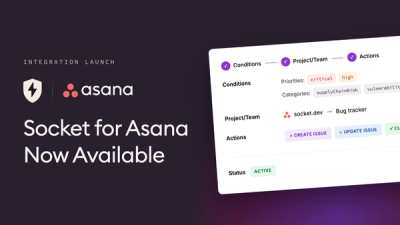
Create and manage Asana tasks directly from Socket alerts, with manual task creation, automated ticketing rules, and two-way sync.

Security News
Open VSX has removed three extension IDs from its malicious-extension list as the legitimate publishers they impersonated move to claim the names for themselves.