
Product
Socket Now Protects the Microsoft Edge Extension Ecosystem
Enterprise security teams can now detect malware, credential theft, suspicious network activity, and risky updates across Microsoft Edge extensions.
By John Tuckner - Aug 28, 2026
@sonenta/astro
Advanced tools
Official Astro integration for Sonenta i18n — build-time CDN translations, zero client JS (SSG).
Official Astro integration for Sonenta i18n.
Your translations live in Sonenta; this integration pulls the released bundles from the CDN at build time and inlines them into your static HTML. There is zero client-side JavaScript — it's pure SSG, the way Astro content sites want i18n to work.
npm install @sonenta/astro
# or: pnpm add @sonenta/astro / yarn add @sonenta/astro
v0.2 — standalone. This release does string resolution,
{var}interpolation, source-language fallback, and device-surface variants (responsive text via build-time overlays + CSS, zero JS). CLDR plurals and accessibility surfaces arrive additively in0.3.0(backed by@sonenta/i18n-core) without any breaking change to the API below — see CONTRACT.md.
// astro.config.mjs
import { defineConfig } from "astro/config";
import sonenta from "@sonenta/astro";

export default defineConfig({
  // Astro's native i18n routing — the integration reads Astro.currentLocale.
  i18n: { defaultLocale: "fr", locales: ["fr", "en", "es"] },
  integrations: [
    sonenta({
      project: "your-project-uuid",   // from your Sonenta dashboard
      locales: ["fr", "en", "es"],
      defaultLocale: "fr",
      namespaces: ["common"],
    }),
  ],
});
---
// src/pages/index.astro
import { getT, defaultLocale } from "sonenta:i18n";

const t = getT(Astro.currentLocale ?? defaultLocale);
---
<html lang={Astro.currentLocale ?? defaultLocale}>
  <head><title>{t("home.title")}</title></head>
  <body>
    <h1>{t("home.title")}</h1>
    <p>{t("home.greeting", { name: "Ada" })}</p>
  </body>
</html>
That's it. astro build fetches common.json for every locale and freezes the
strings into the page. Nothing ships to the browser.
sonenta:i18n virtual moduleThe integration exposes a virtual module you can import from any .astro file
(or .ts/.js run at build time):
| Export | Description |
|---|---|
getT(locale) | Returns a t(key, vars?) bound to locale. |
locales | The locales fetched into the build. |
defaultLocale | The resolved source/default locale. |
getCatalog(locale, ns?) | Raw fetched dictionary, or null if absent. |
TypeScript types for the virtual module are injected automatically (Astro's
injectTypes), so getT is fully typed with no extra config.
t("home.cta.label").ns:key syntax: t("docs:intro").
Un-prefixed keys resolve against the first namespace (default "common").t("greeting", { name: "Ada" }) replaces {name}.
Unknown placeholders are left intact.fallbackLng (default: the
source locale). A locale whose bundle is absent (e.g. plan-limit) falls back
the same way. Still missing everywhere → the raw key is returned (i18next
parity).A surface lets one key carry different values per device — e.g. a CTA that
reads "Commencer gratuitement" on desktop and "Commencer" on mobile. Values
come from a sparse CDN overlay ({ns}.{surface}.json) layered over the base
bundle; nothing about your authoring changes except adding per-surface values
in the dashboard.
Because SSG can't know the viewport at build time, the integration fetches every surface and renders them all — a CSS media query reveals the right one. No client JavaScript.
Enable surfaces in the integration, then use the <SurfaceText> component:
// astro.config.mjs
sonenta({
  project: "your-project-uuid",
  locales: ["fr", "en", "es"],
  surfaces: ["desktop", "mobile"],   // also fetch these overlays
})
---
import SurfaceText from "@sonenta/astro/SurfaceText.astro";
const locale = Astro.currentLocale ?? "fr";
---
<a href="/signup">
  <SurfaceText key="cta.start" locale={locale} />
</a>
<!-- desktop → "Commencer gratuitement", mobile → "Commencer" -->
<SurfaceText> auto-collapses: when a key has no overlay (every surface
resolves equal) it renders a single element — no wrapper spans, no <style>,
no bloat. Props: key, locale, vars?, as? (wrapper tag, default
span), class?, breakpoints?.
Prefer your own markup (e.g. Tailwind hidden md:inline)? Use the primitives:
---
import { getSurfaces, getT } from "sonenta:i18n";
const { desktop, mobile } = getSurfaces(locale, "cta.start");
const oneSurface = getT(locale).surface("cta.start", "mobile");
---
Breakpoint ladder (mirrors @sonenta/react-i18next): mobile < 640px,
tablet 640–1023px, desktop ≥ 1024px; configurable via surfaceBreakpoints
or the <SurfaceText breakpoints> prop.
Surface overlays must be published on the CDN for the key (dashboard / backend side). A key with no overlay simply renders its base value on every surface — safe by default.
Prefer an explicit top-level await? Use the runtime directly — no virtual
module, no Vite plugin:
// src/i18n.ts
import { createSonentaI18n } from "@sonenta/astro/runtime";

export const i18n = await createSonentaI18n({
  project: "your-project-uuid",
  locales: ["fr", "en", "es"],
  defaultLocale: "fr",
});
export const getT = i18n.getT;
| Option | Type | Default | Notes |
|---|---|---|---|
project | string | — | Required. Project UUID. |
locales | string[] | — | Required. Locales to fetch + freeze. |
version | string | "main" | Released version slug / pinned hash. |
defaultLocale | string | locales[0] | Source / fallback locale. |
fallbackLng | string | string[] | [defaultLocale] | Missing-key fallback chain. |
namespaces | string[] | ["common"] | Bundle files; first is the default ns. |
surfaces | Surface[] | [] (off) | Device surfaces to fetch (desktop/mobile/tablet). |
surfaceBreakpoints | {mobile,tablet} | {640,1024} | <SurfaceText> media-query ladder. |
cdnBase | string | https://cdn.sonenta.com | CDN host (no /p). Env: SONENTA_CDN_BASE. |
apiBase | string | https://api.sonenta.dev | Reserved (forward-compat). |
fetchImpl | typeof fetch | global fetch | Custom fetch (runtime API only). |
Bundles are fetched from
{cdnBase}/p/{project}/{version}/latest/{locale}/{namespace}.json — the same
CDN layout as @sonenta/react-i18next.
$value that is a plural dict is
treated as "no string" (resolves to fallback/raw key); t.aria/t.alt and
pluralization arrive in 0.3.0 on @sonenta/i18n-core. See
CONTRACT.md.@sonenta/feedback, @sonenta/realtime, and
@sonenta/in-context are runtime/DOM SDKs — they run inside Astro client
islands (reusing the React bindings), not in static .astro output.MIT © Sonenta
FAQs
Official Astro integration for Sonenta i18n — build-time CDN translations, zero client JS (SSG).
The npm package @sonenta/astro receives a total of 1 weekly downloads. As such, @sonenta/astro popularity was classified as not popular.
We found that @sonenta/astro demonstrated a healthy version release cadence and project activity because the last version was released less than a year ago. It has 1 open source maintainer collaborating on the project.
Product
Enterprise security teams can now detect malware, credential theft, suspicious network activity, and risky updates across Microsoft Edge extensions.

Research
/Security News
Socket researchers found 18 Chrome extensions and one Edge extension delivering a wallet drainer, credential theft, and other malicious payloads.
Product
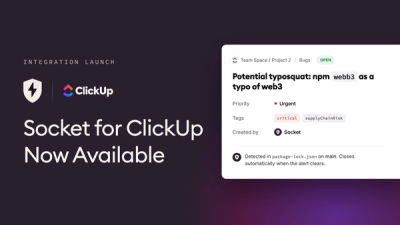
Create ClickUp tasks from Socket alerts, automate ticketing with custom rules, and keep alert and task status synchronized.