

Security News
Next.js moves to scheduled security releases
Vercel is formalizing a monthly release program for Next.js. The change follows React2Shell and a sharp rise in AI-assisted vulnerability discovery.
By Sarah Gooding - Jul 16, 2026
@stll/folio-agents
Advanced tools
Framework-neutral LLM tool layer over folio's ai-edits engine: function-calling tools so an agent can read and mutate .docx documents through @stll/folio-core.
A framework-neutral (React-free, DOM-free) LLM tool layer over
@stll/folio-core's AI-edits
engine: function-calling tool definitions and an executor so a model can read
and mutate a .docx document, with every mutation landing as a tracked change
or comment pending human review.
Part of stella, an open-source legal workspace.
bun add @stll/folio-agents
@stll/folio-core is installed automatically as a dependency.
| Tool | What it does |
|---|---|
read_document | Read the document body as { blockId, kind, text } blocks |
find_text | Search block text for a string; returns block id, occurrence, and context per match |
read_comments | Read comment threads (author, text, resolved, anchored block, replies) |
read_changes | Read pending tracked changes (insertions/deletions) awaiting review |
add_comment | Attach a comment to a block, optionally quoting specific text |
suggest_changes | Propose block or stable-range edits as tracked changes |
reply_comment | Reply to a comment thread |
resolve_comment | Resolve or reopen a comment thread |
read_page | Read a page's plain text (live editor only) |
read_selection | Read the current text selection (live editor only) |
scroll_to_block | Scroll the live editor to a block (live editor only) |
Block ids and comment ids always come from a prior tool call
(read_document, find_text, read_comments) within the same conversation —
never guess them. suggest_changes reports a plain-language reason when an
operation is skipped (e.g. the block changed since it was last read), so the
model can re-read and retry. Successful mutation results include receipts
that identify affected blocks, ranges, insertions, and created comments.
read_document, read_comments, read_changes, and find_text return
document content verbatim. If a .docx comes from an untrusted party, its
text can carry prompt-injection payloads straight into the model's context —
treat any document-derived tool result as untrusted model input, the same way
you would treat a fetched web page. Mutations stay safe by design regardless:
suggest_changes and add_comment land as tracked changes or comments
pending human review, so an injected instruction can propose an edit but
cannot silently apply one.
import { FolioDocxReviewer } from "@stll/folio-core/server";
import {
  createReviewerBridge,
  executeFolioToolCall,
  getFolioToolDefinitions,
  toAnthropicTools,
} from "@stll/folio-agents";

const reviewer = await FolioDocxReviewer.fromBuffer(docxBuffer, { author: "AI" });
const bridge = createReviewerBridge(reviewer);
const tools = toAnthropicTools(getFolioToolDefinitions());

// Inside your tool-use loop, for each tool_use block the model emits:
const result = executeFolioToolCall(toolName, toolInput, bridge);
// result: { ok: true, result } | { ok: false, error } — feed either back to the model.

const reviewedBuffer = await reviewer.toBuffer();
import { createEditorRefBridge, executeFolioToolCall } from "@stll/folio-agents";

// `docxEditorRef` is a DocxEditorRef from @stll/folio-react (or any object
// structurally matching FolioAgentEditorRefLike).
const bridge = createEditorRefBridge({
  ref: docxEditorRef.current,
  author: "AI",
  getComments: () => comments,
  setComments: (next) => setComments(next),
});

const result = executeFolioToolCall("suggest_changes", { operations: [...] }, bridge);
On a DocxEditorRef that implements the read surface (getTrackedChanges,
getCommentAnchors, getSelectionText, getPageText), the editor-ref bridge
has full parity with the headless one: read_changes returns real tracked
changes, comment entries carry a resolved blockId / quote, and read_page
/ read_selection work against the live view. Against an older ref that
predates those methods, the bridge degrades per-member: read_changes
returns [], comment entries fall back to blockId: null / quote: "", and
read_page / read_selection report an unsupported-capability error — see
src/bridges/editor-ref.ts for the exact fallback per method.
A host with its own review-queue UX (its own place to store proposed edits
pending approval, distinct from folio's tracked-changes redlines) can validate
a model's suggest_changes / add_comment tool-call arguments with the same
canonical rules executeFolioToolCall uses, without applying them through a
bridge at all:
import { parseSuggestChangesInput } from "@stll/folio-agents";

const parsed = parseSuggestChangesInput(toolInput);
if (!parsed.ok) {
  // Feed `parsed.error` back to the model as the tool result, same as
  // executeFolioToolCall would.
} else {
  // `parsed.operations` is FolioAIEditOperation[] — route it into your own
  // review queue instead of bridge.applyDocumentOperations(...).
  reviewQueue.enqueue(parsed.operations);
}
parseAddCommentInput is the equivalent for add_comment, returning
{ ok: true; operation } on success.
Two different questions come up under "what changed":
1. Pending tracked changes in one document — what a human reviewer would
see as redlines right now. Use the read_changes tool (or
reviewer.getChanges() directly) and hand the insertions/deletions to the
model:
const changes = reviewer.getChanges();
const prompt = `Summarize these pending edits for a reviewer:\n${changes
  .map((c) => `${c.type === "insertion" ? "+" : "-"} [${c.blockId}] ${c.text}`)
  .join("\n")}`;
2. Between two saved versions — what changed across two .docx buffers,
independent of whether either one has any tracked changes at all. Use
compareDocxVersions + formatVersionDiffForLLM:
import { compareDocxVersions, formatVersionDiffForLLM } from "@stll/folio-agents";

const diff = await compareDocxVersions(previousVersionBuffer, currentVersionBuffer);
const prompt = `Summarize what changed between these two document versions:\n${formatVersionDiffForLLM(diff)}`;
// -> feed `prompt` to your model as a normal user/system message.
Both recipes compare the AS-ACCEPTED view of a document: any tracked changes
already pending in a buffer count as already applied before the comparison
runs (compareDocxVersions parses each buffer through the same
FolioDocxReviewer snapshot read_document uses). Diffing two versions that
each have their own uncommitted redlines still produces a clean, readable diff
instead of raw markup noise.
compareDocxVersions ships as a plain async function, not a tool definition:
a model can describe a tool call, but it can't attach two document buffers to
one — buffers aren't JSON-serializable tool arguments a model could produce.
The natural shape is a host-side tool keyed by version identifiers instead
(e.g. a server tool the model calls with two stored version ids, which your
backend resolves to buffers, diffs, and returns the formatted text for).
TanStack AI's toolDefinition accepts a raw JSON Schema object as
inputSchema, so the definitions plug in without any wrapper:
import { toolDefinition } from "@tanstack/ai";
import { getFolioToolDefinitions } from "@stll/folio-agents";

const defs = getFolioToolDefinitions().map((def) =>
  toolDefinition({
    name: def.name,
    description: def.description,
    inputSchema: def.inputSchema,
  }),
);
// Client-executed tools: run executeFolioToolCall(name, args, bridge) where the
// live editor lives and report the payload back via your chat client's
// addToolResult; server-executed tools: chain .server((args) => ...) instead.
The schemas stay within a conservative JSON Schema subset (type: "object",
properties, required, enum, additionalProperties: false, plain arrays).
Some providers (e.g. Gemini's OpenAPI-3.0 subset) reject less common keywords;
if your stack projects tool schemas through a provider-safe filter, these
definitions pass through it unchanged.
This package ships no ai dependency; map its tool definitions with the AI
SDK's own jsonSchema() / tool() helpers:
import { jsonSchema, tool } from "ai";
import { executeFolioToolCall, getFolioToolDefinitions } from "@stll/folio-agents";

const tools = Object.fromEntries(
  getFolioToolDefinitions().map((def) => [
    def.name,
    tool({
      description: def.description,
      inputSchema: jsonSchema(def.inputSchema),
      execute: async (input) => executeFolioToolCall(def.name, input, bridge),
    }),
  ]),
);
folio began as a private fork of Eigenpal's
docx-editor. The original license
and copyright are preserved in
NOTICE.md.
Apache-2.0
FAQs
Framework-neutral LLM tool layer over folio's ai-edits engine: function-calling tools so an agent can read and mutate .docx documents through @stll/folio-core.
The npm package @stll/folio-agents receives a total of 2,892 weekly downloads. As such, @stll/folio-agents popularity was classified as popular.
We found that @stll/folio-agents demonstrated a healthy version release cadence and project activity because the last version was released less than a year ago. It has 1 open source maintainer collaborating on the project.
Did you know?

Socket for GitHub automatically highlights issues in each pull request and monitors the health of all your open source dependencies. Discover the contents of your packages and block harmful activity before you install or update your dependencies.
Security News
Vercel is formalizing a monthly release program for Next.js. The change follows React2Shell and a sharp rise in AI-assisted vulnerability discovery.

Research
/Security News
11 malicious NuGet tools pose as game cheats to deploy Windows payloads, track hosts, and use Google Sheets for telemetry and control.
Research
/Security News
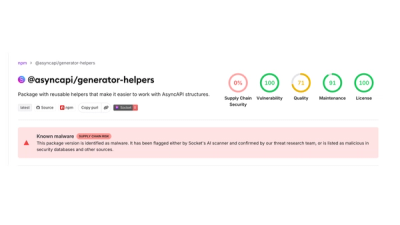
4 compromised asyncapi packages deliver miasma botnet loader on macOS, Linux and Windows.