
Product
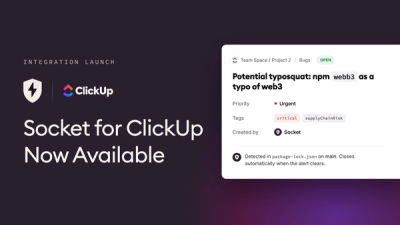
Socket for ClickUp Is Now Available
Create ClickUp tasks from Socket alerts, automate ticketing with custom rules, and keep alert and task status synchronized.
By Jeppe Hasseriis - Aug 26, 2026
@vercel/ncc
Advanced tools
Simple CLI for compiling a Node.js module into a single file, together with all its dependencies, gcc-style.

Simple CLI for compiling a Node.js module into a single file, together with all its dependencies, gcc-style.
go)npm i -g @vercel/ncc
$ ncc <cmd> <opts>
Eg:
$ ncc build input.js -o dist
If building an .mjs or .js module inside a "type": "module" package boundary, an ES module output will be created automatically.
Outputs the Node.js compact build of input.js into dist/index.js.
Note: If the input file is using a
.cjsextension, then so will the corresponding output file. This is useful for packages that want to use.jsfiles as modules in native Node.js using a"type": "module"in the package.json file.
  build <input-file> [opts]
  run <input-file> [opts]
  cache clean|dir|size
  help
  version
  -o, --out [dir]          Output directory for build (defaults to dist)
  -m, --minify             Minify output
  -C, --no-cache           Skip build cache population
  -s, --source-map         Generate source map
  -a, --asset-builds       Build nested JS assets recursively, useful for
                           when code is loaded as an asset eg for workers.
  --no-source-map-register Skip source-map-register source map support
  -e, --external [mod]     Skip bundling 'mod'. Can be used many times
  -q, --quiet              Disable build summaries / non-error outputs
  -w, --watch              Start a watched build
  -t, --transpile-only     Use transpileOnly option with the ts-loader
  --v8-cache               Emit a build using the v8 compile cache
  --license [file]         Adds a file containing licensing information to the output
  --stats-out [file]       Emit webpack stats as json to the specified output file
  --target [es]            ECMAScript target to use for output (default: es2015)
                           Learn more: https://webpack.js.org/configuration/target
  -d, --debug              Show debug logs
For testing and debugging, a file can be built into a temporary directory and executed with full source maps support with the command:
$ ncc run input.js
The only requirement is to point ncc to .ts or .tsx files. A tsconfig.json
file is necessary. Most likely you want to indicate es2015 support:
{
  "compilerOptions": {
    "target": "es2015",
    "moduleResolution": "node"
  }
}
If typescript is found in devDependencies, that version will be used.
Some packages may need some extra options for ncc support in order to better work with the static analysis.
See package-support.md for some common packages and their usage with ncc.
require('@vercel/ncc')('/path/to/input', {
  // provide a custom cache path or disable caching
  cache: "./custom/cache/path" | false,
  // externals to leave as requires of the build
  externals: ["externalpackage"],
  // directory outside of which never to emit assets
  filterAssetBase: process.cwd(), // default
  minify: false, // default
  sourceMap: false, // default
  assetBuilds: false, // default
  sourceMapBasePrefix: '../', // default treats sources as output-relative
  // when outputting a sourcemap, automatically include
  // source-map-support in the output file (increases output by 32kB).
  sourceMapRegister: true, // default
  watch: false, // default
  license: '', // default does not generate a license file
  target: 'es2015', // default
  v8cache: false, // default
  quiet: false, // default
  debugLog: false // default
}).then(({ code, map, assets }) => {
  console.log(code);
  // Assets is an object of asset file names to { source, permissions, symlinks }
  // expected relative to the output code (if any)
})
When watch: true is set, the build object is not a promise, but has the following signature:
{
  // handler re-run on each build completion
  // watch errors are reported on "err"
  handler (({ err, code, map, assets }) => { ... })
  // handler re-run on each rebuild start
  rebuild (() => {})
  // close the watcher
  void close ();
}
Webpack is a popular module bundler for JavaScript applications. It can bundle multiple modules into a single file or multiple files, and it offers a wide range of plugins and configuration options. Compared to @vercel/ncc, Webpack is more flexible and can be used for both frontend and backend projects, but it requires more configuration.
Rollup is a module bundler for JavaScript that focuses on ES6 modules. It is known for its tree-shaking feature, which removes unused code from the final bundle. Rollup is often used for libraries and smaller projects. Compared to @vercel/ncc, Rollup provides more control over the bundling process but may require additional plugins for certain features.
Parcel is a zero-configuration bundler that works out of the box. It supports both JavaScript and TypeScript and can handle various types of assets like CSS, HTML, and images. Parcel is designed to be easy to use and fast. Compared to @vercel/ncc, Parcel is more suitable for frontend projects and offers a simpler setup process.
FAQs
Simple CLI for compiling a Node.js module into a single file, together with all its dependencies, gcc-style.
The npm package @vercel/ncc receives a total of 936,812 weekly downloads. As such, @vercel/ncc popularity was classified as popular.
We found that @vercel/ncc demonstrated a healthy version release cadence and project activity because the last version was released less than a year ago. It has 4 open source maintainers collaborating on the project.
Product
Create ClickUp tasks from Socket alerts, automate ticketing with custom rules, and keep alert and task status synchronized.
Product
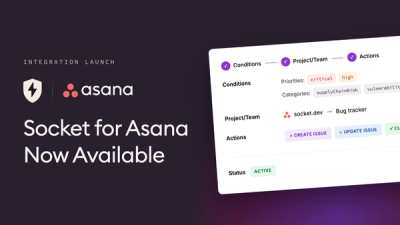
Create and manage Asana tasks directly from Socket alerts, with manual task creation, automated ticketing rules, and two-way sync.

Security News
Open VSX has removed three extension IDs from its malicious-extension list as the legitimate publishers they impersonated move to claim the names for themselves.