
Security News
Next.js moves to scheduled security releases
Vercel is formalizing a monthly release program for Next.js. The change follows React2Shell and a sharp rise in AI-assisted vulnerability discovery.
By Sarah Gooding - Jul 16, 2026
agentapp-ref
Advanced tools
Agent App is a draft standard for complete installable intelligent applications in the Agent standards ecosystem. It packages real app implementation - UI bundles, workers, storage schemas, workflows, agent entries, Skills, Knowledge bindings, tool requirements, artifact contracts, policies, evals, presentation metadata, v0.7 requirement-boundary files, and v0.8 standalone installation metadata - without moving agent execution into the cloud or forcing every user through Lime Desktop.
Agent Runtime answers how tasks execute. Agent UI answers how interaction surfaces render. Agent Context answers how context is assembled. Skills answer how reusable work is done. Knowledge answers what trusted facts are. Tools connect external capabilities; Artifacts persist deliverables; Evidence, Policy, and QC make results trustworthy. Agent App answers how all of those become a complete installable application with host capabilities, UI, data boundaries, entries, lifecycle, v0.7 requirement handoff, and v0.8 install modes.
v0.8 makes one product boundary explicit: Agent App is the product, Lime Runtime is the capability substrate, Lime Desktop is one host, and Lime App Shell is the standalone single-app host. Users can install an Agent App inside Lime Desktop, download it as a standalone branded app, or run it against a shared system Lime Runtime.
Agent App is the business workspace. Lime Agent is the intelligent runtime capability that apps orchestrate. Users should be able to finish a business workflow inside the app surface instead of being forced back into a generic chat UI. Chat and expert entries are valid app surfaces, but they are optional interaction modes rather than the required container for product work.
| Standard / layer | Owns | Entry point | Runtime behavior |
|---|---|---|---|
| Agent Runtime | Task lifecycle, model routing, sessions, checkpoints, event streams, structured output. | Runtime contract | Runs under host policy; App declares intent through app.runtime.yaml. |
| Agent UI | Pages, panels, commands, viewers, Host Bridge interaction surfaces. | UI descriptors / entries | Rendered in host-controlled surfaces through lime.ui. |
| Agent Context | Context assembly, budget, priority, compression, missing-context requests. | Context descriptors | Resolved by host/runtime for each entry or task. |
| Agent Skills | Reusable procedures, scripts, rubrics, and executable process fragments. | SKILL.md | Activated by an agent after trust checks. |
| Agent Knowledge | Source-grounded facts, status, provenance, freshness, and safe context. | KNOWLEDGE.md | Loaded as fenced data or retrieval context; never executed. |
| Agent Tool / Connector | External callable capabilities, MCP, CLI, API, browser adapters, auth, side effects. | Tool / connector descriptor | Invoked by Host/Cloud policy and evidence surfaces. |
| Agent Artifact | Durable deliverables, schemas, viewers, exporters, state. | Artifact schema | Stored and displayed by host artifact services. |
| Agent Evidence / Policy / QC | Provenance, permissions, risk, quality gates, audits, waivers. | Evidence, policy, eval descriptors | Enforced and recorded by Host/Cloud; App declares inputs and gates. |
| Agent Expert | Chat-first entry composed from persona, context, tools, and app state. | Expert entry | Runs inside a host conversation surface; optional App entry, not the App itself. |
| Agent App | Complete installable app package: UI, workers, storage, workflows, entries, permissions, artifacts, evals, lifecycle, v0.7 boundaries, and v0.8 install modes. | APP.md + runtime package | Runs in a compatible host through @lime/app-sdk capability handles. |
| Lime Runtime Core | Agent execution, storage, tools, connectors, secrets, policy, evidence, artifacts, and local governance. | lime.* capabilities | Shared by Lime Desktop, Lime App Shell, runtime-backed apps, and compatible hosts. |
| Lime Host / Cloud | Local shells, sandbox, registry, tenant policy, OAuth, webhook, scheduled sync. | Host shell + lime.* capabilities | Injected into apps as authorized handles; apps do not import host internals. |
| Area | Agent App owns | Lime owns |
|---|---|---|
| Product experience | Business UI, pages, tables, forms, dashboards, review steps, and delivery views. | Host shell, navigation, theme, locale, installation, and app lifecycle. |
| Business logic | Workflow state, domain rules, storage schema, structured result write-back, and human confirmation. | Agent task runtime, capability enforcement, retries, cancellation, cost limits, and telemetry. |
| Data boundary | App-local records, package assets, overlays, and references to workspace data. | Namespaced storage, files, Knowledge binding, secrets, policy, cleanup, and audit. |
| Agent execution | Decides when to call an agent task and how the result updates product state. | Runs lime.agent tasks, model calls, tools, traces, artifacts, and evidence through SDK contracts. |
The boundary is intentionally strict: business should not leave the app context, and agents should not leave Lime capability governance. If an app bypasses Lime to build its own model gateway, permission system, or evidence store, it is becoming an independent SaaS instead of an Agent App. If an app sends users back to generic chat for core work, it is only a chat wrapper rather than a product-level app.
my-agent-app/
├── APP.md                    # required: discovery manifest + app guide
├── app.manifest.json         # optional: separated machine manifest
├── dist/
│   ├── ui/                   # optional: UI bundle and route manifest
│   ├── worker/               # optional: business workers and background jobs
│   └── tools/                # optional: packaged tool adapters
├── storage/
│   ├── schema.json           # optional: app namespace data model
│   └── migrations/           # optional: versioned migrations
├── workflows/                # optional: business workflows and state machines
├── agents/                   # optional: expert-chat personas
├── skills/                   # optional: bundled or referenced Agent Skill packages
├── knowledge-templates/      # optional: required knowledge slots and starter templates
├── artifacts/                # optional: output contracts, viewers, exporters
├── evals/                    # optional: readiness and quality checks
├── policies/                 # optional: permissions and data boundaries
├── app.runtime.yaml          # optional: v0.6 agent task runtime control plane
├── app.requirements.yaml     # optional: v0.7 requirements, MVP, non-goals, acceptance
├── app.boundary.yaml         # optional: v0.7 App / Host / Cloud / Connector / Human boundary
├── app.integrations.yaml     # optional: v0.7 Host/Cloud-managed external integrations
├── app.operations.yaml       # optional: v0.7 side effects, approvals, evidence
├── app.install.yaml          # optional: v0.8 in-Lime, standalone, runtime-backed install modes
├── overlay-templates/        # optional: tenant / workspace overlay schemas
├── app.lock.json             # optional: package file hashes and signatures
└── examples/                 # optional: sample workspaces, prompts, outputs
APP.md is not the app implementation. It is the discovery and review surface. Product-level functionality belongs in the runtime package and calls host services through the Capability SDK.
Compatible hosts should expose versioned, authorized, mockable capabilities such as:
lime.ui for pages, panels, commands, settings, artifact viewerslime.storage for app namespaces, tables, indexes, migrationslime.files for user-selected files and parsinglime.agent for local agent tasks, streaming, retries, traceslime.knowledge for Knowledge Pack binding and retrievallime.tools for Tool Broker / ToolHub invocationlime.connectors for Host/Cloud-managed MCP, CLI, API, browser, OAuth, webhook, and sync adapterslime.artifacts for persistent deliverableslime.workflow for business state and background taskslime.policy for permissions, cost, risk, data boundarylime.evidence for provenance and replaylime.secrets for credentials without plaintext app accessApps must not import host internals. They declare capability requirements in the manifest and receive runtime handles from the host. v0.8 keeps the layered manifest model, keeps v0.6 app.runtime.yaml for the lime.agent task control plane, keeps v0.7 requirement-boundary files, and adds app.install.yaml so packages can declare in_lime, standalone, runtime_backed, and web_host install modes.
| Mode | User experience | Runtime relationship |
|---|---|---|
in_lime | Install and launch from Lime Desktop. | Uses the Desktop-hosted Lime Runtime. |
standalone | Download a branded business app directly. | Bundles a compatible Lime Runtime profile through Lime App Shell. |
runtime_backed | Install a lightweight app package. | Requires an already installed system lime-runtime. |
web_host | Open in a compatible hosted environment. | Host provides web capability handles and policy. |
Compatible hosts should:
APP.md.npx agentapp-ref@0.8.0 validate ./my-agent-app --version 0.8
npx agentapp-ref@0.8.0 to-catalog ./my-agent-app
npx agentapp-ref@0.8.0 project ./my-agent-app
npx agentapp-ref@0.8.0 readiness ./my-agent-app --workspace ./workspace
npx agentapp-ref@0.8.0 migrate-check ./my-agent-app
npx agentapp-ref@0.8.0 migrate-generate ./my-agent-app --target 0.8.0
npm install
npm run dev
npm run build
FAQs
Reference CLI and documentation for Agent App packages.
The npm package agentapp-ref receives a total of 2 weekly downloads. As such, agentapp-ref popularity was classified as not popular.
We found that agentapp-ref demonstrated a healthy version release cadence and project activity because the last version was released less than a year ago. It has 1 open source maintainer collaborating on the project.
Did you know?

Socket for GitHub automatically highlights issues in each pull request and monitors the health of all your open source dependencies. Discover the contents of your packages and block harmful activity before you install or update your dependencies.
Security News
Vercel is formalizing a monthly release program for Next.js. The change follows React2Shell and a sharp rise in AI-assisted vulnerability discovery.

Research
/Security News
11 malicious NuGet tools pose as game cheats to deploy Windows payloads, track hosts, and use Google Sheets for telemetry and control.
Research
/Security News
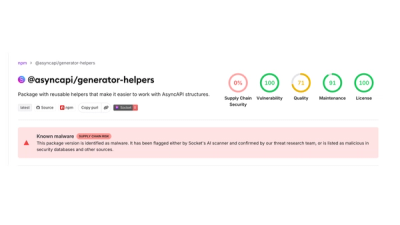
4 compromised asyncapi packages deliver miasma botnet loader on macOS, Linux and Windows.