
Product
Socket Now Protects the Microsoft Edge Extension Ecosystem
Enterprise security teams can now detect malware, credential theft, suspicious network activity, and risky updates across Microsoft Edge extensions.
By John Tuckner - Aug 28, 2026
agentify-openapi
Advanced tools
Turn any OpenAPI/Swagger spec into an agent-ready MCP server. Point it at a spec and every operation becomes a tool an agent can call.
Turn any OpenAPI / Swagger spec into an agent-ready MCP server.

io.github.sani-savaliya/agentify) and Smithery.
Point it at a spec — a URL, a file, OpenAPI 3.x or Swagger 2.0 — and every operation becomes a tool an AI agent can call. No code generation, no per-API boilerplate, no hosting. One command.
npx agentify-openapi https://petstore3.swagger.io/api/v3/openapi.json --list
Swagger Petstore - OpenAPI 3.0 v1.0.27
Base URL: https://petstore3.swagger.io/api/v3
Tools: 19

  getPetById
    Find pet by ID.
  findPetsByStatus
    Finds Pets by status.
  ...
"Today, agents have to operate software designed for humans. The interfaces of the future will be built for agents — APIs, MCPs, CLIs — with agents as first-class citizens." — YC RFS: Software for Agents
There are tens of thousands of APIs that already describe themselves with an OpenAPI
document. agentify makes every one of them agent-native, instantly, without anyone
hand-writing an integration.
Add to your MCP client config (e.g. Claude Desktop / Claude Code):
{
  "mcpServers": {
    "petstore": {
      "command": "npx",
      "args": ["-y", "agentify-openapi", "https://petstore3.swagger.io/api/v3/openapi.json"]
    }
  }
}
The agent now has one tool per API operation. Calling a tool builds the HTTP request (path params, query string, headers, JSON body) and returns the live response.
Provide credentials via environment variables — agentify reads the spec's declared
security scheme to find the right header name when it can:
| Variable | Effect |
|---|---|
AGENTIFY_BEARER_TOKEN | Authorization: Bearer <token> |
AGENTIFY_BASIC_USER / AGENTIFY_BASIC_PASS | HTTP basic auth |
AGENTIFY_API_KEY | API key (sent as a header by default) |
AGENTIFY_API_KEY_HEADER | Override the api-key header name |
AGENTIFY_API_KEY_QUERY | Send the api key as a query param instead |
You can also inject raw headers from the CLI: --header "X-Org-Id: 42" (repeatable).
agentify <spec-url-or-file> [options]

  --base-url <url>     Override the API base URL from the spec
  --header "K: V"      Add a raw header to every request (repeatable)
  --name <name>        Override the MCP server name
  --list               Print the discovered tools and exit (no server)
  -h, --help           Show help
A small, pure pipeline — each stage is independently unit-tested:
spec ──▶ operations ──▶ tool defs ──▶ http request ──▶ response
 │           │              │              │              │
load &    one tool       JSON Schema   path/query/    fetch + surface
deref     per op         for inputs    header/body    status & body
$refs                                  + auth
Only the HTTP execution and MCP transport touch the outside world; everything else is deterministic and tested.
import { loadSpec, extractOperations, resolveBaseUrl, createServer } from "agentify-openapi";

const spec = await loadSpec("./openapi.yaml");
const tools = extractOperations(spec);
const baseUrl = resolveBaseUrl(spec);
// ...build your own MCP server, or just inspect the generated tool defs
multipart/form bodies are passed
through best-effort.cookie parameters and OAuth2 flows are not yet handled (use --header for now).npm install
npm test # vitest, 80%+ coverage enforced
npm run build # tsc -> dist/
node scripts/smoke.mjs # end-to-end MCP client smoke test (network)
MIT
FAQs
Turn any OpenAPI/Swagger spec into an agent-ready MCP server. Point it at a spec and every operation becomes a tool an agent can call.
We found that agentify-openapi demonstrated a healthy version release cadence and project activity because the last version was released less than a year ago. It has 1 open source maintainer collaborating on the project.
Product
Enterprise security teams can now detect malware, credential theft, suspicious network activity, and risky updates across Microsoft Edge extensions.

Research
/Security News
Socket researchers found 18 Chrome extensions and one Edge extension delivering a wallet drainer, credential theft, and other malicious payloads.
Product
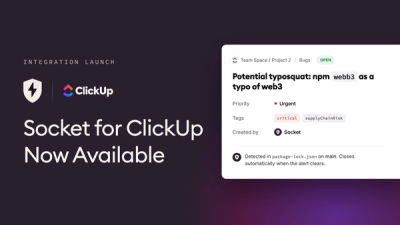
Create ClickUp tasks from Socket alerts, automate ticketing with custom rules, and keep alert and task status synchronized.