
Research
/Security News
Compromised npm Packages in the AsyncAPI Namespace Deliver Miasma Botnet Loader
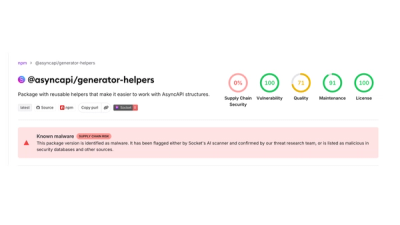
4 compromised asyncapi packages deliver miasma botnet loader on macOS, Linux and Windows.
By Socket Research Team - Jul 14, 2026
argusqa-os
Advanced tools
Argus — AI-powered automated dev-testing platform using Chrome DevTools MCP and Claude Code




Argus catches the bugs your test suite misses — visual regressions, API loops, CSS drift, console noise, accessibility failures, and more — and delivers rich reports to Slack (or a local HTML dashboard).
Quick Start · Features · Setup · MCP Tools · CLI Commands · Troubleshooting · Full Reference
No install required.
npxauto-downloads Argus on first run.
Step 1 — Add to .mcp.json in your project root:
{
  "mcpServers": {
    "chrome-devtools": { "command": "npx", "args": ["-y", "chrome-devtools-mcp@latest"] },
    "argus":           { "command": "npx", "args": ["-y", "argusqa-os"] }
  }
}
Or via Claude Code CLI:
claude mcp add chrome-devtools -- npx -y chrome-devtools-mcp@latest
claude mcp add argus -- npx -y argusqa-os
Step 2 — Start Chrome with remote debugging:
# macOS
open -a "Google Chrome" --args --remote-debugging-port=9222 --headless=new

# Windows (PowerShell)
& "C:\Program Files\Google\Chrome\Application\chrome.exe" --remote-debugging-port=9222 --headless=new --no-sandbox --disable-gpu --user-data-dir="$env:TEMP\chrome-argus"

# Linux
google-chrome --remote-debugging-port=9222 --headless=new --no-sandbox
Step 3 — Run an audit:
Run argus_audit on http://localhost:3000
Argus scans your app and either posts findings to Slack or opens a local report.html. That's it.
32 analysis engines, 149 distinct issue types, zero test-file maintenance:
| Category | What it detects |
|---|---|
| JavaScript | Uncaught exceptions, unhandled promise rejections, console.error on critical routes |
| Network & API | HTTP 5xx, 401/403 auth failures, duplicate API calls (infinite loops), 4xx errors, broken links |
| Performance | LCP > 2500ms, CLS > 0.1, TTFB > 800ms, slow APIs > 1s/3s, payloads > 500KB/2MB, JS bundles > 500KB |
| Accessibility | axe-core (80+ WCAG rules), color-blind simulation, missing ARIA, keyboard focus, heading hierarchy |
| SEO | Missing meta description, OG tags, canonical, viewport, h1 |
| Security | Auth tokens in localStorage/URL, eval(), missing CSP/X-Frame-Options, CSP violations, missing SRI on external scripts, source map exposure, open redirects, npm CVEs |
| CSS | Cascade overrides, component style leaks, unused rules, React inline style conflicts |
| Content | null/undefined as visible text, lorem ipsum, broken images, empty data lists |
| Responsive | Horizontal overflow at 375px/768px, touch targets < 44×44px |
| Memory | Detached DOM nodes via V8 heap snapshot, heap growth across navigation |
| Visual | Pixel-level screenshot regression via pixelmatch (≥0.1% warning, ≥5% critical) |
| Figma | Design-to-implementation fidelity — 13 property types (color, spacing, typography, shadows, etc.) |
| Forms | Missing required, autocomplete, aria-describedby; unlabelled inputs |
| Fonts | FOIT, FOUT, missing fallbacks, slow loads > 1s, suboptimal formats |
| Motion | prefers-reduced-motion violations, autoplay without pause controls |
| Network baseline | New requests, missing requests, status-code regressions vs saved HAR baseline |
| Environment diff | Dev vs staging — screenshot diff, DOM changes, console/network regressions |
And every finding is post-processed with:
| Post-processor | What it adds |
|---|---|
| Intelligent baseline filtering | Findings that flip-flop across runs are tagged noisy and downgraded to info — pure cross-run heuristics, no API calls (ARGUS_NOISE_FILTER=0 to disable) |
| Root cause linking | New findings are annotated with the recent git commits and files most likely to have caused them (ARGUS_ROOT_CAUSE=0 to disable) |
All findings are classified as
critical/warning/infoand routed to the right Slack channel — or surfaced in the local HTML report. For per-finding severity tables and detection methods, see REFERENCE.md.
Default ON. Argus audits your app for secrets and vulnerabilities — so its findings are exactly the data you least want leaving your machine. Aegis redacts them at every external boundary before they cross.
A finding sent to an external sink — an MCP tool response (which lands in the calling agent's context window and transits to that agent's model provider), a Slack message, a GitHub PR comment + its ::error annotations, the hosted/CI HTML report, or CI logs — is reduced to a need-to-know projection: a sensitive finding crosses as its type + route + severity + a 🔒 marker, and never its raw payload (message, evidence, request/response bodies, headers, cookies, stack). URLs are projected with the query string stripped (tokens hide there). A benign finding keeps its message — but that message is still scrubbed for any accidentally-embedded secret or PII.
| Principle | Behavior |
|---|---|
| Local fidelity preserved | The on-disk JSON report and the locally-opened HTML keep 100% detail — redaction only removes detail on the way out |
| Fail-closed | On any classifier error or unknown finding shape, Aegis redacts more, never less |
| Deny-by-default | Only an explicit allowlist of safe fields ever crosses; a new field leaks nothing until deliberately allowlisted |
| 5-layer detection | Category rules ∪ 13 secret regexes ∪ statistical rarity (entropy / token-efficiency) ∪ 7 Luhn-validated PII rules ∪ context boosting |
| Opt-out | ARGUS_REDACT_SENSITIVE=0 → output is byte-identical to pre-Aegis |
This implements the OWASP LLM02:2025 — Sensitive Information Disclosure mitigations (data minimization, redaction, deny-by-default egress filtering) at Argus's own boundaries. An optional, local-only re-hydration vault (ARGUS_REDACT_VAULT=1) can mint reversible, information-free tokens for diff-stable artifacts — re-inflate locally with npm run report:rehydrate. Full behavior change is documented in CHANGELOG.md.
Ask Claude (or any MCP client) — no terminal required:
| Tool | Description |
|---|---|
argus_audit | Fast pass — JS, network, accessibility, SEO, security, CSS, content |
argus_audit_full | Deep pass — adds Lighthouse, responsive checks, memory leak detection, hover-state bugs |
argus_compare | Diff dev vs staging — screenshots, findings delta, environment regressions |
argus_get_context | Capture everything broken on the open tab for Claude to diagnose |
argus_watch_snapshot | Snapshot the open tab without navigating (preserves auth/form state) |
argus_last_report | Return last JSON report without re-running |
argus_design_audit | Figma URL → 13 design-token finding types (color, spacing, typography, shadows, etc.) |
argus_visual_diff | Screenshot baseline comparison. Pass updateBaseline: true to reset. |
argus_pr_validate | Fetch GitHub PR diff → map changed files to affected routes → targeted audit → baseline-aware block decision (blocks on findings the PR introduces) + idempotent PR comment + Check Run → { blocked, findings, baseline, reporting } |
Every tool response is projected through the Aegis egress boundary before it reaches the agent, and carries an optional
redactionrider ({ redacted, total }) when sensitive detail was withheld.
Example prompts:
Run argus_audit on http://localhost:3000/checkout
Run argus_audit_full on http://localhost:3000/dashboard
Run argus_compare
Run argus_get_context
| Requirement | Version |
|---|---|
| Node.js | v20.19+ |
| Chrome | Stable (desktop or headless) |
| Claude Code | Latest (npm install -g @anthropic-ai/claude-code) |
| Slack workspace | Optional — omit for local report.html mode |
No local install needed. Use the Quick Start above, then add your target URL:
# .env in your project root
TARGET_DEV_URL=http://localhost:3000
TARGET_STAGING_URL=https://staging.example.com   # optional — enables argus_compare
Optional — Slack notifications:
chat:write, files:write, files:readxoxb-... token#bugs-critical, #bugs-warnings, #bugs-digest and run /invite @BugBot in eachSLACK_BOT_TOKEN=xoxb-...
SLACK_CHANNEL_CRITICAL=C0000000000
SLACK_CHANNEL_WARNINGS=C0000000001
SLACK_CHANNEL_DIGEST=C0000000002
Without Slack: Argus auto-generates
reports/report.htmland opens it in your browser — zero extra config.
npm install --save-dev argusqa-os
npx argus init   # interactive wizard — detects framework, discovers routes, writes .env
npm run crawl    # run after Chrome is started
git clone https://github.com/ironclawdevs27/Argus.git
cd Argus
npm install
npm run init     # interactive setup wizard
Manual setup (skip the wizard):
cp .env.example .env
# Fill in TARGET_DEV_URL and optional Slack tokens
Then configure your routes in src/config/targets.js:
export const routes = [
  { path: '/',          name: 'Home',      critical: true,  waitFor: 'main' },
  { path: '/login',     name: 'Login',     critical: true,  waitFor: 'form' },
  { path: '/dashboard', name: 'Dashboard', critical: true,  waitFor: '[data-testid="dashboard"]' },
  { path: '/settings',  name: 'Settings',  critical: false, waitFor: null },
];
critical: true — errors on this route go to #bugs-criticalwaitFor — CSS selector Argus waits for before capturing (signals page-ready)npm run chrome # Launch Chrome with --remote-debugging-port=9222 (auto-detects binary)
npm run doctor # Pre-flight check: Chrome reachable, .mcp.json valid, .env has TARGET_DEV_URL
npm run crawl # Batch audit of all configured routes
npm run compare # Dev vs staging diff (CSS-only if no staging URL)
npm run watch # Passive monitor — polls open Chrome tab every 1s
npm run report:html # Generate reports/report.html from last JSON audit
npm run report:pdf # Export HTML report to A4 PDF (requires: npm install puppeteer)
npm run server # Start Slack slash-command server (port 3001)
npm run init # Interactive setup wizard
npm run test:unit # 495 unit tests — no Chrome required
npm run test:harness # 168-block correctness harness — requires Chrome
npm run test:harness:log # same, but tees full output to harness-results.txt
npm run test:coverage # merged unit + harness coverage gate (requires Chrome)
Watch mode — live monitoring as you develop:
# Terminal 1: start your app
npm run dev

# Terminal 2: start Argus watcher
npm run watch
# Ctrl+C → stops monitor and writes reports/report.html
Slack slash command (on-demand from any channel):
/argus-retest https://staging.example.com/checkout
To expose the server via tunnel: cloudflared tunnel --url http://localhost:3001 (free, no account required). Set the resulting URL as the Request URL in Slack App → Slash Commands.
Add to your repo's secrets (Settings → Secrets → Actions):
| Secret | Required | Value |
|---|---|---|
TARGET_STAGING_URL | Yes | Your staging base URL |
SLACK_BOT_TOKEN | No | xoxb-... token (omit for HTML-only mode) |
SLACK_CHANNEL_CRITICAL | No* | Channel ID (needed when Slack is configured) |
SLACK_CHANNEL_WARNINGS | No* | Channel ID |
SLACK_CHANNEL_DIGEST | No* | Channel ID |
GITHUB_TOKEN | No | Auto-injected by Actions for PR comments + Check Runs |
The included workflow runs on push to main, daily at 6 AM UTC, and on manual trigger. If critical issues are found, the pipeline fails.
| Variable | Default | Description |
|---|---|---|
TARGET_DEV_URL | — | Required. Base URL of your dev environment |
TARGET_STAGING_URL | — | Staging URL — enables argus_compare; omit for CSS-only mode |
SLACK_BOT_TOKEN | — | xoxb-... token. Omit for local report.html mode |
SLACK_SIGNING_SECRET | — | For /argus-retest slash command verification |
SLACK_CHANNEL_CRITICAL | — | Channel ID for critical bugs |
SLACK_CHANNEL_WARNINGS | — | Channel ID for warnings |
SLACK_CHANNEL_DIGEST | — | Channel ID for info / daily digest |
PORT | 3001 | Slack slash-command server port |
REPORT_OUTPUT_DIR | ./reports | Where to write JSON reports |
ARGUS_CONCURRENCY | 1 | Parallel MCP clients for route crawling |
ARGUS_LOG_LEVEL | info | trace / debug / info / warn / error |
ARGUS_LOG_PRETTY | — | Set 1 for human-readable logs in dev |
ARGUS_RETRY_ATTEMPTS | 3 | Max retries for navigate/fill MCP calls |
ARGUS_WATCH_INTERVAL_MS | 1000 | Watch mode poll interval (ms) |
ARGUS_WATCH_UI_PORT | 3002 | Watch mode web dashboard port |
ARGUS_SOURCE_DIR | — | App source path — enables env-var / feature-flag / dead-route analysis and framework-aware PR route mapping (import-graph: a changed component/stylesheet → only the routes that render it) |
ARGUS_ENV_FILE | — | Path to app .env for codebase cross-reference |
SCREENSHOT_DIFF_THRESHOLD | 0.5 | Pixel diff % threshold for environment comparison |
GITHUB_TOKEN | — | For PR comments + Check Runs |
GITHUB_REPOSITORY | — | owner/repo format |
GITHUB_PR_NUMBER | — | Auto-injected by Actions from PR context |
ARGUS_CRITICAL_THRESHOLD | 1 | New criticals before blocking merge (0 = never block) |
ARGUS_DIFF_IMAGE_URL | — | Visual diff image URL to embed in PR comment |
OTEL_EXPORTER_OTLP_ENDPOINT | — | OTLP collector for Jaeger / Grafana Tempo |
FIGMA_API_TOKEN | — | Required for argus_design_audit |
FONT_SLOW_MS | 1000 | Slow web font load threshold (ms) |
A11Y_CONTRAST_AA | 4.5 | WCAG AA min contrast ratio for CVD simulation |
ARGUS_REDACT_SENSITIVE | ON | Aegis egress redaction. 0 disables (byte-identical pre-Aegis output) |
ARGUS_REDACT_MODE | mask | Matched-span style: mask / label / hash / token / drop |
ARGUS_REDACT_HTML | off local / ON in CI | 1 redacts the hosted HTML report too |
ARGUS_REDACT_VAULT | OFF | 1 (with ARGUS_REDACT_MODE=token) mints reversible AEGIS_<hmac16> tokens into a local 0600 vault; re-inflate with npm run report:rehydrate |
Chrome DevTools MCP not connecting
claude mcp add chrome-devtools -- npx chrome-devtools-mcp@latest
# Restart Claude Code after adding
Slack messages not posting
xoxb- (not xoxp-, xoxe-, or xapp-)/invite @BugBot in each channelchat:write, files:write, files:readScreenshots are blank
pageSettleMs in src/config/targets.js or add a waitFor selector for the route/argus-retest returns "dispatch_failed"
CSS analysis returns empty results
CI pipeline fails immediately
sleep 3 to sleep 5 in .github/workflows/argus.ymlArgus is a complementary layer, not a replacement for unit or E2E tests:
| Playwright / Cypress | Argus | |
|---|---|---|
| Purpose | Test your logic and API contracts | Catch what the user actually sees |
| What it catches | Regressions in behavior | CSS drift, visual regressions, API loops, console noise, perf budgets |
| When it runs | In your test suite | Continuously, on the live running app |
| Setup | Write test files | Configure routes in targets.js |
| Output | Pass / fail | Structured Slack reports with screenshots |
All 978 harness assertions pass (978/978) — there are currently no known MCP- or Chrome-layer restrictions. Lighthouse now runs in headless (after the lighthouse_audit argument fix); the remaining soft assertions (perf traces, GC-dependent heap-growth) are promoted to counted hard assertions only in the weekly strict-soft lane (harness-strict.yml) via ARGUS_HARNESS_STRICT_SOFT.
src/
  argus.js              — single-page audit entry point
  mcp-server.js         — 9 MCP tools exposed to Claude / any MCP client
  orchestration/        — crawl loop, Slack/GitHub dispatch, env comparison, watch mode
  utils/                — 32 analysis engines (accessibility, security, performance, PDF, recording, etc.)
  adapters/browser.js   — CdpBrowserAdapter — wraps all chrome-devtools-mcp calls
  config/targets.js     — routes, thresholds, auth steps
  cli/
    init.js             — argus init interactive setup wizard
    chrome-launcher.js  — npm run chrome / argus-chrome — launches Chrome with correct flags
    doctor.js           — npm run doctor / argus-doctor — pre-flight checks
    pr-validate.js      — headless CI entry point for GitHub Actions
test-harness/           — 168-block correctness harness, 978 hard assertions, 64 fixture pages
test/unit/              — 495 Vitest unit tests (no Chrome required)
landing/                — Product landing page (React 19 + Vite + Tailwind)
Full source map → CLAUDE.md · MCP/DSL reference → SKILL.md
npm run test:unit — verify without Chrome (495 tests)npm run test:harness — full integration coverage (requires Chrome on port 9222)MIT © ironclawdevs27
Argus Panoptes — the all-seeing giant of Greek mythology who never slept.
FAQs
Argus — AI-powered automated dev-testing platform using Chrome DevTools MCP and Claude Code
The npm package argusqa-os receives a total of 106 weekly downloads. As such, argusqa-os popularity was classified as not popular.
We found that argusqa-os demonstrated a healthy version release cadence and project activity because the last version was released less than a year ago. It has 1 open source maintainer collaborating on the project.
Did you know?

Socket for GitHub automatically highlights issues in each pull request and monitors the health of all your open source dependencies. Discover the contents of your packages and block harmful activity before you install or update your dependencies.
Research
/Security News
4 compromised asyncapi packages deliver miasma botnet loader on macOS, Linux and Windows.
Research
/Security News
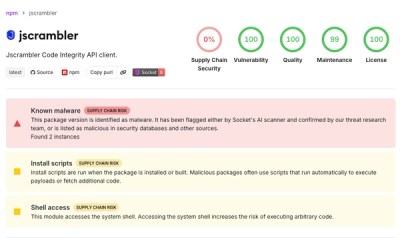
A compromised jscrambler npm release added a malicious preinstall hook that runs hidden native binaries on Linux, macOS, and Windows.
Research
/Security News
A malicious .NET package is typosquatting the Braintree SDK to steal live payment card data, merchant API keys, and host secrets from production apps.