

Product
Socket for Jira Is Now Available
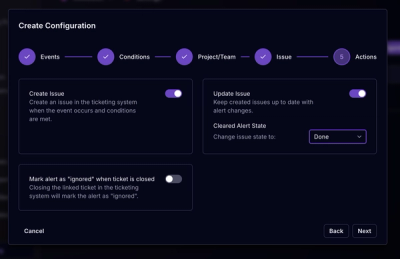
Socket for Jira lets teams turn alerts into Jira tickets with manual creation, automated ticketing rules, and two-way sync.
By Jeppe Hasseriis - Apr 20, 2026
bacon-grunt
Advanced tools
I don't use Grunt anymore, so I don't maintain this package.
Makes for tastier Gruntfiles (not in any way related to Bacon.js)
grunt.registerTask and grunt.initConfig()This add-on requires Grunt 1.x.
If you haven't used Grunt before, be sure to check out the Getting Started guide, as it explains Grunt's inner workings. Once you're familiar with the basics of Grunt, you may install Bacon with this command:
npm install bacon-grunt --save-dev
Once the module has been installed, it may be enabled inside your Gruntfile with this line of JavaScript:
var bacon = require('bacon-grunt')(grunt);
Here's a sample (slightly contrived) Gruntfile enhanced by Bacon:
module.exports = function(grunt) {
  var bacon = require('bacon-grunt')(grunt);
  require('load-grunt-tasks')(grunt); // If you're not using load-grunt-tasks, you should be!

  // grunt.initConfig() is used for global tasks only - the way it should be!
  grunt.initConfig({
    jshint: {
      options: {
        curly: true
      },
      all: {
        src: ['public/js/**/*.js']
      }
    }
  });

  bacon.task('build', [ // Use instead of grunt.registerTask() for multi-step tasks

    'jshint', // Reference tasks the old-fashioned way, or...

    // Adds a `uglify:build` task
    // Also creates an alias as `build:uglify` for better readability
    bacon.subtask('uglify',
      // Second argument of subtask() is the configuration for the task
      // bacon.globFiles() automatically generates an `expand: true` configuration block
      bacon.globFiles('public/js/**/*.js', 'dist/js/', {
        ext: '.min.js'
      }), { // Third argument of subtask() is the `options` object of the configuration
        sourceMap: true
      }),

    // Creates `clean:build` task and `build:clean` alias
    // subtask() uses the second argument as the entire task configuration; it doesn't have to be an object
    bacon.subtask('clean', ['tmp']),

    // For multiple instances of a subtask in a task, you will need more specific names
    // Creates a `copy:buildImg` task and `build:copy:img` alias
    bacon.subtask('copy:img', bacon.globFiles('public/img/**/*.png', 'dist/img/')),

    // `copy:buildIndex`; alias: `build:copy:index`
    bacon.subtask('copy:index', {
      src: 'dist/index.html',
      dest: 'public/index.html'
    }),

    // Can't find a plugin? Just write a quick function to do the job!
    // Equivalent to grunt.registerTask('build:logDone', function() { ... })
    bacon.subtaskCustom('logDone', function() {
      console.log("Done!");
    })
  ]);

  // This whole task is registered like this:
  // grunt.registerTask('build', ['jshint', 'uglify:build', 'clean:build', 'copy:buildImg', 'copy:buildIndex', 'build:logDone']);
};
For comparison, here's the same Gruntfile written without Bacon and load-grunt-tasks (a fellow warrior in the battle against messy Gruntfiles). Notice how you need to scroll back and forth between the grunt.registerTask() calls and the grunt.initConfig() section in order to understand it:
module.exports = function(grunt) {

  grunt.initConfig({

    clean: {
      build: ['tmp']
    },

    jshint: {
      options: {
        curly: true
      },
      all: {
        src: ['public/js/*.js']
      }
    },

    copy: {
      buildImg: {
        expand: true,
        cwd: 'public/img/'
        src: '**/*.png',
        dest: 'dist/img/'
      },
      buildIndex: {
        src: 'dist/index.html',
        dest: 'public/index.html'
      }
    },

    uglify: {
      build: {
        expand: true,
        cwd: 'public/js/'
        src: '**/*.js',
        dest: 'dist/js/',
        ext: '.min.js',
        options: {
          sourceMap: true
        }
      }
    }
  });

  grunt.loadNpmTasks('grunt-contrib-uglify');
  grunt.loadNpmTasks('grunt-contrib-clean');
  grunt.loadNpmTasks('grunt-contrib-copy');
  grunt.loadNpmTasks('grunt-contrib-jshint');

  grunt.registerTask('build:logDone', function() {
    console.log("Done!");
  });

  grunt.registerTask('build', ['jshint', 'uglify:build', 'clean:build', 'copy:buildImg', 'copy:buildIndex', 'build:logDone']);
};
bacon.task(taskName: String, subtasks: [String or BaconSubtask])Registers a new task sequence with the name taskName.
Any BaconSubtasks (created with bacon.subtask(), or bacon.subtaskCustom()) in the subtasks array will be registered with Grunt. In addition, any strings in the subtasks array will be interpreted as the name of a task defined elsewhere.
If only strings are used in the subtasks array, this function is identical to grunt.registerTask(taskName, subtasks).
bacon.subtask(subtaskName: String, config: Object[, options: Object])Returns a BaconSubtask for use with bacon.task().
Example usage:
bacon.task('doThings', [
  // Simple
  bacon.subtask('build', 'allTheThings'),
  // Specific name
  bacon.subtask('clean:tmp', ['tmp']),
  // With options
  bacon.subtask('uglify', {
    src: 'public/**/*.js', dest: 'build'
  }, {
    mangle: false
  })
])
Equivalent vanilla Gruntfile:
grunt.initConfig({
  build: {
    doThings: 'allTheThings'
  },
  clean: {
    doThingsTmp: ['tmp']
  },
  uglify: {
    doThings: {
      src: 'public/**/*.js', dest: 'build',
      options: {
        mangle: false
      }
    }
  }
});

grunt.registerTask('doThings:build', ['build:doThings']);
grunt.registerTask('doThings:clean:tmp', ['clean:doThingsTmp']);
The subtaskName usually refers to the name of a multiTask (e.g. clean, build, and uglify in this example, or copy, less, etc). You can optionally add additional colon-seperated names for additional specificity (e.g. clean:tmp in this example, or copy:img, less:bootstrap, etc). This is sometimes required, since every subtask must have a unique name within the task.
This function will set config as the Grunt configuration for a task with the convention of <multiTask>:<parentTask><Specificiers> (any colons in the subtaskName will be converted to camelcase). The examples above will create Grunt configuration for build:doThings, clean:doThingsTmp, and uglify:doThings tasks, respectively.
If the optional options argument is provided, the value will merged into config with a key of options; see the uglify task in this example.
For more intuitive task names, this function will also create an alias to this task called <parentTask>:<subtaskName>. In this example, the aliases are doThings:build, doThings:clean:tmp, and doThings:uglify respectively.
bacon.subtaskCustom(subtaskName: String, subtask: Function)Returns a BaconSubtask for use with bacon.task().
Example usage:
bacon.task('doThings', [
  // Simple
  bacon.subtaskCustom('build:allTheThings', function() {
    console.log("BUILT ALL THE THINGS");
  })
])
Equivalent vanilla Gruntfile:
grunt.registerTask('doThings:build:allTheThings', function() {
  console.log("BUILT ALL THE THINGS");
});
This mounts the subtask function as a task called <parentTask>:<subtaskName>. Unlike with bacon.subtask(), colons in the subtaskName are left mostly untouched. (In this example, the task is created as doThings:build:allTheThings).
bacon.globFiles(src: String, dest: String[, extras: Object])Returns an Object configuration for building a Files list dynamically.
The src argument will be split between the cwd and src properties of the return object: everything before the first wildcard (*) will be put into cwd.
Optional extras:
exclude: A String or array of Strings representing glob patterns that should not be matched.Any properties in extras will be merged into the result.
Example usage:
bacon.task('build', [
  bacon.subtask('uglify', bacon.globFiles('public/js/**/*.js', 'dist/js', {
    exclude: ['public/js/vendor/**/*.js', 'public/js/jquery.js']
    ext: '.min.js'
  }))
])
Equivalent vanilla Gruntfile:
grunt.initConfig({
  uglify: {
    build: {
      expand: true,
      cwd: ['public/js/', '!vendor/**/*.js', '!jquery.js'],
      src: '**/*.js',
      dest: 'dist/js',
      ext: '.min.js'
    }
  }
});
In lieu of a formal styleguide, take care to maintain the existing coding style. Add unit tests for any new or changed functionality. Lint and test your code using Grunt.
FAQs
Makes for tastier Gruntfiles
We found that bacon-grunt demonstrated a not healthy version release cadence and project activity because the last version was released a year ago. It has 1 open source maintainer collaborating on the project.
Did you know?

Socket for GitHub automatically highlights issues in each pull request and monitors the health of all your open source dependencies. Discover the contents of your packages and block harmful activity before you install or update your dependencies.
Product
Socket for Jira lets teams turn alerts into Jira tickets with manual creation, automated ticketing rules, and two-way sync.
Company News
Socket won two 2026 Reppy Awards from RepVue, ranking in the top 5% of all sales orgs. AE Alexandra Lister shares what it's like to grow a sales career here.

Security News
NIST will stop enriching most CVEs under a new risk-based model, narrowing the NVD's scope as vulnerability submissions continue to surge.