
Product
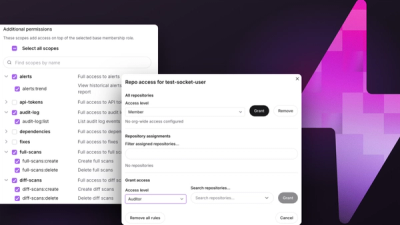
Introducing Repository Access Permissions and Custom Roles
Socket now supports Custom Roles and Repository Access Permissions so organizations can control who can access specific repositories and actions.
By Joe Werle - Jun 19, 2026
Security scanner for OpenClaw AI agents — 100-point audit with auto-fix.



Clawhatch runs 100 automated security checks against your OpenClaw installation, scores it on a 100-point scale (A+ to F), and can auto-fix safe issues. Think of it as npm audit for your AI agent.
npx clawhatch scan
No installation required. Clawhatch auto-detects your OpenClaw installation at ~/.openclaw (or %APPDATA%\openclaw on Windows).
npm install -g clawhatch
# Basic scan — auto-detects your OpenClaw config
clawhatch scan

# Scan with workspace files (SOUL.md, skills, markdown)
clawhatch scan --workspace .

# Deep scan — analyze full session logs (slower)
clawhatch scan --deep

# JSON output for scripting and CI
clawhatch scan --json

# HTML report
clawhatch scan --format html

# Auto-fix safe issues (prompts for behavioral changes)
clawhatch scan --fix

# Custom OpenClaw installation path
clawhatch scan --path /custom/path

# Combine flags
clawhatch scan --workspace . --deep --fix
  Clawhatch Security Scanner v0.1.0

  Clawhatch Security Scan
  ==================================================

  Security Score: 72/100 (B — Acceptable)

  Platform: win32
  OpenClaw: 1.2.0
  Checks: 100 run, 94 passed, 6 findings
  Duration: 842ms
  Scanned: 14 files

  --------------------------------------------------

  HIGH (2 findings)

  ! Gateway auth token is weak
     Auth token is short or low-entropy (< 32 characters)
     Risk: Weak tokens can be brute-forced
     Fix: Generate a strong token: openssl rand -hex 32

  ! Session logs contain potential secrets
     API keys or tokens detected in session log files
     Risk: Secrets persisted in plaintext logs
     Fix: Enable log sanitization and rotate exposed keys

  MEDIUM (3 findings)

  ~ DM policy set to "open"
     Channel accepts messages from any sender
     Risk: Unauthorized users can interact with the agent
     Fix: Set dmPolicy to "allowlist" and configure allowFrom

  ~ No tool rate limiting configured
     Tool execution has no throttle (tools.rateLimit missing)
     Risk: Rapid tool invocation can spam external APIs
     Fix: Set tools.rateLimit in openclaw.json (e.g., 60)

  ~ Session log retention not configured
     No sessionLogTTL set — logs kept indefinitely
     Risk: Stale data accumulation and potential compliance issues
     Fix: Set retention.sessionLogTTL (e.g., 30 days)

  LOW (1 finding)

  - No health check endpoint configured
     Gateway has no monitoring.enabled setting
     Risk: No automated way to verify agent is running correctly
     Fix: Enable monitoring in openclaw.json

  ==================================================

  3 issue(s) can be auto-fixed. Run with --fix
  Run with --json for machine-readable output
  Run with --deep for thorough session log scanning
Clawhatch runs 100 checks across 10 security categories:
| Category | Checks | What It Covers |
|---|---|---|
| Identity & Access | 15 | DM policies, allowlists, pairing config, access groups, OAuth, API key rotation |
| Network Exposure | 10 | Gateway binding, auth mode, TLS, trusted proxies, insecure auth flags |
| Sandbox Configuration | 8 | Sandbox mode, workspace access, Docker isolation, browser host control |
| Secret Scanning | 10 | Hardcoded API keys, .env permissions, secrets in markdown, session log leakage |
| Model Security | 7 | Model config, legacy models, injection resistance, SOUL.md analysis, fallback order |
| Cloud Sync | 1 | iCloud, OneDrive, Dropbox, Google Drive detection |
| Tool Security | 20 | Elevated tools, command injection, Docker socket exposure, audit logging |
| Skill Security | 12 | Untrusted sources, dangerous dependencies, native modules, sandboxing |
| Data Protection | 10 | PII in logs, retention policies, encryption at rest, log rotation |
| Operational | 7 | Logging config, monitoring, git secrets, health checks, dependency staleness |
Clawhatch uses a 100-point scoring system with severity-based penalties:
| Severity | Penalty per finding |
|---|---|
| Critical | −15 points |
| High | −8 points |
| Medium | −3 points |
| Low | −1 point |
Critical cap: Any critical finding hard-caps the score at 40, regardless of calculated total. Fix critical issues first.
| Score | Grade | Label |
|---|---|---|
| 90–100 | A+ | Excellent |
| 80–89 | A | Good |
| 70–79 | B | Acceptable |
| 50–69 | C | Needs Work |
| 30–49 | D | Poor |
| 0–29 | F | Critical |
--fix)When you run clawhatch scan --fix, the scanner applies fixes in two tiers:
Safe fixes — applied automatically:
.env to 600).gitignoreBehavioral fixes — prompts for confirmation:
All fixes create timestamped backups (.bak.<timestamp>) before modifying any file.
--json)clawhatch scan --json > report.json
Outputs a structured ScanResult object:
{
  "timestamp": "2026-02-06T12:00:00.000Z",
  "openclawVersion": "1.2.0",
  "score": 82,
  "findings": [
    {
      "id": "NETWORK-001",
      "severity": "CRITICAL",
      "confidence": "high",
      "category": "Network Exposure",
      "title": "Gateway bound to 0.0.0.0",
      "description": "...",
      "risk": "...",
      "remediation": "...",
      "autoFixable": true,
      "fixType": "behavioral"
    }
  ],
  "suggestions": [],
  "summary": {
    "score": 82,
    "grade": "A",
    "label": "Good",
    "critical": 0,
    "high": 1,
    "medium": 2,
    "low": 0,
    "suggestions": 3,
    "autoFixable": 1
  },
  "filesScanned": 14,
  "checksRun": 100,
  "checksPassed": 97,
  "duration": 1234,
  "platform": "win32"
}
| Code | Meaning |
|---|---|
0 | Scan passed (no critical findings) |
1 | Critical findings detected |
Clawhatch separates output into two groups:
name: Security Audit
on: [push, pull_request]

jobs:
  clawhatch:
    runs-on: ubuntu-latest
    steps:
      - uses: actions/checkout@v4
      - uses: actions/setup-node@v4
        with:
          node-version: '18'

      - name: Run Clawhatch scan
        run: npx clawhatch scan --workspace . --json > clawhatch-report.json

      - name: Check score
        run: |
          score=$(jq '.score' clawhatch-report.json)
          echo "Security score: $score"
          [ "$score" -ge 50 ] || exit 1

      - uses: actions/upload-artifact@v4
        if: always()
        with:
          name: clawhatch-report
          path: clawhatch-report.json
| Platform | Status | Notes |
|---|---|---|
| Windows | ✅ Supported | Full support including %APPDATA%\openclaw detection |
| Linux | 🔄 Coming soon | Core checks work, platform-specific checks in progress |
| macOS | 🔄 Coming soon | Core checks work, platform-specific checks in progress |
clawhatch initGenerate a secure baseline OpenClaw configuration:
clawhatch init
clawhatch init --path /custom/path
Creates a hardened openclaw.json and .env template with secure defaults.
Clawhatch includes a community threat intelligence network. When you share your scan results, they're anonymized and aggregated to protect everyone:
clawhatch scan --share              # Anonymize and share with community
clawhatch scan --upload             # Same as --share
Only check IDs, severity levels, and categories are shared. No file paths, secrets, or descriptions ever leave your machine.
clawhatch threats # View the community threat feed
Shows the top threats across all users, trending attacks, new advisories, and the community average score.
clawhatch subscribe --webhook https://discord.com/api/webhooks/...   # Discord
clawhatch subscribe --webhook https://hooks.slack.com/services/...   # Slack
clawhatch subscribe --threshold CRITICAL                             # Only critical alerts
When a new threat is detected across the community, subscribers are notified instantly via their configured webhook.
clawhatch scan --shareclawhatch scan --json --share--path)Contributions welcome! Please see the GitHub repository for details.
git checkout -b feat/my-check)src/checks/npm testMIT © Clawhatch
FAQs
Security scanner for OpenClaw AI agents — 100-point audit with auto-fix
The npm package clawhatch receives a total of 0 weekly downloads. As such, clawhatch popularity was classified as not popular.
We found that clawhatch demonstrated a healthy version release cadence and project activity because the last version was released less than a year ago. It has 1 open source maintainer collaborating on the project.
Did you know?

Socket for GitHub automatically highlights issues in each pull request and monitors the health of all your open source dependencies. Discover the contents of your packages and block harmful activity before you install or update your dependencies.
Product
Socket now supports Custom Roles and Repository Access Permissions so organizations can control who can access specific repositories and actions.
Product
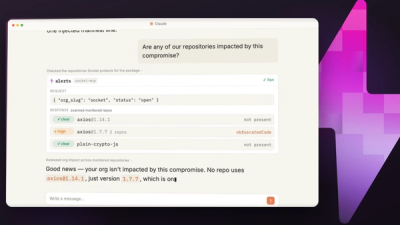
Socket MCP now lets AI assistants review org alerts, investigate threats using the Socket threat feed, and inspect package files in addition to dependency scoring.
Product
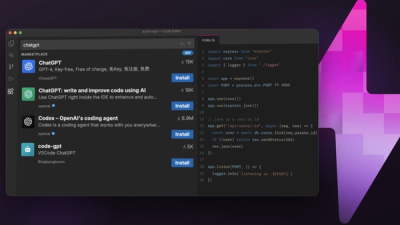
Socket Firewall blocks malicious VS Code and Open VSX extensions before install, protecting developers from compromised editor marketplaces.