

Product
Introducing Reports: An Extensible Reporting Framework for Socket Data
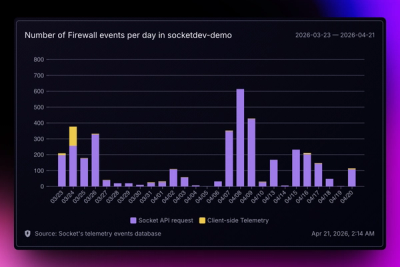
Explore exportable charts for vulnerabilities, dependencies, and usage with Reports, Socket’s new extensible reporting framework.
By André Staltz - Apr 21, 2026
express-jwt-blacklist
Advanced tools


A library designed to be a complementary plugin for express-jwt middleware.
var express = require('express');
var jwt = require('express-jwt');
var blacklist = require('express-jwt-blacklist');
var app = express();
app.use(jwt({
secret: 'my-secret',
isRevoked: blacklist.isRevoked
}));
app.get('/logout', function (req, res) {
blacklist.revoke(req.user)
res.sendStatus(200);
});
var server = app.listen(3000);
npm install express-jwt-blacklist
By default in-memory cache is used to store blacklist data. I do not recommend using this in production and especially if you are dealing with multiple server instances. That's why this library provides two options for a fast key value store:
By passing options you can set the following:
store.type - Store type memory, memcached or redis (default: memory)store.client - Client object, obviates store.host, store.port, store.optionsstore.host - Store host (default: 127.0.0.1)store.port - Store port (default: 11211 memcached, 6379 redis)store.keyPrefix - Key prefix for store to avoid collisions (default: jwt-blacklist:)store.options - Additional store client options (default: {})tokenId - JWT claim unique to user (default: sub)indexBy - JWT claim used for revocation (default: iat), note that purge still uses iatstrict - Strict revocation policy will return revoked true on store failure (default: false)blacklist.configure({
tokenId: 'jti',
strict: true,
store: {
type: 'memcached',
host: '127.0.0.1'
port: 11211,
keyPrefix: 'mywebapp:',
options: {
timeout: 1000
}
}
});
This function it s plug-in for express-jwt revoked tokens function. It will take care of the isRevoked callback and handle the validation internally.
This function will revoke a token, by passing in a token payload skeleton in the req.user format set by the express-jwt library. The lifetime of the revocation entry in the store, can optionally be set explicitly (in seconds), and is otherwise calculated from the exp claim. If no argument is provided and the token is missing the exp claim, the revocation entry will not expire. An optional callback function can be supplied that will be called on error with the error as its only argument.
Typically, the server backend will call this function when a particular route is hit and the token to be revoked is the same one supplied for authentication, i.e. in a logout route initiated by the user in question. Alternatively, the backend can construct a token payload skeleton, which may be useful in a case where an admin user would like to forcibly logout a user from a single session. In the latter case, it may be useful to set the lifetime argument explicitly, as the proper value for the exp claim will likely be unavailable.
By default, revocation is based on the claim specified by tokenId as well as the iat claim, resulting in revocation of only the provided req.user token. The optional index configuration argument allows revocation of all tokens issued for a specific user that share the same value for the specified claim with req.user.
The index argument may be useful if tokens are being refreshed, and you would therefore like to invalidate some, but not all, of the previously issued tokens, e.g. only those from a specific session.
In particular, your token scheme may use the sub claim to represent the user, and the jti claim to represent a session, where the original and all subsequent refreshed tokens contain identical sub and jti claims, but other sessions for the user contain an identical sub claim, but different jti claims. In this scenario, tokenId would be set to sub (the default), and the index should be set to jti. Note that if one user in this scenario is issued a token with a jti claim identical to a token that has been revoked for a different user, it will still not be marked as revoked, as revocation is always based on the tokenId as well as the index argument.
This function will purge all tokens older than current timestamp, by passing in a a token payload skeleton in the req.user format set by the express-jwt library. The lifetime of the revocation entry in the store, can optionally be set explicitly (in seconds), and is otherwise calculated from the exp claim. If no argument is provided and the token is missing the exp claim, the revocation entry will not expire. An optional callback function can be supplied that will be called on error with the error as its only argument.
Typically, the server backend will call this function when a particular route is hit and the tokens to be purged are similar to the one supplied for authentication, i.e. in a password change route initiated by the user in question. Alternatively, the backend can construct a token payload skeleton, which may be useful in a case where an admin user would like to forcibly logout all sessions for a different user. In the latter case, it may be useful to set the lifetime argument explicitly, as the proper value for the exp claim will likely be unavailable.
You can implement your own store by passing store object that implements these two functions:
get(key, callback)set(key, data, lifetime, callback)User object req.user that's being set by the express-jwt library should contain claims matching tokenId and 'indexBy' from configuration.
sub or jti or some other claim in the payload when signing a JWT token to identify a user.exp claim is optional but desired, as it will allow for expiration of revocation entries from the store, increasing the speed of the isRevoked check. Alternatively, a specified lifetime value can be passed to each revoke/purge call by the backend.iat timestamp claim must be present, even if indexBy is set to another claim, so as to allow purge operations to work. iat is also used to calculate token lifetime, if no specified lifetime is set, and exp is present.JSON Web Tokens have many applications. One of the more popular one is using them as a non-persistent session tokens for your web app.
They are signed with a secret phrase or a private key, this makes token verification extremely fast, no database lookups just cryptography. Tokens are being issued once user has been successfully authenticated and contain expiration timestamp, they become invalid once the expiration time is up.
Tokens are usually stored on the client, browser cookie, local storage or some other store. By having a non-persistent session tokens we loose the ability to revoke them once they're out in the wild.
The Open Web Application Security Project states this in the Session Management section
Session Expiration: "When a session expires, the web application must take active actions to invalidate the session on both sides, client and server. The latter is the most relevant and mandatory from a security perspective. In order to close and invalidate the session on the server side, it is mandatory for the web application to take active actions when the session expires, or the user actively logs out."
Privilege Level Change: "The session ID must be renewed or regenerated by the web application after any privilege level change within the associated user session. Previous session IDs have to be ignored, a new session ID must be assigned to every new request received for the critical resource, and the old or previous session ID must be destroyed."
Even without token revocation mechanism, using JWT tokens is considered secure as long as you only send them over secure connection SSL.
User logs out of your web application, we want to invalidate this specific session token on the server so that it can't be used again. blacklist.revoke(req.user)
User password change or permission change, we want invalidate all session tokens older than the time of this event. blacklist.purge(req.user)
The unit tests are based on the mocha module, which may be installed via npm. To run the tests make sure that the npm dependencies are installed by running npm install from the project directory.
npm test
express-jwt-blacklist is an Open Source project maintained by Layer. Feedback and contributions are always welcome and the maintainers try to process patches as quickly as possible. Feel free to open up a Pull Request or Issue on Github.
FAQs
express-jwt plugin for token blacklisting
The npm package express-jwt-blacklist receives a total of 1,881 weekly downloads. As such, express-jwt-blacklist popularity was classified as popular.
We found that express-jwt-blacklist demonstrated a not healthy version release cadence and project activity because the last version was released a year ago. It has 1 open source maintainer collaborating on the project.
Did you know?

Socket for GitHub automatically highlights issues in each pull request and monitors the health of all your open source dependencies. Discover the contents of your packages and block harmful activity before you install or update your dependencies.
Product
Explore exportable charts for vulnerabilities, dependencies, and usage with Reports, Socket’s new extensible reporting framework.
Product
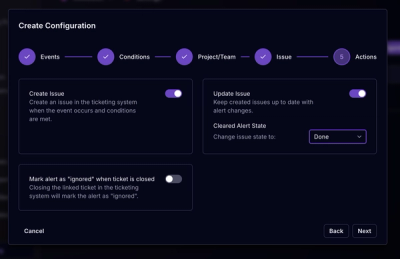
Socket for Jira lets teams turn alerts into Jira tickets with manual creation, automated ticketing rules, and two-way sync.
Company News
Socket won two 2026 Reppy Awards from RepVue, ranking in the top 5% of all sales orgs. AE Alexandra Lister shares what it's like to grow a sales career here.