
Product
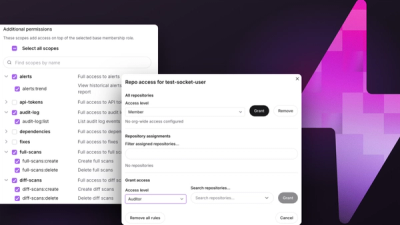
Introducing Repository Access Permissions and Custom Roles
Socket now supports Custom Roles and Repository Access Permissions so organizations can control who can access specific repositories and actions.
By Joe Werle - Jun 19, 2026
figma-plugin-api
Advanced tools
Harness the power of JSON-RPC in your Figma plugin communication.
figma-plugin-api allows you to create an API between your Figma plugin (logic) and plugin UI by defining a set of methods with your business logic. The plugin <-> UI communication is handled by the package using JSON-RPC 2.0 and all you need to do is call your methods asynchronously wherever you need the results.
The plugin is also strongly typed and the methods you pass to the API creators retain their types.
Based on the work of Mathieu Dutour in https://github.com/Lona/figma-jsonrpc
Define your plugin API:
import { createPluginAPI, createUIAPI } from 'figma-plugin-api';
// Create a set of methods that are called from plugin UI and executed in plugin logic
export const api = createPluginAPI({
ping() {
return 'pong';
},
setToken(token: string) {
return figma.clientStorage.setAsync('token', token);
},
getToken() {
return figma.clientStorage.getAsync('token');
}
});
// Create a set of methods that are called from plugin logic and executed in plugin UI
export const uiApi = createUIAPI({
selectionChanged(selection) {
// Display Figma selection in UI
}
});
Use the Plugin API in the UI:
import { api } from './api';

const pong = await api.ping();

await api.setToken('new token');
Use the UI API in the plugin:
// Import methods to use from uiApi
import { uiApi } from './api';

// Show plugin UI with figma.showUI(__html__) etc.

figma.on('selectionchange', () => {
  uiApi.selectionChange(figma.currentPage.selection);
});
NOTE: You must always import the APIs you have created in both the plugin and the UI, even if you aren't calling them. It is necessary so that both modules can handle calls from each other.
If needed, plugin options can be used to set plugin ID, target origins for messages passed between plugin and UI, and adjust timeout for API calls.
NOTE: If you are running a hosted (non-null origin) plugin UI, you must set pluginId to allow messages to be passed between plugin logic and UI.
import { createPluginAPI, createUIAPI, RPCOptions } from 'figma-plugin-api';

import manifest from '../manifest.json';

const pluginOptions: RPCOptions = {
  /**
   * Timeout in milliseconds
   * Default: 3000
   */
  timeoutMs: 5000,
  /**
   * If your plugin UI is hosted (non-null origin), pluginId must be defined to allow messages to be sent
   */
  pluginId: manifest.id,
  /**
   * Specifies what the origin of the plugin UI must be for a message to be dispatched from plugin logic to UI
   * If defined, add 'http://localhost:<port>' to this field in your local environment
   * to allow messaging while running on a dev server
   * Default: '*'
   */
  logicTargetOrigin: 'https://www.your-hosted-plugin.com',
  /**
   * Specifies what the origin of the plugin logic must be for a message to be dispatched from UI to plugin logic
   * Usually 'https://www.figma.com'
   * Default: '*'
   */
  uiTargetOrigin: 'https://www.figma.com'
};

export const api = createPluginAPI(
  {
    ...
  },
  pluginOptions
);

export const uiApi = createUIAPI(
  {
    ...
  },
  pluginOptions
);
FAQs
Harness JSON-RPC in your Figma plugin communication.
The npm package figma-plugin-api receives a total of 2 weekly downloads. As such, figma-plugin-api popularity was classified as not popular.
We found that figma-plugin-api demonstrated a not healthy version release cadence and project activity because the last version was released a year ago. It has 1 open source maintainer collaborating on the project.
Did you know?

Socket for GitHub automatically highlights issues in each pull request and monitors the health of all your open source dependencies. Discover the contents of your packages and block harmful activity before you install or update your dependencies.
Product
Socket now supports Custom Roles and Repository Access Permissions so organizations can control who can access specific repositories and actions.
Product
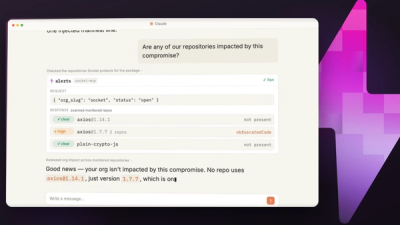
Socket MCP now lets AI assistants review org alerts, investigate threats using the Socket threat feed, and inspect package files in addition to dependency scoring.
Product
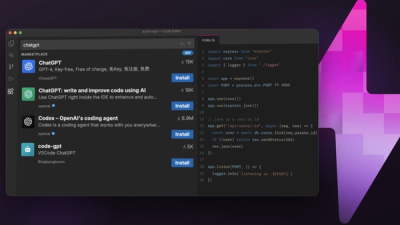
Socket Firewall blocks malicious VS Code and Open VSX extensions before install, protecting developers from compromised editor marketplaces.