
Research
/Security News
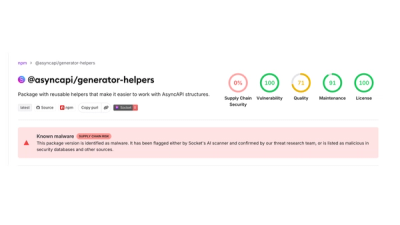
Compromised npm Packages in the AsyncAPI Namespace Deliver Miasma Botnet Loader
4 compromised asyncapi packages deliver miasma botnet loader on macOS, Linux and Windows.
By Socket Research Team - Jul 14, 2026
figma-plugin-react-hooks
Advanced tools
<!--- Do not edit README.md, it is overwritten by the build script. Edit docs/index.md instead. -->
Use Figma selection in your plugin UI via React hooks.
Supports TypeScript.
npm install figma-plugin-react-hooks
You need to import the package in your plugin logic for the React hooks to work, as it sets up the other end of the communication pipeline.
plugin.ts (plugin logic):
// Set up change handlers
import 'figma-plugin-react-hooks';
You can then use the hook in React like any other hook. Note the import from figma-plugin-react-hooks/hook.
React app (plugin UI):
import { FC } from 'react';

import useFigmaSelection from 'figma-plugin-react-hooks/hook';

const SomeComponent: FC = () => {
  const [selection] = useFigmaSelection();

  // Do something with the selection, e.g. display node names
  return <div>{selection.map((node) => node.name).join(', ')}</div>;
};

export default SomeComponent;
The hook can be configured by passing an options object to the hook call.
Important: only one set of options, from the first time the hook is called in your app, will take presence.
It is best to create the hook options as a constant that is imported into each of the files where the hook is used.
constants.ts:
import { FigmaSelectionHookOptions } from 'figma-plugin-react-hooks/hook';

export const selectionHookOptions: FigmaSelectionHookOptions = {
  resolveChildrenNodes: true
};
React app:
import { FC } from 'react';

import useFigmaSelection from 'figma-plugin-react-hooks/hook';

import { selectionHookOptions } from './constants';

const SomeComponent: FC = () => {
  const [selection] = useFigmaSelection(selectionHookOptions);

  ...
};

export default SomeComponent;
Ƭ RPCOptions: Object
| Name | Type | Description |
|---|---|---|
timeoutMs? | number | Timeout in milliseconds Default: 3000 |
pluginId? | string | If your plugin UI is hosted (non-null origin), pluginId must be defined to allow messages to be sent |
logicTargetOrigin? | string | Specifies what the origin of the plugin UI must be for a message to be dispatched from plugin logic to UI If defined, add http://localhost:<port> to this field in your local environment to allow messaging while running on a dev server Default: '*' |
uiTargetOrigin? | string | Specifies what the origin of the plugin logic must be for a message to be dispatched from UI to plugin logic Usually 'https://www.figma.com' Default: '*' |
Ƭ SerializedResolvedNode: SerializedNode<SceneNode> & { ancestorsVisible?: boolean ; children?: readonly SerializedResolvedNode[] }
Ƭ FigmaSelectionHookOptions: Object
| Name | Type | Description |
|---|---|---|
nodeTypes? | ReadonlyArray<SceneNode["type"]> | Only return specific types of nodes. If left undefined, all nodes in the selection will be returned. Default: undefined |
resolveChildrenNodes? | boolean | Resolve children nodes of the selection. If used with nodeTypes, all nodes of the specified types will be returned as a flat array. Default: false |
resolveProperties? | ReadonlyArray<SceneNodePropertyKey> | "all" | Figma node properties are lazy-loaded, so to use any property you have to resolve it first. Resolving all node properties causes a performance hit, so you can specify which properties you want to resolve. If set to [], no properties will be resolved and you will only get the ids of the nodes. Node methods (such as getPluginData) will never be resolved. Default: all |
resolveVariables? | boolean | Resolve bound variables of the selection. Default: false |
addAncestorsVisibleProperty? | boolean | Add ancestorsVisible property to all nodes. This property is true if all ancestors of the node are visible. Default: false |
apiOptions? | RPCOptions | Options for figma-plugin-api Default: see the RPCOptions type |
• Const FIGMA_MIXED: "57999e63-7384-42a1-acf8-d80b9f6c36a7"
Used to replace figma.mixed during JSON serialization
FAQs
Use Figma selection in your plugin UI via React hooks.
The npm package figma-plugin-react-hooks receives a total of 21 weekly downloads. As such, figma-plugin-react-hooks popularity was classified as not popular.
We found that figma-plugin-react-hooks demonstrated a not healthy version release cadence and project activity because the last version was released a year ago. It has 1 open source maintainer collaborating on the project.
Did you know?

Socket for GitHub automatically highlights issues in each pull request and monitors the health of all your open source dependencies. Discover the contents of your packages and block harmful activity before you install or update your dependencies.
Research
/Security News
4 compromised asyncapi packages deliver miasma botnet loader on macOS, Linux and Windows.
Research
/Security News
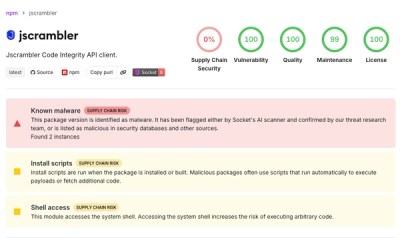
A compromised jscrambler npm release added a malicious preinstall hook that runs hidden native binaries on Linux, macOS, and Windows.

Research
/Security News
A malicious .NET package is typosquatting the Braintree SDK to steal live payment card data, merchant API keys, and host secrets from production apps.