
Product
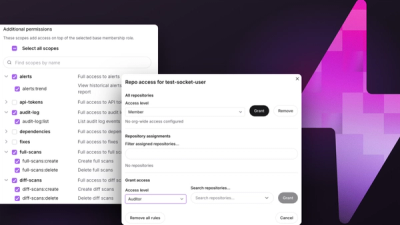
Introducing Repository Access Permissions and Custom Roles
Socket now supports Custom Roles and Repository Access Permissions so organizations can control who can access specific repositories and actions.
By Joe Werle - Jun 19, 2026
An opinionated library that can turn Markdown string into React.ReactNode[].
Markdown with React
It is very common to use Markdown files as a content source (either from CMS or local files) for React applications, for building interactive documentation sites, blogs, knowledge bases, etc. However, many existing Markdown renderers (like marked.js or markdown-it, and many more) focus on converting Markdown to static HTML strings, which has limitations when working with React:
dangerouslySetInnerHTML, which can lead to security vulnerabilities if not handled properly.<Link /> component instead of a standard <a> tag.Why not MDX
MDX is somewhat a popular solution to this problem. In fact, I have been using MDX in some of my projects for a while, the most notable one being MirrorZ Help (GitHub). However, MDX has its own limitations:
VFile, and then you will have to process them through the Retext and/or Remark infrastructure. Then you will have to convert Markdown/MDX to HTML (not exactly, but you get the idea), and then process the HTML (actually it is HAST, but you get the idea) through Rehype infrastructure.eval or new Function (@mdx-js/mdx even exposes new Function via its run and runSync exports).What makes foxmd different
foxmd offers a more straightforward solution that focuses on very specific use cases, so it is way simpler and performant:
marked.js's Tokenizer/Lexer to turn a Markdown string into a series of Tokens, and turns those Tokens directly into React elements, without generating or processing any AST.htmlparser2 (one of the most performant JavaScript-based HTML parsers), foxmd can turn an HTML string into a series of "DOM" Tokens, and then render them into React elements (yes, still no AST here). This not only avoids the need for dangerouslySetInnerHTML, but also allows customization of how HTML tags are rendered.MDXComponents).eval or new Function.useEffect.# npm
npm install foxmd
# yarn
yarn add foxmd
# pnpm
pnpm add foxmd
Turn Markdown string into React elements
import { foxmd, tocArrayToTree } from 'foxmd';
import Link from 'next/link';

export interface MarkdownComponentProps {
  filePath: string;
}

// Example React Server Component that renders Markdown content
export default async function MarkdownComponent({ slug }: MarkdownComponentProps) {
  /** Load your markdown string from file system, CMS, or other sources, in your React Server Component **/
  const markdownString = await fsp.readFile(filePath, 'utf-8');

  const { jsx, toc }: React.ReactNode[] = foxmd(markdownString, {
    // Whether to parse markdown as inline or as block, default to false (block)
    isInline: false,
    // Options for rendering markdown tokens
    foxmdRendererOptions: {
      // Whether to add `suppressHydrationWarning` to all elements, default to false
      // Note that if you override the default render methods, this option no longer applies
      suppressHydrationWarning: false,
      // Define how different markdown tokens should be rendered to React elements
      customRenderMethods: {
        // Here is an example of customizing how the Markdown "link" token is rendered
        link(reactKey: string, href: string, text: ReactNode, title?: string) {
          // You can even strip potentially dangerous links here
          if (href.startsWith('javascript:')) {
            href = '#';
          }
          return <Link key={reactKey} href={href} title={title}>{text}</Link>;
        }
      },
      // Define how different tags should be rendered to React elements.
      // This option is not applied to customized markdown token render method (overridden by `customRenderMethods` above)
      customReactComponentsForHtmlTags: {
        // Here is an example of customizing how `<a>` tag is rendered
        // This is just for demonstration purposes. In real-world usage, since you have already customized the "link" token render method above,
        // This option will not affect links from markdown (if you have "UNSAFE_allowHtml" enabled, links from inline HTML still apply).
        a: (props) => <Link {...props} />
      },
      // Whether to use `htmlparser2` to parse inline HTML and turn them into React elements, default to false
      //Even though foxmd does not use `dangerouslySetInnerHTML`, enabling this option may still introduce XSS security risks
      // if the markdown content is not sanitized properly
      UNSAFE_allowHtml: false
    },
    foxmdParserOptions: {
      // This is a very special option designed to work with Hexo (https://hexo.io/), a Node.js-powered static site generator.
      // Have I ever mentioned that foxmd is opinionated? This is one of those opinions. Default to false, only enable this if you know what you are doing.
      UNSAFE_pickSingleImageChildOutOfParentParagraph: false
    },
    // Options for the Marked.js lexer
    // By default, GFM and Breaks are enabled (opinionated choices), but you can always provide your own options here
    lexerOptions: {},
    // Sometimes Marked.js options are not enough, you may want to provide your own customized Marked.js instance,
    // e.g., enabling some Marked.js extensions/plugins that are not supported via options, and here is where you do it
    // Note that not all Marked.js extensions/plugins are compatible with foxmd, since foxmd only uses the Tokenizer/Lexer from Marked.js
    markedInstance: undefined,

    // Want to work with the Table of Contents (TOC)? No problem, foxmd gets you covered.
    //
    // foxmd has a built-in slugger that handles slug/id generation and collision avoidance out of the box.
    //
    // However, if you want to customize the slug/id generation logic (e.g., working with your existing system),
    // here is where you can provide your own slug/id generation function.
    slugize: (str: string) => {
      // Imagine you have set up a custom slug instance before foxmd() invocation
      //
      // import GithubSlugger from 'github-slugger'
      // const slugger = new GithubSlugger();
      return slugger.slug(str);

      // It is recommended to create one slugger instance per foxmd() call, so collision avoidance only tracks within
      // the current markdown content, which is also the foxmd built-in slugger does.
    }
  });

  // Note that the `toc` is a flat array of headings, with their level, id (already slugified) and text content.
  // Most likely, you will want to convert this flat array into a tree structure.
  // Currently, foxmd does export an opinionated utility `tocArrayToTree`, but you can always write your own transformation if you wish.
  console.log({ tocTree: tocArrayToTree(toc) });

  return (
    <div>
      {/** Since foxmd returns an array of React elements, you can just use it directly in your React component */}
      {jsx}
    </div>
 );
}
Get Pure Text version of the Markdown content
Sometimes you may want to extract the pure text content from a Markdown string. Here are the most notable use cases:
<meta /> description for SEO or OpenGraph purposeAnd foxmd has got you covered:
import { markdownToText } from 'foxmd';

// For the word counter/reading time estimator example, I use the "alfaaz" package here
// It is the fastest word counter library on Node.js with CJK support
import { countWords } from "alfaaz";

const markdownString = `
# Hello World
`;

const textContent = markdownToText(markdownString, {
  // You are already familiar with these options by now
 lexerOptions: {},
 markedInstance: undefined,
  // Whether to SKIP (NOT INCLUDE) code block content when extracting text, default to false
  // Enable this option if you don't want code block content to be included in the text content
  // Inline code (`code`) is always included
 skipCodeBlock: false
});

const wordCount = countWords(textContent);
foxmd © Sukka, Authored and maintained by Sukka with help from contributors (list).
Personal Website · Blog · GitHub @SukkaW · Telegram Channel @SukkaChannel · Twitter @isukkaw · BlueSky @skk.moe · Mastodon @sukka@acg.mn
FAQs
An opinionated library that can turn Markdown string into `React.ReactNode[]`
The npm package foxmd receives a total of 4 weekly downloads. As such, foxmd popularity was classified as not popular.
We found that foxmd demonstrated a healthy version release cadence and project activity because the last version was released less than a year ago. It has 1 open source maintainer collaborating on the project.
Did you know?

Socket for GitHub automatically highlights issues in each pull request and monitors the health of all your open source dependencies. Discover the contents of your packages and block harmful activity before you install or update your dependencies.
Product
Socket now supports Custom Roles and Repository Access Permissions so organizations can control who can access specific repositories and actions.
Product
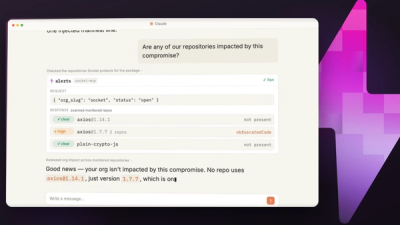
Socket MCP now lets AI assistants review org alerts, investigate threats using the Socket threat feed, and inspect package files in addition to dependency scoring.
Product
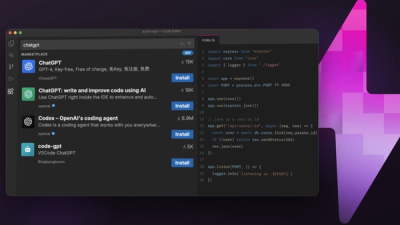
Socket Firewall blocks malicious VS Code and Open VSX extensions before install, protecting developers from compromised editor marketplaces.