git stack
- ✨ Stacked diffs for
git
- 🚀 Simple one-branch workflow
- 🎯 Interactively select commits for each pull request
- 💬 Group commits for focused code review
- 🌐 Use the official GitHub CLI
- ♻️ Automatically synchronize each pull request in the stack
- 💪 Work seamlessly with GitHub's interface
- 🚫 Avoid juggling mutiple branches and complex rebasing
- 📚 Preserve your detailed commit history
- ⚡ Faster, in-memory rebase via
git revise
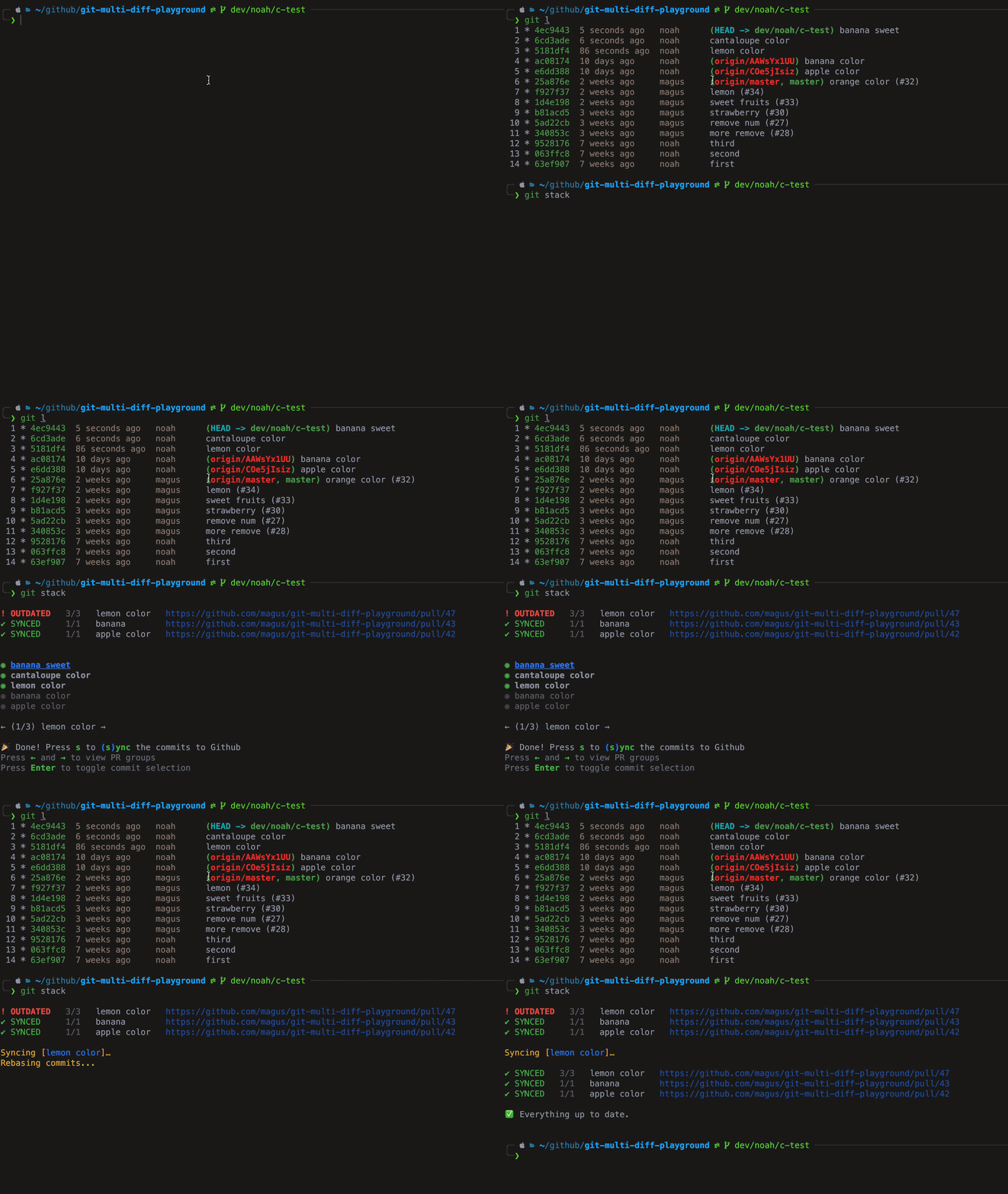
Demo
Install
[!TIP]
Install via Homebrew to ensure the official Github CLI and git revise dependencies are installed automatically
brew install magus/git-stack/git-stack
npm alternative
If you prefer to use npm you will need to install the official Github CLI and git revise dependencies separarely
brew install gh
brew install git-revise

npm i -g git-stack-cli
Usage
git stack
git stack --check
git stack --verbose
git stack --no-verify
git stack help
Adding new commits and pull requests
Adding commits to a PR is as simple as running git stack and adding commits to a PR.
- Run
git stack
- Press
c to create a new PR
- Use
↑↓ and space/enter to navigate and assign commits to the PR
- Press
s to sync created PRs and commits to Github
Base PRs on master branch
By default PRs are stacked based on the order of commits in your branch.
To separate a PR and base it on your master branch press m.
Editing existing commits and pull requests
Sometimes you want to add changes to an existing commit or pull request.
With git-stack this is as simple as amending the commit.
git add -p your changes to the stagegit stack log to find the relative commit number you want to amendgit stack fixup <number> to amend the specific commit with your staged changes.
git add -p
git stack log
git stack fixup 2

Running git stack afterward will update any existing pull requests with your changes.
Syncing with remote
To update your local branch with the latest changes in the remote branch (e.g. master, main)

git stack rebase
Branch names
By default git stack generates a unique identifier and appends it to your local branch name.
For example, if you are locally working in dev/feature-a, PRs branch names will look like dev/feature-a-3cmrMBSUj.
Overriding defaults
git stack has many optional flags to control its behavior.
You can view them by running git stack help and set them as needed.
If you prefer to set them once in your environment, you can use the command below to generate a one-time configuration.
❯ git stack config --draft --force

Add the line below to your shell rc file (.zshrc, .bashrc, etc.)

export GIT_STACK_CONFIG="{\"draft\":true,\"force\":true}"
Copy this environment variable into your shell configuration, e.g. .zshrc, .bashrc, etc.
Why?
The goal of git stack is to combine the simplicity of developing in a single branch in order to preserve your commit history while also grouping commits into pull requests for code review.
Often pushing all your commits to a single pull request is the simplest and fastest approach to development.
This comes at a price, your teammates have to review larger, less related pieces of code and you will lose some of your atomic commit history if you "Squash and merge".
When you decide to break changes up into multiple diffs that depend on one another this process is commonly referred to as stacked diffs (pull requests that depend on other pull requests).
This approach is popular at many major companies such as Twitter, Facebook, etc.
Managing stacked diffs manually involves managing multiple local branches, jumping between them, rebasing, etc.
This process gets even more complicated when you start getting feedback in code review and have to update individual branches.
Managing even a few stacked diffs requires a relatively strong knowledge of git, even with tricks like --update-refs.
How is this different than x
git stack automatically synchronizes each pull request in your stack, as neededgit stack does not create local branches (instead it annotates commits locally with metadata to denote groups of commits, e.g. git-stack-id: E63ytp5dj)ghstack requires rebasing and squashing since each commit creates a pull request, which means you lose commit historygit stack allows developing in a single local branch and selecting groups of commits for each pull requestgit stack adds a clear comment to each pull request in the stack showing the entire stackgit stack does not break if you land pull requests through Github directly, ghstack requires landing from the CLI interfacegit stack uses the official GitHub CLI (gh) instead of personal access tokens
Development
Ensure node --version is the same across both projects you are using to test the git-stack cli
corepack enable

git submodule update --init --recursive
pnpm i
pnpm run dev

node --enable-source-maps ./dist/js/index.js
Build single-file executable
pnpm run compile

./dist/js/with-sourcemaps/git-stack-bun-darwin-arm64 --no-sync
Publishing
[!IMPORTANT]
You must update the version in package.json before running pnpm run release.
DO NOT use npm version or commit the change, the release scripts handle git tags etc.
pnpm run release
pnpm run release:npm
pnpm run release:github
pnpm run release:brew