
Product
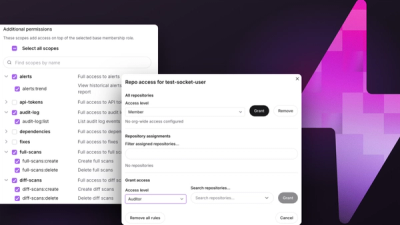
Introducing Repository Access Permissions and Custom Roles
Socket now supports Custom Roles and Repository Access Permissions so organizations can control who can access specific repositories and actions.
By Joe Werle - Jun 19, 2026
kxco-pq-sdk
Advanced tools
Institution identity layer for the KXCO stack — ML-DSA-65 hierarchical credentials, HSM-backed signing, and optional on-chain anchoring via Armature L1.



Institution identity layer for the KXCO stack — ML-DSA-65 hierarchical credentials, HSM-backed signing, and optional on-chain anchoring via Armature L1.
This package is for institutions participating in the KXCO network. Use it when you need to:
If you are building an agent, relay, or encrypted channel, this is not the right package.
npm install kxco-pq-sdk
import { KxcoIdentity, mlDsa } from 'kxco-pq-sdk'

// Institution: generate identity once, store keypair securely
const institution = await KxcoIdentity.create()

// User: generate keypair (e.g. in a browser or mobile app)
const userKeypair = mlDsa.ml_dsa65.keygen()

// Institution: issue a credential after KYC approval
const credential = await institution.issue(userKeypair.publicKey, {
  role:      'verified-user',
  authority: ['sign:transactions'],
  expiresIn: '365d',
})

// User: reconstruct a signing identity from keypair + credential
const userIdentity = KxcoIdentity.fromCredential({ keypair: userKeypair, credential })

// User: sign a document or transaction
const envelope = await userIdentity.attest(
  { action: 'transfer', amount: 1000, currency: 'GBP' },
  { purpose: 'trade-confirmation' },
)

// Verifier: check the full chain offline
const result = KxcoIdentity.verifyChain({
  envelope,
  credential,
  institutionPublicKey: await institution.getPublicKey(),
})
// result.valid, result.role, result.authority, result.issuedBy
KxcoIdentity.create(opts?)Creates an institution (root) identity. Generates a new ML-DSA-65 keypair unless keypair or hsm is supplied.
| Option | Type | Description |
|---|---|---|
keypair | { publicKey, secretKey } | Existing keypair — generated if omitted |
hsm | PqHsm | AuditedHsm | HSM instance for production key storage |
label | string | Required when hsm is provided |
auditLog | AuditLog | Logs identity:created |
chain | KxcoChain | Registers institution on Armature L1 |
metadataUrl | string | Passed to chain registration |
institution.issue(userPublicKey, opts)Issues a signed credential to a user. Institution identities only.
| Option | Type | Description |
|---|---|---|
role | string | Required. e.g. 'verified-user', 'compliance-officer' |
authority | string[] | Default []. e.g. ['sign:transactions'] |
metadata | object | Arbitrary key/value — e.g. Sumsub applicant ID |
expiresIn | string | '365d', '24h', '30m', '60s' |
auditLog | AuditLog | Logs credential:issued |
chain | KxcoChain | Anchors credential on Armature L1 |
Returns a plain JSON object. Serialise and deliver to the user over HTTP.
institution.revoke(userKid, opts?)Revokes a user credential. Institution identities only. Does nothing locally — side effects are the audit log entry and the on-chain revocation.
| Option | Type | Description |
|---|---|---|
reason | string | Optional revocation reason |
auditLog | AuditLog | Logs credential:revoked |
chain | KxcoChain | Anchors revocation on Armature L1 |
KxcoIdentity.fromCredential({ keypair, credential })Reconstructs a user's signing identity from their keypair and a received credential. Returns a KxcoIdentity with role, authority, parentKid, and metadata populated.
identity.attest(data, opts?)Signs arbitrary data and returns a self-contained envelope. data can be a string, Buffer, Uint8Array, or any JSON-serialisable object.
| Option | Type | Description |
|---|---|---|
purpose | string | e.g. 'regulatory-report', 'trade-confirmation' |
aud | string | Intended audience |
exp | string | ISO 8601 expiry |
context | object | Additional fields merged into the envelope |
identity.sign(message)Raw ML-DSA-65 signing. Returns a Uint8Array signature. Prefer attest() for structured envelopes.
identity.verify(envelope)Verifies that this identity signed the envelope. Returns { valid, payload, iss, role, authority, iat, ... }.
KxcoIdentity.verifyChain({ envelope, credential, institutionPublicKey })Verifies the full chain offline: institution signed the credential, user signed the envelope, iss matches userKid, nothing expired.
const result = KxcoIdentity.verifyChain({
  envelope,
  credential,
  institutionPublicKey,  // Uint8Array — fetch from institution's well-known URL
})
// result.valid, result.role, result.authority, result.metadata, result.issuedBy
| Property | Institution | User |
|---|---|---|
kid | 16-hex fingerprint | 16-hex fingerprint |
role | null | e.g. 'verified-user' |
authority | null | string[] |
parentKid | null | institution kid |
credential | null | signed credential object |
metadata | {} | {} |
Import from kxco-pq-sdk. All implement the PqHsm interface.
| Backend | Use case |
|---|---|
MemoryBackend | Testing only — keys are not persisted |
FileBackend | Encrypted JSON file — suitable for server environments without hardware HSM |
Pkcs11Backend | Hardware HSM via PKCS#11 — production institution keys |
AuditedHsm | Wraps any backend and writes every keygen/sign/delete to an AuditLog |
import { KxcoIdentity, AuditedHsm, PqHsm, FileBackend, AuditLog, mlDsa } from 'kxco-pq-sdk'

const logKeypair = mlDsa.ml_dsa65.keygen()
const log        = new AuditLog({ keypair: logKeypair })
const hsm        = new PqHsm(new FileBackend({ path: './institution.json', password: process.env.HSM_PASSWORD }))
const auditedHsm = new AuditedHsm(hsm, log)

const institution = await KxcoIdentity.create({ hsm: auditedHsm, label: 'institution-key' })
Pass a KxcoChain instance from kxco-pq-chain to create, issue, or revoke to anchor operations on Armature L1. The chain parameter is optional on all three methods — omit it to run fully offline. When provided, create calls chain.registerInstitution, issue calls chain.issueCredential, and revoke calls chain.revokeCredential. Credential chain verification via verifyChain is always offline and requires no chain connection.
kxco-pq-chain directly for chain communication| Package | Role |
|---|---|
kxco-post-quantum | ML-DSA-65, ML-KEM primitives |
kxco-pq-attest | Standalone attestation without identity |
kxco-pq-audit | Tamper-evident audit log |
kxco-pq-hsm | HSM backends |
kxco-pq-sdk | This package — institution identity layer |
kxco-pq-chain | Armature L1 chain client |
Cryptography: ML-DSA-65 (NIST FIPS 204) via @noble/post-quantum, independently audited by Cure53 in 2024. No custom cryptography.
To report a vulnerability: security@kxco.ai — do not open a public issue.
Shayne Heffernan and John Heffernan — kxco.ai
Apache-2.0 © 2026 KXCO by Knightsbridge
FAQs
Institution identity layer for the KXCO stack — ML-DSA-65 hierarchical credentials, HSM-backed signing, and optional on-chain anchoring via Armature L1.
The npm package kxco-pq-sdk receives a total of 13 weekly downloads. As such, kxco-pq-sdk popularity was classified as not popular.
We found that kxco-pq-sdk demonstrated a healthy version release cadence and project activity because the last version was released less than a year ago. It has 1 open source maintainer collaborating on the project.
Did you know?

Socket for GitHub automatically highlights issues in each pull request and monitors the health of all your open source dependencies. Discover the contents of your packages and block harmful activity before you install or update your dependencies.
Product
Socket now supports Custom Roles and Repository Access Permissions so organizations can control who can access specific repositories and actions.
Product
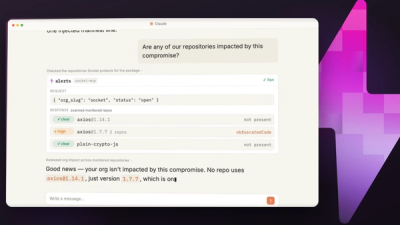
Socket MCP now lets AI assistants review org alerts, investigate threats using the Socket threat feed, and inspect package files in addition to dependency scoring.
Product
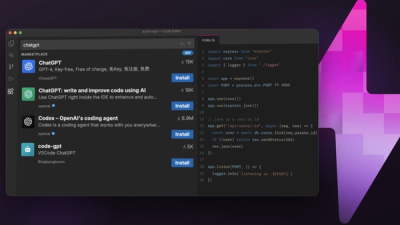
Socket Firewall blocks malicious VS Code and Open VSX extensions before install, protecting developers from compromised editor marketplaces.