
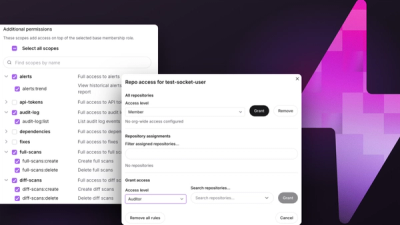
Product
Introducing Repository Access Permissions and Custom Roles
Socket now supports Custom Roles and Repository Access Permissions so organizations can control who can access specific repositories and actions.
By Joe Werle - Jun 19, 2026
MCP server for emulators that speak PINE (PCSX2, and other PINE-compatible emulators) — exposes memory read/write and savestate control




An MCP server for emulators that speak PINE (Protocol for Instrumentation of Network Emulators) — exposes memory read/write and savestate control to MCP-compatible clients (Claude Desktop, Claude Code, etc.).
What you can't do (because PINE itself doesn't expose these):
This makes mcp-pine well-suited for memory inspection, cheat / RAM hunting, savestate automation, and reverse engineering, but not for "play games via Claude." For input + screenshot capability on Game Boy Advance, see the sister project mcp-mgba.
+----------------+ stdio +----------------+ PINE socket +-----------------+
| MCP client | JSON-RPC | mcp-pine | (TCP or Unix) | Emulator |
| (Claude etc.) | -----------> | (Node.js) | ---------------> | (PINE server) |
+----------------+ +----------------+ +-----------------+
mcp-pine opens a loopback connection to the emulator's PINE server (TCP on Windows, Unix domain socket on Linux/macOS) and translates each MCP tool call into a binary PINE message.
| Emulator | Platform | PINE built in? | Default slot |
|---|---|---|---|
| PCSX2 ≥ 1.7 (setup) | PlayStation 2 | ✅ Yes (toggle in settings) | 28011 |
| RPCS3 (setup) | PlayStation 3 | ⚠️ Has IPC with PINE-compatible opcodes — verify before relying on it | varies |
| Duckstation | PlayStation 1 | ⚠️ PINE has been discussed in upstream issues; check current build | varies |
Other emulators implementing the PINE spec should work out of the box once you point mcp-pine at the right slot — open an issue if you've tested one and it works.
npm install -g mcp-pine
Verify with mcp-pine (it prints a startup line and waits for stdio — Ctrl+C to exit).
npx (no install)npx -y mcp-pine
git clone https://github.com/dmang-dev/mcp-pine
cd mcp-pine
npm install        # also runs the build via the `prepare` hook
PINE_SLOT for mcp-pine.That's it — no scripts, no console commands. PINE is always-on once the toggle is set.
RPCS3 has its own IPC implementation that mirrors PINE's opcode set, but the wire-level compatibility hasn't been thoroughly tested with this client. To try it:
PINE_TARGET=rpcs3 PINE_SLOT=<port> mcp-pine.If something doesn't work, please file an issue with details.
Check whether your build of Duckstation includes a PINE server (this varies by version). If yes, set PINE_TARGET=duckstation PINE_SLOT=<port>.
claude mcp add pine --scope user mcp-pine
Verify:
claude mcp list
# pine: mcp-pine - ✓ Connected
Edit claude_desktop_config.json:
| Platform | Path |
|---|---|
| macOS | ~/Library/Application Support/Claude/claude_desktop_config.json |
| Windows | %APPDATA%\Claude\claude_desktop_config.json |
| Linux | ~/.config/Claude/claude_desktop_config.json |
{
  "mcpServers": {
    "pine": {
      "command": "mcp-pine"
    }
  }
}
Restart Claude Desktop after editing.
mcp-pine speaks standard MCP over stdio. Run it and connect any compatible client.
| Env var | Default | Purpose |
|---|---|---|
PINE_TARGET | pcsx2 | Emulator name — used as the prefix in the Unix socket file path on Linux/macOS (<target>.sock.<slot>). Ignored on Windows (TCP only). |
PINE_SLOT | 28011 | PINE slot — also the TCP port on Windows |
PINE_HOST | 127.0.0.1 | Override the host (TCP only) |
PINE_SOCKET_PATH | (auto) | Override the full Unix socket path on Linux/macOS, bypassing automatic resolution |
| Tool | Description |
|---|---|
pine_ping | Verify the connection by querying the emulator version |
pine_get_info | Title, serial (e.g. SLUS-21274), disc CRC, game version, status |
pine_get_status | Just the running/paused/shutdown state |
pine_read8 / pine_read16 / pine_read32 / pine_read64 | Read memory |
pine_read_range | Bulk read up to 4096 bytes (client-side pipelined PINE calls) |
pine_write8 / pine_write16 / pine_write32 / pine_write64 | Write memory (RAM only — ROM writes are silently dropped) |
pine_save_state | Trigger save state to a numbered slot (0-255) |
pine_load_state | Trigger load state from a numbered slot (0-255) |
See docs/RECIPES.md for end-to-end examples (RAM hunting, struct decoding, snapshot-experiment-restore).
| Range | Region |
|---|---|
0x00000000 | EE main RAM (32 MiB) — start here for game data |
0x10000000 | Hardware registers (DMA, GIF, VIF) |
0x11000000 | VU0 / VU1 memory |
0x12000000 | GS privileged registers |
0x1C000000 | IOP RAM (2 MiB) |
0x1F800000 | IOP scratchpad |
0x70000000 | EE scratchpad (16 KiB) |
| Symptom | Cause / Fix |
|---|---|
Cannot reach PINE server | Emulator isn't running, PINE isn't enabled in its settings, or the slot/port doesn't match. Check PINE_SLOT. |
PINE FAIL response (0xFF) | The emulator rejected the request — most often because no game is loaded, or the address is unmapped. |
| Reads return zeros | Address is in an unallocated region. Try 0x00100000 first (almost always inside loaded EE RAM). |
| Tool calls work but values look corrupted | Check endianness expectations — PINE returns little-endian; if you're interpreting strings, use read_range-style byte reads. |
PINE call timed out (10s) from pine_ping after some heavy use | PCSX2's PINE server can wedge. Its request queue is fragile — if a third-party tool pipelines too aggressively (more than ~6 in-flight requests) it silently drops requests, and from then on every reply is mis-aligned with the wrong waiting client. Symptom: even a fresh pine_ping times out. Fix: fully restart PCSX2. Reconnecting alone won't help — the corruption is on the emulator side. |
pine_read_range slower than mGBA's read_range | Expected. PINE has no native bulk read, so we issue calls serially (pipelining can wedge PCSX2 — see above). Loopback TCP is fast enough that this isn't usually a problem: measured ~52 ms for a full 4096-byte read on PCSX2 v2.6.3. For workloads that need lower latency and can tolerate occasional emulator restarts, set PINE_PIPELINE_BATCH=2. |
npm install
npm run dev      # tsc --watch
Quick smoke test against a running PCSX2:
node .scratch/smoke.cjs
FAQs
MCP server for emulators that speak PINE — first-class PCSX2 (PS2) and RPCS3 (PS3), with target-aware tool descriptions, memory r/w, and savestate control
The npm package mcp-pine receives a total of 224 weekly downloads. As such, mcp-pine popularity was classified as not popular.
We found that mcp-pine demonstrated a healthy version release cadence and project activity because the last version was released less than a year ago. It has 1 open source maintainer collaborating on the project.
Did you know?

Socket for GitHub automatically highlights issues in each pull request and monitors the health of all your open source dependencies. Discover the contents of your packages and block harmful activity before you install or update your dependencies.
Product
Socket now supports Custom Roles and Repository Access Permissions so organizations can control who can access specific repositories and actions.
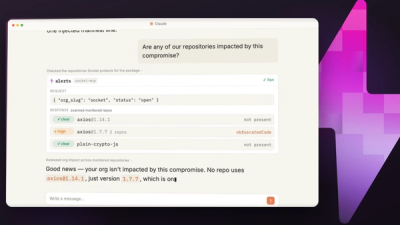
Product
Socket MCP now lets AI assistants review org alerts, investigate threats using the Socket threat feed, and inspect package files in addition to dependency scoring.
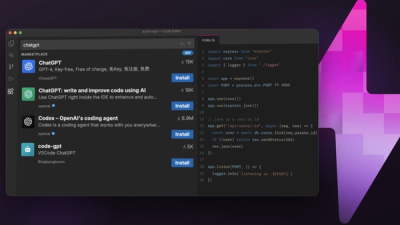
Product
Socket Firewall blocks malicious VS Code and Open VSX extensions before install, protecting developers from compromised editor marketplaces.