
Product
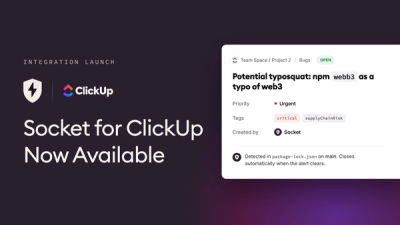
Socket for ClickUp Is Now Available
Create ClickUp tasks from Socket alerts, automate ticketing with custom rules, and keep alert and task status synchronized.
By Jeppe Hasseriis - Aug 26, 2026
Detect upstream API breaking changes, scan your codebase for impact, and open the fix PR.
Dependabot, but for every API you depend on. We watch your upstream API providers for breaking changes, scan your codebase for impact, and open the fix PR before your integration breaks.
This tool is designed for teams that cannot let source code leave their machines. The security model is the product, not a FAQ entry:
payload.js) is whitelist-constructed: provider names, SDK versions, file basenames, line numbers, and symbol names only. Code snippets are structurally impossible to include — the field does not exist in the payload schema. Reporting requires an explicit --report-to flag; it is never on by default.contents:read + pull_requests:write on repos you choose. Never admin.Three components form a closed loop:
| Component | Role | Where it runs |
|---|---|---|
| Watcher | Monitors 20 major API providers (Stripe, OpenAI, Anthropic, Shopify, Twilio, Slack, GitHub, Google, AWS, Plaid, PayPal, Meta, Cloudflare, Vercel, Supabase, Firebase, Notion, HubSpot, Salesforce, SendGrid) via SDK release feeds and official developer changelogs. Classifies each change (breaking / deprecation / additive / fix / docs-only) into a structured SQLite database. | Our infrastructure (or yours, self-hosted) |
| Scanner | Reads the change database, detects which providers your repo actually uses (SDK imports, API hosts, env vars — context-aware, not naive grep), and pinpoints the exact files, lines, and symbols affected by each breaking change. Three-tier confidence scoring plus an optional LLM semantic review pass keeps false positives near zero. | Locally, on your machine or CI |
| Fixer | Applies deterministic migration rule packs (e.g. openai-v3-to-v4, stripe-v7-to-v8) to produce a reviewable diff, then opens a fix PR on a dedicated branch with the official migration guide cited in the commit message. | Locally by default; hosted for paid plans |
Requires Node.js 22+ (uses built-in node:sqlite). Zero npm dependencies.
# Fetch the latest API change feed (the only command that touches the network)
mendapi sync

# Scan the current repo against the breaking-change database (zero config)
mendapi scan

# Or scan a specific repo and save the report
mendapi scan --repo /path/to/your/repo --out impact.json

# Review medium-confidence findings (optional LLM semantic pass)
mendapi review impact.json --pending

# Preview fixes (dry-run: writes a unified diff, changes nothing)
mendapi fix --from-report impact.json

# Create a fix branch + commit + PR-ready description (local only;
# --push is required to actually push, and is never implied)
mendapi pr --repo /path/to/your/repo --from-report impact.json
Running from a checkout? node app/cli.js <command> works identically.
mendapi mcp starts a Model Context Protocol server on stdio — offline-first, zero network: every tool call runs the local CLIs against the local SQLite database only, and the server ships with zero npm dependencies. It speaks the current MCP revision (2026-07-28, per-request _meta version negotiation + server/discover) and keeps full backward compatibility with older clients that use the initialize handshake (2025-06-18 / 2025-03-26) — a dual-era server, because a tool that repairs breaking changes should not ship one.
Claude Code (one line):
claude mcp add mendapi -- npx mendapi mcp
Cursor (or any JSON-configured MCP client) — add to .cursor/mcp.json:
{
  "mcpServers": {
    "mendapi": { "command": "npx", "args": ["mendapi", "mcp"] }
  }
}
Tools exposed: scan, deps, fix, changes — the same schema_version-stamped JSON as the CLI --json flags. See the For AI agents docs page for the full tool catalog and an autonomous-maintenance recipe.
Alert fatigue kills tools like this. Our scanner gates every finding through:
youtube release does not page the team that only uses S3.getR never matches getRelatedArticles.process.env.STRIPE_KEY counts; a regex constant named META_RE does not.Dogfooding across three production repos: the current pipeline reports zero false positives where an earlier naive version produced 27.
Pre-release. Not yet published; API and name subject to change.
AGPL-3.0-only for the CLI (see LICENSE). Chosen so security teams can audit every line that reads code or builds a payload, and so hosted forks must share their changes.
FAQs
Detect upstream API breaking changes, scan your codebase for impact, and open the fix PR.
The npm package mendapi receives a total of 181 weekly downloads. As such, mendapi popularity was classified as not popular.
We found that mendapi demonstrated a healthy version release cadence and project activity because the last version was released less than a year ago. It has 1 open source maintainer collaborating on the project.
Product
Create ClickUp tasks from Socket alerts, automate ticketing with custom rules, and keep alert and task status synchronized.
Product
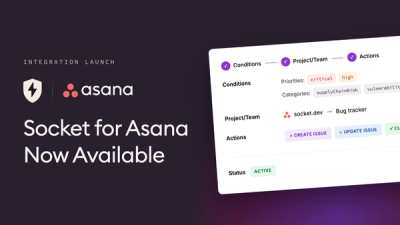
Create and manage Asana tasks directly from Socket alerts, with manual task creation, automated ticketing rules, and two-way sync.

Security News
Open VSX has removed three extension IDs from its malicious-extension list as the legitimate publishers they impersonated move to claim the names for themselves.