
Product
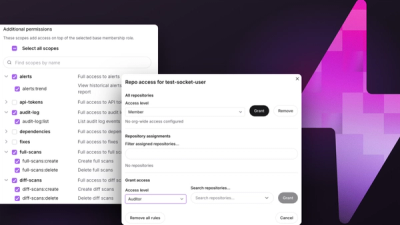
Introducing Repository Access Permissions and Custom Roles
Socket now supports Custom Roles and Repository Access Permissions so organizations can control who can access specific repositories and actions.
By Joe Werle - Jun 19, 2026
react-machine
Advanced tools

When useState or useReducer is not enough, useMachine hook can be used to express more complex component state and business logic. Machines are especially useful for handling asynchronous effects in your components, for example, saving a form.
Features include:
useMachine hook for declaratively describing state machinesstates and transitions between statesreducers and queue effects when transitioningimmediate transitions with guardsinternal transitions for updating state data or queuing effectsinvoke effectsuseReducer and useEffect hooksimport React from 'react'
import { useMachine } from 'react-machine'
const isSuccess = ctx => ctx.item.status === 'success'
const isError = ctx => ctx.item.status === 'error'
const increment = (ctx, data) => ({ ...data, count: data.count + 1 })
const retry = ctx => ctx.retry()
const machine = ({ state, transition, immediate, internal, enter }) => {
state(
'loading',
immediate('counter', { guard: isSuccess }),
immediate('error', { guard: isError })
)
state('error',
transition('retry', 'loading', { effect: retry })
)
state(
'counter',
enter({ assign: { count: 0 } }),
internal('increment', { reduce: increment })
)
}
export function Component({ item, retry }) {
const { state, send } = useMachine(machine, { item, retry })
if (state.name === 'loading') return <div>Loading</div>
if (state.name === 'error') return <button onClick={() => send('retry')}>Retry</button>
return <button onClick={() => send('increment')}>{state.data.count}</button>
}
Also see:
react-machine is very much inspired by XState and Robot - thank you for really great libraries 🙏
Robot is a great Finite State Machine library with integrations into React, Preact, Svelte and more. It has a neat succint API that inspired the API of react-machine and boasts a lightweight implementation. Here are some differences:
react-machine uses a similar DSL, but passes helpers as arguments to the machine creation function or takes them as options. This means you only ever need to import useMachine, which is more akin to how you'd use useState or useReducer for managing state.react-machine (in the upcoming V2) will support arbitrarily nested and parallel states, adhering more closely to the SCXML spec.enter and exit hooks, and does not allow custom effect implementations.react-machine is built with React in mind, it has a special ability to react to context (or prop) changes to drive machine transitions.XState is the most powerful modern state chart / state machine implementation for JavaScript. It's rich in features and supports React and Vue out of the box. Here are some differences:
react-machine strives to create a smaller surface area, less features, less options, less packages. This could be seen as a good or a bad thing depending on your perspective and your requirements. For example, you will not find actors, machine inter messaging, delayed events or history states in react-machine.react-machine, SCXML (and it's interpration algorithm in particular) is only used to guide the implementation of react-machine.react-machine uses a more functional machine declaration DSL that is closer to that found in Robot, whereas XState declares machines using a deeply nested object notation, this might well be a personal preference, give both a try, and also XState might gain new optional DSL adapters in the future.react-machine in the future.react-machine is built with React in mind, it has a special ability to react to context (or prop) changes to drive machine transitions.In summary, react-machine is an experiment in creating a lightweight and flexible solution for component level state management in React. The core machine logic is pure and stateless, which allows for delegating the state storage to useReducer and effect execution to useEffect, done so with concurrent mode compatibility in mind.
Machines are created using the API passed into machine description function, here's an exhaustive example showing all possible types of transitions and hooks:
const { state, send, context, machine } = useMachine(({ state, transition, immediate, internal, enter, exit }) => {
    state(stateName,
      enter({ reduce, assign, invoke, effect }),
      transition(event, target, { guard, reduce, assign, effect }),
      immediate(target, { guard, reduce, assign, effect }),
      internal(event, { guard, reduce, assign, effect }),
      exit({ reduce, assign, effect }),
    )
}, context, options)
When you invoke the useMachine hook it returns machine state, send, context and the constructed machine itself. Typically you'll use state, send and you could use context in case you're passing it down to other components.
State - state consists of name and data (state data). Name is the name of the current state node the machine is in. State data is any data that has been computed using reducers (and assigners) as part of transitioning between states.
Send - this is the main way you will transition machine from one state to another. Send can take the event name, or an event object with key type and arbitrary other keys as payload.
Context - context is passed as the second argument to useMachine and is not to be confused with machine state or machine state data. Context is a little bit like React component props. It's some immutable data that gets passed into every machine hook (such as guard, reduce or effect). Context provides the best way for your machine to utilise component props in machine's business logic. If context changes (or more specifically, any of value of the context object changes), an event of type assign and no payload will be sent into the machine, which will evaluate any guarded immediated transitions and any transitions listening to assign event. This is very useful if you want your machine to change states or update it's state data based on changing context. It is also efficient, since context changes that are not relevant to the current machine state will not trigger any re-renders.
useMachine(description, context, options)Create and initialise the machine.
description - the machine description function invoked with state, transition, immediate, internal, enter, exit and initial as arguments.context - the context to be assigned to the machine's state. Since it's common to pass props and other computed data via context, by default, whenever any of the values of the context change, the hook will send an event of type assign with the context object spread onto the event object, this event can be renamed or disabled in options.options - hook optionsAvailable options:
assign (default: "assign") - the name of the event to be sent when context changes. Set this to false to disable sending the event altogether.areEqual (default: compare object values) - by default all context values are checked for changes on each render. Use this option to customize how equality is computed when comparing the previous context with the new context.Returns { state, send, context, machine }:
state - current state of shape { name, data, final }send - send an event, e.g. send('save') or send({ type: 'save', item: 'x' })context - the same value that was passed in as the context argument to the hookmachine - a stateless machine description that is used internally to compute transitionsconst myMachine = useCallback(({ state, transition, initial }) => {
initial({ x: 0 })
state('a', transition('next', 'b'))
state('b', transition('next', 'c'))
state('c')
}, [])
const {state, send, context, machine } = useMachine(myMachine, { close: props.close })
const { name, data, final } = state
state(name, ...transitions)Declare a state.
name - name of the statetransitions - any number of available: transition(), immediate(), internal(), enter(), exit()state('loading')
state('loading', transition('go', 'ready'))
state('loading', immediate('ready', { guard: ctx => ctx.loaded }))
transition(event, target, options)Declare a transition between states.
event - the name of the event that will trigger this transitiontarget - the name of the target stateoptions - in the shape of { reduce, assign, invoke, effect, guard }transition('save', 'saving')
transition('reset', 'edit', { reduce: (ctx, data) => ({ ...data, value: null }) })
transition('close', 'closing', { effect: ctx => ctx.onClose() })
immediate(target, options)A special type of transition that is executed immediately upon entering (or re-entering a state with an internal transition). If no guard option is used, the transition will always immediately be applied and move the machine to a new state. If the guard option is used, the transition will only be applied if the guard condition passes. Note that, when immediate transitions take place, all of the intermediate transition hooks and intermediate state enter/exit hooks are triggered, however the effects (including invoke) are only executed for the final state, not any of the intermediate states.
target - the name of the target stateoptions - in the shape of { reduce, assign, invoke, effect, guard }immediate('ready')
immediate('ready', { guard: { guard: ctx => ctx.loaded } })
internal(event, options)A special type of transition that does not leave the state and does not trigger any enter/exit hooks. Useful for performing effects or updating context without leaving the state. Note: this transition does re-evaluate all immediate transitions of the state.
event - the name of the event that will trigger this transitionoptions - in the shape of { reduce, assign, invoke, effect, guard }internal('assign', { assign: true })
internal('reset', { assign: { count: 0 } })
enter(options)Hooks to run when entering a state.
options - in the shape of { reduce, assign, invoke, effect }enter({ effect: ctx => ctx.start() })
enter({ invoke: (ctx, data) => ctx.fetch('/item/' + data.id) })
enter({ assign: { count: 0 } })
exit(options)Hooks to run when leaving the state.
options - in the shape of { reduce, assign, effect }exit({ effect: ctx => ctx.stop() })
exit({ assign: { error: null } })
initial(...)A hook for setting initial state and/or initial state data. If initial state name is omitted, the first state node will be used as the initial state. The initial data can be a static object (or any kind of data structure) or a function that takes context and returns the initial data.
initial('loading')
initial('loading', { item: null })
initial('loading', (ctx) => ({ item: ctx.item }))
initial('loading', (ctx) => { item: ctx.item })
initial({ item: null })
initial((ctx) => ({ item: ctx.item }))
initial((ctx) => { item: ctx.item })
guardIf the guard condition fails, the transition is skipped when matching against the event and selection proceeds to the next transition. Commonly used with immediate transitions, but works with any type of transition.
{ guard: (context, data, event) => context.status === 'success' }
reduceUpdated context based on current context and the incoming event.
{ reduce: (context, data, event) => nextData }
{ reduce: (context, data, { type, ...payload }) => nextData }
{ reduce: [reduce1, reduce2] }
assignReturn a partial context update object, that will be immutably assigned to the current context. A commonly useful shortcut for assigning event paylods to the context.
{ assign: (context, data, { type, ...payload }) => ({ ...data , ...payload }) }
{ assign: true } // same as above
{ assign: { some: 'value' } }
{ assign: [assign1, assign2] }
invokeA way to invoke async functions as part of entering a state. If the promise is fulfilled, an event of shape { type: 'done', result } is sent, and if the promise rejects, an event of { type: 'error', error } is sent. Note, if the machine exits the state while the promise is pending, the results will be ignored and no event will get sent. Note, internally, invoke is turned into an effect.
state('save',
  enter({ invoke: async (context, data, event) => context.save() }),
  transition('done', 'show', { assign: (ctx, data, event) => ({ item: event.result }) }),
  transition('error', 'edit', { assign: (ctx, data, event) => ({ error: event.error }) }),
)
effectA way of handling side effects, async effects, subscriptions or activities. Once the state is entered, the effect gets started (in useEffect and only after finalising all of the immediate transitions) and can send any number of events. Note that context will be valid when initially running the effect, but will get stale afterwards. Also note that send will be ignored after the effect is cleaned up, and similarly send can not be used in the cleanup function of the effect.
const addPing = (ctx, data, event) => ({ pings: data.pings.concat(event.ping) })
const listenToPings = (context, data, event, send) => {
  const cancel = context.ponger.subscribe((ping) => {
    send({ type: 'ping', ping })
  })
  return () => cancel()
}

state('save',
  enter({ assign: { pings: [] }, effect: listenToPings }),
  internal('ping', { assign: addPing })
)
FAQs
A lightweight state machine for React applications
The npm package react-machine receives a total of 493 weekly downloads. As such, react-machine popularity was classified as not popular.
We found that react-machine demonstrated a healthy version release cadence and project activity because the last version was released less than a year ago. It has 1 open source maintainer collaborating on the project.
Did you know?

Socket for GitHub automatically highlights issues in each pull request and monitors the health of all your open source dependencies. Discover the contents of your packages and block harmful activity before you install or update your dependencies.
Product
Socket now supports Custom Roles and Repository Access Permissions so organizations can control who can access specific repositories and actions.
Product
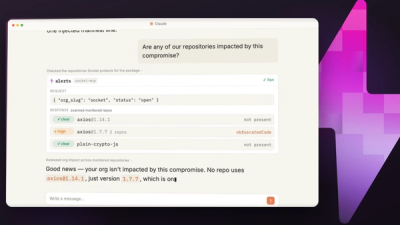
Socket MCP now lets AI assistants review org alerts, investigate threats using the Socket threat feed, and inspect package files in addition to dependency scoring.
Product
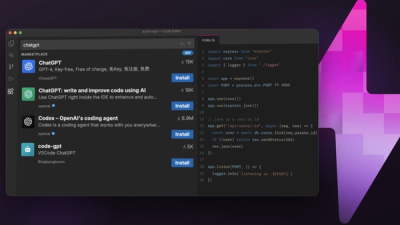
Socket Firewall blocks malicious VS Code and Open VSX extensions before install, protecting developers from compromised editor marketplaces.