
Product
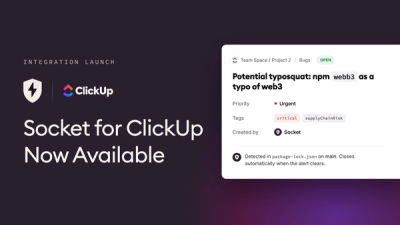
Socket for ClickUp Is Now Available
Create ClickUp tasks from Socket alerts, automate ticketing with custom rules, and keep alert and task status synchronized.
By Jeppe Hasseriis - Aug 26, 2026
Local-first version control for AI work. Savepoint and resume your project state across chats and LLMs.
Never explain your project to an AI twice.
Your chat is a workspace, not an archive. StateArk turns a working session into a versioned, portable project state that any new chat can pick up.
npx stateark
Then quit Claude Desktop completely (Cmd+Q) and reopen it. That is the whole install.
(Not published to npm yet? Install from the folder: npm install && npm run build && npm run setup — see INSTALL.md.)
You:  ...three hours of work...
You:  Savepoint
      -> my-project v0.3 written to ~/StateArk

      (next day, new chat, empty context)

You:  Resume my-project
      -> decisions, constraints, rejected approaches, open questions,
         and the actual files - all current, none of the detours
Local by default. Savepoints are ordinary folders of Markdown, JSON and your real files. Nothing is uploaded. If StateArk disappears tomorrow, you still have everything.
~/StateArk/projects/my-project/v0.3/
  state.md        <- the canonical state, readable in any editor
  state.json
  manifest.json   <- every artifact with its SHA-256
  artifacts/
    app.py
    schema.sql
| In the chat | What happens |
|---|---|
Savepoint | consolidate the session into a new version |
Resume <project> | load the latest state into a fresh chat |
History <project> | list the versions |
Diff <project> | what actually changed between two savepoints |
| In the terminal | |
|---|---|
npx stateark | register with Claude Desktop |
npx stateark report | anonymised local usage summary, printed for you only |
npx stateark remove | unregister; savepoints are kept |
// ... rest unchanged), files that collapsed in size, files the
state describes but never handed over, savepoints identical to their predecessor.
It warns, it never blocks: the savepoint is always written.Node 20+. Claude Desktop, or Claude Code (claude mcp add --transport http ...).
Custom-connector UIs (Claude web, Cowork, ChatGPT web) dial your server from the
vendor's cloud and cannot reach localhost. See INSTALL.md.
Elastic License 2.0. Use it for anything including commercially, read and modify the source, share the package. You may not offer it to third parties as a hosted or managed service. Your savepoints are yours and are not covered by this licence.
ChatGPT / Claude / Gemini-capable MCP client
                 |
                 v
          StateArk Local Agent      <- 127.0.0.1 only, by default
                 |
                 v
        ~/StateArk/projects         <- SOURCE OF TRUTH
                 |
                 | optional
                 v
             Supabase               <- mirror / backup / transport
A Savepoint is an ordinary directory, not a proprietary database:
StateArk/projects/my-project/
  journal.ndjson      # entries recorded since the last savepoint
  project.json        # index (self-healing: rebuilt from disk if corrupt)
  v0.3/
    state.md          # human- and LLM-readable canonical state + integrity warnings
    state.json        # the same state, structured
    meta.json         # version, lineage, platform, sync status, warnings
    manifest.json     # artifacts with SHA-256, stored/pending, carried_forward_from
    journal.ndjson    # the entries this savepoint consolidated
    artifacts/
      app.py
      schema.sql
      prototype.zip
If StateArk disappears, those files remain usable.
Requires Node 20+.
npm install
npm run typecheck
npm test          # 30 checks against a throwaway store — run this first
npm start
No .env is needed for local-only mode. Copy .env.example to .env only if you want
to change the port, the store location, or enable the Supabase mirror.
On first run StateArk generates a random access key and stores it in
~/StateArk/.access-key (mode 0600). The startup banner prints your endpoints:
MCP:         http://localhost:8787/mcp/<key>
Upload page: http://localhost:8787/upload/<key>
Health:      http://localhost:8787/health
The agent is an unauthenticated-by-default local HTTP server, so v0.4 assumes any web page you visit is hostile:
| Control | Default |
|---|---|
| Bind address | 127.0.0.1 (STATEARK_BIND to change) |
| Access key | random per install, in <root>/.access-key, constant-time compared |
Origin header | loopback only, plus STATEARK_ALLOWED_ORIGINS |
Host header | loopback only, plus STATEARK_ALLOWED_HOSTS (DNS-rebinding guard) |
| CORS | echoes the validated origin, never * |
| Upload form | single-use CSRF token, capped body size |
| Non-loopback bind | refuses to start unless the access key is ≥ 24 chars |
Before exposing the agent over HTTPS: set a long STATEARK_ACCESS_KEY, set
STATEARK_ALLOWED_HOSTS to your tunnel hostname, and put a real reverse proxy in front.
Local-first and hosted LLMs are different networking environments. Claude Desktop/Code and
other local MCP clients can talk to the local agent directly. A hosted ChatGPT/Gemini
client generally cannot reach localhost on your computer. For those you need either
(a) a secure HTTPS route to your running local agent, or (b) a StateArk cloud gateway that
reads the synced copy. Do not confuse a cloud container's filesystem with the user's device.
Recommended order for your own testing:
Leave SUPABASE_URL, SUPABASE_SECRET_KEY and STATEARK_OWNER_ID unset. Cloud sync stays
off and files never leave the machine. Default store: ~/StateArk
(override with STATEARK_LOCAL_ROOT).
Run the migrations in the Supabase SQL editor, in order:
supabase/migrations/001_stateark.sqlsupabase/migrations/002_artifacts.sqlsupabase/migrations/003_hardening.sqlThen set SUPABASE_URL, SUPABASE_SECRET_KEY (server-side Secret key, never a
publishable key), STATEARK_OWNER_ID, and STATEARK_STORAGE_BUCKET.
Cloud is a mirror, not the master:
meta.json (disabled / pending / synced / failed);sync_savepoint tool.Text/code artifacts up to 2 MB are mirrored inline in Postgres; everything else goes to the private Storage bucket. The mirror is not end-to-end encrypted. Add client-side encryption before selling a "private encrypted sync" tier.
When you say Savepoint, the host LLM should:
transfer=text;transfer=base64 only when truly available;transfer=pending instead of fabricating it;... rest unchanged.Local creation is atomic: StateArk writes a temporary bundle and renames it only when
complete. Artifact names are sanitised; if a name had to be changed, manifest.json
records the original under original_name.
Every savepoint is compared against its predecessor. Findings are returned in the tool
result and rendered at the top of state.md. The savepoint is always written — a
check never costs you work, it only tells the model to come clean.
| Code | Meaning |
|---|---|
artifact_carried_forward | file was not re-submitted and not declared deleted, so it was copied from the previous version |
artifact_became_pending | content that was stored is now only pending |
artifact_shrank | file collapsed to under 50% of its previous size |
truncation_marker | stored text contains ... rest unchanged, [...], … gekürzt and similar |
no_change | this savepoint is identical to the previous one |
journal_not_reflected | decisions were journalled but the submitted state lists none |
note_event records one short line per turning point, silently, and only for projects
that already exist in StateArk. Untracked projects return tracked: false and nothing is
written — that is the filter that keeps scratch conversations out.
At the next Savepoint the journal is consolidated into the new version and cleared. It is never cleared before the savepoint is durably on disk.
Inspect pending entries with the journal tool. Nudging is based on entry count
(STATEARK_JOURNAL_NUDGE_AT, default 20), never on a timer.
diff_savepoints with no version arguments compares the latest savepoint against its
predecessor: LCS line diff on the text fields, set diff on the lists, SHA-256 comparison on
the artifacts, plus an attention block for anything that looks like silent loss.
Every stored artifact has a SHA-256. Pending files are explicit in manifest.json and in
the resume_project output, so the LLM cannot quietly pretend a file exists.
If a binary cannot travel through MCP, open the local upload page printed at startup and attach it to the existing project/version. This resolves the pending manifest entry.
Resume My Project returns state.md plus the artifact manifest. The LLM calls
get_artifact for exact text only when needed. For binaries it gets the verified local
path and hash rather than invented content.
localhost. Expose the agent
through an authenticated HTTPS route (and set STATEARK_ALLOWED_HOSTS), or build the
cloud gateway. Do not solve this by moving the source of truth into an ephemeral cloud
filesystem.Free / Local: unlimited Savepoint, Resume, History, artifacts, open format, no account.
Pro / Sync (future): cloud backup, multi-device continuity, remote Resume, and the web/mobile gateway that makes cross-platform continuity actually work.
Note that "sync a folder" alone is weak as a paid tier — the format is open files, so a user
can point Dropbox or git at ~/StateArk and get it for free. The defensible paid surface is
the remote gateway (reaching your state from a hosted LLM), not storage.
StateArk's promise: Local by default. Continue anywhere when you choose to sync.
FAQs
Local-first version control for AI work. Savepoint and resume your project state across chats and LLMs.
The npm package stateark receives a total of 392 weekly downloads. As such, stateark popularity was classified as not popular.
We found that stateark demonstrated a healthy version release cadence and project activity because the last version was released less than a year ago. It has 1 open source maintainer collaborating on the project.
Product
Create ClickUp tasks from Socket alerts, automate ticketing with custom rules, and keep alert and task status synchronized.
Product
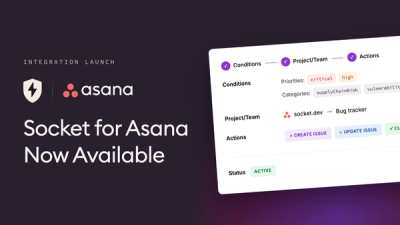
Create and manage Asana tasks directly from Socket alerts, with manual task creation, automated ticketing rules, and two-way sync.
Security News
Open VSX has removed three extension IDs from its malicious-extension list as the legitimate publishers they impersonated move to claim the names for themselves.