
Research
/Security News
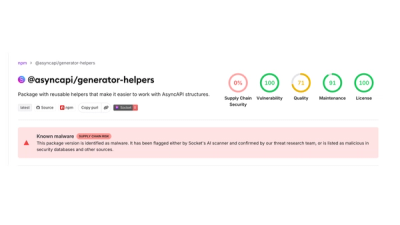
Compromised npm Packages in the AsyncAPI Namespace Deliver Miasma Botnet Loader
4 compromised asyncapi packages deliver miasma botnet loader on macOS, Linux and Windows.
By Socket Research Team - Jul 14, 2026
staticsearch
Advanced tools
StaticSearch is a simple search engine you can implement on a static website.
An indexer scans your site's built files to generates a directory of JavaScript and JSON data. A search facility is then available on that site without the need for server-side processing or a database.
It currently works best on English language sites, but most Western languages can be used.
This is a functional beta project. Use it at your own risk.
Assuming your static site has been generated in a sub-directory named ./build/, run StaticSearch using:
npx staticsearch
It will create a new directory named ./build/search/ containing JavaScript code and word index data.
If your site is in a different directory, such as ./dist/, use:
npx staticsearch --builddir ./dist/ --searchdir ./dist/search/
A web component is provided so you can easily add a search facility to your web page HTML, e.g.
<script type="module" src="/search/staticsearch-component.js"></script>

<static-search title="press Ctrl+K to search">
  <a href="https://duckduckgo.com/?q=search%20site:mysite.com">search</a>
</static-search>
Any HTML element can be placed inside <static-search> to activate the search when it's clicked. In this example, a link has been provided to a search engine when JavaScript fails or is not available.
Several JavaScript-only static search options are available, but:
StaticSearch offers a simpler indexing process and generates minimal code.
13Kb of JavaScript and 4Kb of CSS is provided for the web component. Sites just using the bind module require 8Kb of JavaScript. Sites directly using the API require 6Kb of JavaScript.
A typical 100 page site is indexed in less than one second and generates 100Kb of word data.
A typical 1,000 page site is indexed in less than six seconds and generates 800Kb of word data.
Index data is incrementally loaded on demand as you search for different words. Indexes are cached in IndexedDB so results appear faster the more searches you do.
StaticSearch weights words according to their location in headings, content, links etc. To keep it lightweight, it does not store full text indexes or other factors, but the results work well on smaller sites.
Run the StaticSearch indexing process whenever your site content changes. It would typically be done just before or as part of a deployment process.
During indexing, StaticSearch extracts words from all the HTML files in a build directory (./build/). By default, it:
does not index any file matching a Disallow: /some-directory/ line in robots.txt where it's defined below User-agent: * or User-agent: staticsearch.
does not index any file with a noindex meta tag, e.g. <meta name="robots" content="noindex"> or <meta name="staticsearch" content="noindex">.
only examines words contained in the <main> HTML element.
removes words contained in <nav> HTML elements (within <main>).
A new directory (./build/search/) is created that contains:
StaticSearch can be configured using CLI arguments, environment variables, or a Node.js API. The following parameters are available:
| CLI | ENV | API | description |
|---|---|---|---|
env | load defaults from an .env file | ||
builddir | BUILD_DIR | .buildDir | directory containing static files (./build/) |
searchdir | SEARCH_DIR | .searchDir | index file directory (./build/search/) |
domain | SITE_DOMAIN | .siteDomain | site domain if links use full URL (http://localhost) |
root | BUILD_ROOT | .buildRoot | site root path (/) |
indexfile | SITE_INDEXFILE | .siteIndexFile | default index file (index.html) |
ignorerobotfile | SITE_PARSEROBOTSFILE | .siteParseRobotsFile | parse robot.txt Disallows (true) |
ignorerobotmeta | SITE_PARSEROBOTSMETA | .siteParseRobotsMeta | parse robot meta noindex (true) |
dom | PAGE_DOMSELECTORS | .pageDOMSelectors | comma-separated content DOM nodes (main) |
domx | PAGE_DOMEXCLUDE | .pageDOMExclude | comma-separated DOM nodes to exclude (nav) |
language | LANGUAGE | .language | language (en) |
wordcrop | WORDCROP | .wordCrop | crop word letters (7) |
stopwords | STOPWORDS | .stopWords | comma-separated list of stop words |
weightlink | WEIGHT_LINK | .wordWeight.link | word weight for inbound links (5) |
weighttitle | WEIGHT_TITLE | .wordWeight.title | word weight for main title (10) |
weightdesc | WEIGHT_DESCRIPTION | .wordWeight.description | word weight for description (8) |
weighth2 | WEIGHT_H2 | .wordWeight.h2 | word weight for H2 headings (6) |
weighth3 | WEIGHT_H3 | .wordWeight.h3 | word weight for H3 headings (5) |
weighth4 | WEIGHT_H4 | .wordWeight.h4 | word weight for H4 headings (4) |
weighth5 | WEIGHT_H5 | .wordWeight.h5 | word weight for H5 headings (3) |
weighth6 | WEIGHT_H6 | .wordWeight.h6 | word weight for H6 headings (2) |
weightemphasis | WEIGHT_EMPHASIS | .wordWeight.emphasis | word weight for bold and italic (2) |
weightalt | WEIGHT_ALT | .wordWeight.alt | word weight for alt tags (1) |
weightcontent | WEIGHT_CONTENT | .wordWeight.content | word weight for content (1) |
version | show application version | ||
help | show help | ||
helpenv | show .env/environment variable help | ||
helpapi | show Node.js API help |
The build directory (builddir|BUILD_DIR|.buildDir) is an absolute or relative path to the directory where static website files are built.
The search directory (searchdir|SEARCH_DIR|.searchDir) is an absolute or relative path to the directory where the search JavaScript and JSON data files are generated. This will normally be inside the build directory.
If your pages use links with fully qualified URLs, you should set a domain (domain|SITE_DOMAIN|.siteDomain) so they can be identified.
The web root path is presumed to be /, so the file named ./build/index.html is your home page. You can set it to another path, such as /blog/ if necessary (root|BUILD_ROOT|.buildRoot). The file at ./build/index.html is then presumed to have the URL http://site.com/blog/index.html (or http://site.com/blog/).
The HTML index file used as the default for directory paths is presumed to be index.html. You can change this to another filename if necessary (indexfile|SITE_INDEXFILE|.siteIndexFile).
StaticSearch parses the robots.txt file in the root of the build directory and will not index any HTML file matching a Disallow: /some-directory/ line below User-agent: * or User-agent: staticsearch. This can be disabled by setting --ignorerobotfile|SITE_PARSEROBOTSFILE=false|.siteParseRobotsFile=false.
StaticSearch parses HTML meta tags and will not index any HTML file where content="noindex" in <meta name="robots"> or <meta name="staticsearch">. This can be disabled by setting --ignorerobotmeta|SITE_PARSEROBOTSMETA=false|.siteParseRobotsMeta=false.
The dom|PAGE_DOMSELECTORS|.pageDOMSelectors value defines a comma-delimited list of CSS DOM selectors to index on the page. The default is main, but you can set it to anything else, e.g. article.primary,footer,.other.
The domx|PAGE_DOMEXCLUDE|.pageDOMExclude value defines a comma-delimited list of CSS DOM selectors to exclude from the dom|PAGE_DOMSELECTORS|.pageDOMSelectors. The default is nav, but you can set it to anything else, e.g. nav,aside,.private.
The default language|LANGUAGE|.language is English (en). This provides stemming and stop word lists to reduce the size of the index and provide fuzzier searching. Setting any other language indexes every word without stemming or stop words.
By default, wordcrop|WORDCROP|.wordCrop is set to 7: only the first 7 letters of any word are considered important. Therefore, the word "consider", "considered", and "considering" are effectively identical (and indexed as conside). You can change this limit if necessary.
You can add further stop words (words omitted from the index) using stopwords|STOPWORDS|.stopWords. For example, if your site is about "Acme widgets", it's probably mentioned on every page. The words are of little use in the search index so set the stop words acme,widget.
The weight values define the score allocated to a word on a page and can be configured to your preferences. If PageX contains the word "static" in the title, description meta tag, and an H2, it will score 10 + 8 + 6 = 24 for that word. Someone searching for "static" would see it above any page scoring 23 or lower.
In addition, every page linking to PageX using the word "static" will add a further 5 points to the score. Lots of inbound links therefore override mentions in titles and text. It's best to omit menus from indexing since they will link to most pages (domx|PAGE_DOMEXCLUDE|.pageDOMExclude is set to nav).
There is no need to install StaticSearch since you can use npx.
View CLI help:
npx staticsearch --help
To use the CLI, run:
npx staticsearch [options]
where CLI [options] are listed above. For example, index the ./dist/ directory, omitting nav and .private DOM nodes, with an inbound link weight of 20:
npx staticsearch --builddir ./dist/ --searchdir ./dist/search/ --domx nav,.private --weightlink 20
Note you can install StaticSearch globally if you intend using it on several sites:
npm install staticsearch -g
You can then run it without npx:
staticsearch [options]
You can set indexing options with environment variables (as listed above).
View environment variable help:
npx staticsearch --helpenv
It may be easier to define variables in an .env file, e.g.
# Example .env file
BUILD_DIR=./dest/
SEARCH_DIR=./dest/index/
PAGE_DOMEXCLUDE=nav,.private
WEIGHT_LINK=20
then load it using:
npx staticsearch --env .env
Note that CLI arguments take precedence over environment variables.
You can include StaticSearch within any Node.js project and configure it using JavaScript code to set properties (as listed above). This may be practical if you want to make StaticSearch an integral part of your build process.
View Node.js API help:
npx staticsearch --helpapi
Install the module into a Node.js project:
npm install staticsearch
Add code to a Node.js file (such as index.js):
// EXAMPLE CODE
import { staticsearch } from 'staticsearch';

// configuration
staticsearch.buildDir = './dest/';
staticsearch.searchDir = './dest/index/';
staticsearch.pageDOMExclude = 'nav,.private';
staticsearch.wordWeight.link = 20;

// run indexer
await staticsearch.index();
Then run it:
node index.js
When a value is not defined, StaticSearch falls back to an environment variable then the default value.
StaticSearch provides three options for implementing search on your site. This can be achieved in HTML alone unless you want to implement your own JavaScript functionality.
The following examples assume the search index files have been generated in the static site's /search/ directory.
The <static-search> web component provides full search functionality in any web page:
<!-- include script once on your page -->
<script type="module" src="/search/staticsearch-component.js"></script>

<!-- define web component -->
<static-search title="press Ctrl+K to search">
  <p>search</p>
</static-search>
A single inner element is required that can be clicked to activate the search. It opens a modal dialog with an input field and list of results.
The following attributes can be added to the <static-search> element:
title="<string>" - activation instructions (clicking and Ctrl|Cmd + K is supported)label="<string>" - the label on the search <input>minscore="<num>" - only show pages with total relevancy scores of this or above on resultsmaxresults="<num>" - show up to this number of pages on the resultsThe web component uses the bind module so it provides the same functionality.
A message is shown at the top of results with the following HTML:
<p part="resultmessage">
<span part="resultcount">0</span> found for
<span part="searchterm"></span>…
</p>
You can override this using a <template> with an ID of staticsearch_resultmessage in your HTML page (it can be within <static-search> or anywhere else). It can set the part attributes "resultmessage", "resultcount", and "searchterm" as necessary, e.g.
<template id="staticsearch_resultmessage">

  <p part="resultmessage">
    Static search found
    <span part="resultcount">0</span> results
    for <span part="searchterm"></span>.
  </p>

</template>
Search results are shown in an ordered list <ol part="searchresult">. The following HTML is used for each item:
<li part="item">
  <a part="link">
    <h2 part="title"></h2>
    <p part="description"></p>
  </a>
</li>
You can override this using a <template> with an ID of staticsearch_item in your HTML page (it can be within <static-search> or anywhere else). It can set the part attributes "item", "link", "title", and "description" as necessary, e.g. show the title but no description in an <article>:
<template id="staticsearch_item">

  <li part="item">
    <article>
      <h2 part="title"><a part="link"></a></h2>
    </article>
  </li>

</template>
The following CSS custom properties (variables) can be set in the :root or any element containing <static-search>. The defaults are shown below. Light/dark themes will be followed presuming your CSS sets color-scheme: light dark;, color-scheme: light;, or color-scheme: dark; accordingly.
:root {
  /* font size */
  --staticsearch-fontsize: 1em;

  /* modal dimensions */
  --staticsearch-maxwidth: 60ch;
  --staticsearch-margin: 3vmin;
  --staticsearch-padding: 2vmin;
  --staticsearch-fieldset-height: calc(3em + (2 * var(--staticsearch-padding)));

  /* colors */
  --staticsearch-color-back: Canvas;
  --staticsearch-color-border: ButtonFace;

  --staticsearch-color-fore: CanvasText;
  --staticsearch-color-dim: color-mix(in oklab, CanvasText 70%, Canvas);

  --staticsearch-color-link: color-mix(in oklab, LinkText 70%, CanvasText);
  --staticsearch-color-visited: color-mix(in oklab, VisitedText 70%, CanvasText);

  --staticsearch-color-shadow: #000;
  --staticsearch-color-backdrop: color-mix(in srgb, var(--colshad0), transparent 30%);
  --staticsearch-backdrop-blur: 3px;
}
Alternatively, you can target static-search elements and part selectors, e.g.
static-search {

  /* modal dialog */
  &::part(dialog) {
    border: 5px solid #f00;
  }

  /* input */
  &::part(searchlabel) {
    text-transform: uppercase;
  }

  &::part(searchinput) {
    font-family: monospace;
  }

  /* results */
  &::part(results) {
    font-style: italic;
  }

  &::part(resultmessage) {
    font-size: 1.5em;
  }

  &::part(description) {
    font-size: 0.8em;
  }

}
The JavaScript bind module can automatically or programmatically attach StaticSearch functionality to an HTML <input> and a result element. It provides functionality to handle:
The module's used by the web component so the processes are similar.
The following example automatically binds input and results elements without further code:
<!-- include script once on your page -->
<script type="module" src="/search/staticsearch-bind.js"></script>

<!-- define input and result elements -->
<search>

  <input type="search" id="staticsearch_search">
  <div id="staticsearch_result"></div>

</search>
As shown above, you can set your own HTML <template>s and style anything as you like:
<search>

  <input type="search" id="staticsearch_search">
  <div id="staticsearch_result"></div>

  <!-- custom result message -->
  <template id="staticsearch_resultmessage">
    <p part="resultmessage">
      Static search found
      <span part="resultcount">0</span> results
      for <span part="searchterm"></span>.
    </p>
  </template>

  <!-- custom result output -->
  <template id="staticsearch_item">
    <li part="item">
      <article>
        <h2 part="title"><a part="link"></a></h2>
      </article>
    </li>
  </template>

</search>
Alternatively, you can programmatically bind input and result elements. This may be useful if you're using a client-side framework to dynamically create content. Consider the HTML:
<search>

  <input type="search" id="mysearch">
  <div id="myresult"></div>

</search>
you can bind the elements to StaticSearch in JavaScript:
import { staticSearchInput, staticSearchResult } from '/search/staticsearch-bind.js';

staticSearchInput( document.getElementById('mysearch') );
staticSearchResult( document.getElementById('myresult') );
staticSearchInput() has a single parameter with the input element.
staticSearchResult() has the following parameters:
element - the result element (required)minScore - only show pages with total word scores of this or above on resultsmaxResults - show up to this number of pages on the resultsresultElement - the outer list element (defaults to ol)messageTemplate - a DOM <template> configuring the results messageitemTemplate - a DOM <template> configuring a result itemYou can implement whatever input and output functionality or styling you require by directly using the StaticSearch JavaScript API. The .find() method returns an array of results for a specific search term:
import { staticsearch } from '/search/staticsearch.js';

const result = await staticsearch.find('some search query');
/*
Returns an array of page objects sorted by relevancy. Example:
[
  {
    "id": 42,
    "url": "/news/search-engine-optimization/",
    "title": "Do Publican sites rank better?",
    "description": "Do static sites rank better in search engines?",
    "relevancy": 21
  },
  {
    "id": 55,
    "url": "/docs/recipe/feeds/txt-sitemap/",
    "title": "Create a text sitemap",
    "description": "How to output a list of all pages for search engines.",
    "relevancy": 12
  },
  {
    "id": 22,
    "url": "/news/site-performance/",
    "title": "Are static sites fast?",
    "description": "Static sites typically perform better than others.",
    "relevancy": 2
  }
]
*/
However a search is initiated, staticsearch: events are triggered on the document property:
// search started
document.addEventListener('staticsearch:find', e => {

  // get search term
  const { search } = e.detail;

});

// search result available
document.addEventListener('staticsearch:result', e => {

  // get search term and result array
  const { search, result } = e.detail;

});
FAQs
Simple static site search system.
The npm package staticsearch receives a total of 2 weekly downloads. As such, staticsearch popularity was classified as not popular.
We found that staticsearch demonstrated a healthy version release cadence and project activity because the last version was released less than a year ago. It has 1 open source maintainer collaborating on the project.
Did you know?

Socket for GitHub automatically highlights issues in each pull request and monitors the health of all your open source dependencies. Discover the contents of your packages and block harmful activity before you install or update your dependencies.
Research
/Security News
4 compromised asyncapi packages deliver miasma botnet loader on macOS, Linux and Windows.
Research
/Security News
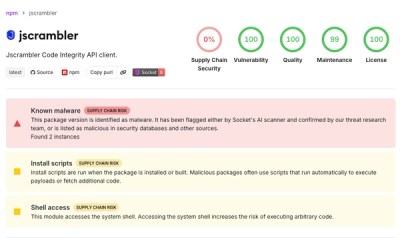
A compromised jscrambler npm release added a malicious preinstall hook that runs hidden native binaries on Linux, macOS, and Windows.

Research
/Security News
A malicious .NET package is typosquatting the Braintree SDK to steal live payment card data, merchant API keys, and host secrets from production apps.