
Security News
Next.js moves to scheduled security releases
Vercel is formalizing a monthly release program for Next.js. The change follows React2Shell and a sharp rise in AI-assisted vulnerability discovery.
By Sarah Gooding - Jul 16, 2026
system-definition
Advanced tools
Descriptive layer for systems designed around a Single Source of Truth (SSOT).




language:  also available in:

This module provides the vocabulary to describe a system — domain types, entities, fields, procedures — as strongly typed, serializable values. From those descriptions, code generators or on-the-fly implementations can derive the table creation scripts, the CRUD endpoints with their database layer, the frontend screens, the serializers in both directions, the type validators, and so on.
This module covers only the descriptive part of systems: it does not generate anything itself.
Every descriptive concept has (at least) two versions, distinguished by a suffix:
XxxDef (definition): what the human writes. It contains only the minimum with semantic
meaning; anything with a sensible default can be omitted.XxxInfo: what the framework produces by completing the Def with the defaults. Everything
is explicit there; it's what the generators consume.The Info is derived deterministically from the Def, and both are serializable (representable
as plain JSON, with no embedded functions).
Each system defines its own type collection (TypeCollection), associating a type name
(e.g. "text", "student id") with the TypeScript type it maps to at runtime. The
framework provides a few common types (text, integer, boolean) as a starting point;
each system can add its own (in the example, fecha — date — and email).
FieldDef / FieldInfoA field is described with FieldDef: its type (a key of the TypeCollection) and,
optionally, label, nullable and description. completeRecord produces the
corresponding FieldInfo, with those three fields always present (defaults: label
derived from the field name, nullable: true, description: ''), preserving the type
literal.
RecordDef / RecordInfoA RecordDef is simply a map of fields (Record<string, FieldDef>): the description of a
row. RecordInfoOf<TRecordDef> is the exact Info type that corresponds to a concrete
RecordDef — it keeps the keys and the type literal of each field — and it's what
completeRecord returns.
RecordInstanceType<TTypeCollection, TRecordDef> deduces, from a RecordDef and the
system's TypeCollection, the TypeScript type of an actual instance of that record (the
values each field would hold at runtime).
EntityDefEntityDef is the container level — the grid-representable unit — shaped as
{pk, fields}, where fields is a RecordDef and pk is the tuple of field names that
make up the primary key (composite keys are supported). It's built with defineEntity,
which checks at compile time that every element of pk is a key of fields, and preserves
the literals (pk ends up typed as an exact tuple, not as string[]).
extractPk / mergePkextractPk(entityDef) returns an entity's pk fields as a RecordDef with the exact type
(PkFieldsOf<TEntityDef>), so they can be inherited by spreading them into another entity
(for example, curso — course — inherits the pks of periodos, materias and
docentes). The rest of the fields need no special function: spreading objects already
dedups keys.mergePk(...pks) merges several pks that may overlap, without repeating elements and
deduplicating at the type level too (preserving the order of first appearance). It's used
for combined pks, like the one for presencias (attendance), which joins the pks of
inscripciones (enrollments) and clases (classes).examples/common/aida.ts describes a student system using this vocabulary. It includes
independent entities (docentes — instructors, materias — subjects, periodos — terms,
alumnos — students) and entities that inherit keys from others:
cursos (courses) inherits the pks of periodos, materias and docentes (the
instructor in charge of the course).clases (classes) extends the cursos pk by adding orden (sequence number).preguntas (questions) extends the clases pk by adding pregunta, and opciones
(options) extends the preguntas pk by adding opcion (pk inheritance chained across
several levels).inscripciones (enrollments) inherits the pks of cursos and alumnos.presencias (attendance) combines, with mergePk, the pks of inscripciones and
clases, which share periodo and materia: those fields aren't repeated.The tests in test/aida-test.ts import these definitions and check, for each part of the
vocabulary, both two-way assignability (a hand-written expected Info and the deduced one
must be mutually assignable) and the expected compile-time rejections (with
// @ts-expect-error): a pk with nonexistent fields, accessing a field the entity doesn't
have, reassigning a literal type, and so on.
src/common: the descriptive framework; it knows nothing about any concrete system.examples/common: an example system (a students system) described with the framework.test/: mocha tests that import the example definitions (the examples double as tests).TDD approach, moving forward in small steps: first the test that shows the problem, then
the minimal implementation that makes it pass. Type tests aren't loose: they check
assignability in both directions and also the expected rejections with
// @ts-expect-error.
npm test compiles with TypeScript and runs mocha over the compiled output (no ts-node,
no loaders).
Design stage.
FAQs
Defining system based on SSOT
We found that system-definition demonstrated a healthy version release cadence and project activity because the last version was released less than a year ago. It has 1 open source maintainer collaborating on the project.
Did you know?

Socket for GitHub automatically highlights issues in each pull request and monitors the health of all your open source dependencies. Discover the contents of your packages and block harmful activity before you install or update your dependencies.
Security News
Vercel is formalizing a monthly release program for Next.js. The change follows React2Shell and a sharp rise in AI-assisted vulnerability discovery.

Research
/Security News
11 malicious NuGet tools pose as game cheats to deploy Windows payloads, track hosts, and use Google Sheets for telemetry and control.
Research
/Security News
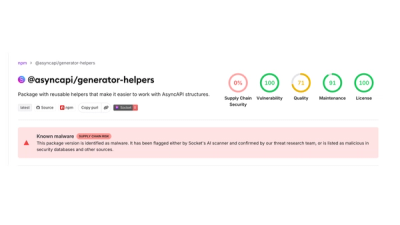
4 compromised asyncapi packages deliver miasma botnet loader on macOS, Linux and Windows.