Professional browser automation for Codex, Claude Code, and MCP clients, powered by DrissionPage.
DrissionPage is a Python web automation library built around direct Chromium/CDP control with requests-style HTTP session support. This server exposes its browser-facing capabilities as typed, atomic MCP tools.
🖱️ Atomic Browser Control with Natural Pointer Motion
DrissionPage MCP 0.8.5 exposes 69 typed browser capabilities. The MCP server provides accurate low-level observation and interaction; the client or an optional Skill composes those capabilities for a site, component library, challenge, or business workflow.
The model decides what to do; the MCP executes the requested browser operation exactly.
Screenshot / page observation
↓
Multimodal model identifies viewport coordinates
↓
page_click_xy(x=442, y=369, profile="natural")
↓
24-step eased cubic path → exact target → press → release
↓
Observe and verify the resulting page state
Core interaction guarantees
Two bounded profiles: direct emits one exact move; natural emits a deterministic 24-step eased cubic path with reproducible 8-14ms intervals and exact final arrival.
No hidden randomness: the same start, target, and profile produce the same path; there is no jitter, overshoot, or anti-detection logic. Pointer position is stateful, so a repeated call can begin from the previous endpoint.
Explicit sequences: click is the selected move profile, optional caller-specified delay, press, release; drag keeps one press across the selected path and ordered waypoints.
Failure-safe input: a pressed pointer button is released if execution fails after the press.
Fresh browser evidence: selector geometry is resolved immediately before selector-backed drag operations.
Typed results: outputs report the executed coordinates, button, step count, and explicit delay metadata.
Use structured DOM targets when reliable selectors exist. Use coordinates, natural motion, and explicit drag waypoints for canvas controls, editors, maps, charts, and other visual-only surfaces. Component-specific target discovery, challenge observation, multi-click sequencing, login procedures, and other business policy belong in the client or an optional Skill.
Designed for authorized browser automation, testing, accessibility workflows, and technical research. The core does not provide challenge-specific or site-specific workflows.
DrissionPage MCP Server is a local Model Context Protocol (MCP) server that brings DrissionPage browser automation tools to Codex CLI/IDE, Claude Code, Claude Desktop, and other MCP clients.
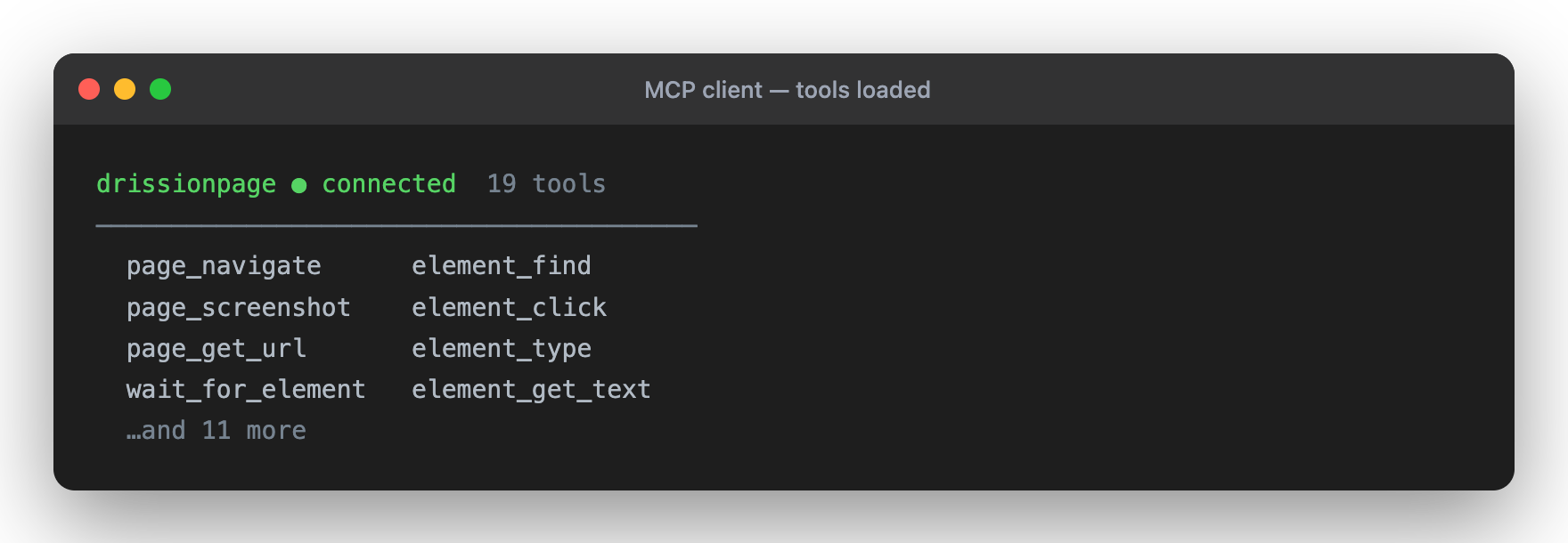
The standalone server exposes 69 typed tools, zero MCP prompts, and one static optional-Skills catalog resource. Version 0.8.5 keeps that registry stable and adds verified PyPI-to-MCP-Registry release metadata and automation. Every tool loads by default; there is no capability profile or opt-in full mode. Models compose these atomic capabilities, while reusable challenge and site procedures live outside the distribution as optional Skills. Browser execution is powered by DrissionPage.
🌟 Why Choose DrissionPage MCP?
Structured-First, Vision-Ready: Uses DOM structure when available and multimodal coordinates when visual interaction is the better tool
Deterministic: Reliable element selection with CSS/XPath normalization for LLM-friendly selectors
Natural Pointer Motion: Offers exact direct movement and a bounded deterministic 24-step eased trajectory from the same atomic tools
Fast & Lightweight: Built on DrissionPage's efficient engine with minimal overhead
Type-Safe: Full type hints and Pydantic validation for all tools
Open-source Friendly: Includes compatibility notes, troubleshooting, and CI checks for maintainable contributions
DrissionPage MCP is backed by a strict regression suite and browser-backed scenario checks:
Strict automated tests: unit, protocol, schema snapshot, response-contract, resource, release-metadata, security-policy, browser-integration, and coverage checks run in CI.
95% coverage floor: CI enforces the current 95% coverage threshold and uploads coverage reports.
Real browser verification: Chrome/Chromium-backed integration tests exercise the same MCP tools exposed to clients.
Document-boundary verification: focused browser tests prove cross-origin OOPIF reads and DrissionPage-exposed closed Shadow DOM lookup without JavaScript piercing fallbacks.
Challenge-surface verification: local fixtures cover normal, hidden, off-viewport, delayed, and CSS 3D cross-origin widgets; official Turnstile dummy keys cover visible, invisible, pass, fail, and forced-interactive callbacks without retaining tokens.
Scenario validation: the playground MCP Lab covers realistic forms, commerce pages, social feeds, timelines, dynamic waits, iframe cases, and recovery paths without depending on public demo websites.
⚡ First Success Path
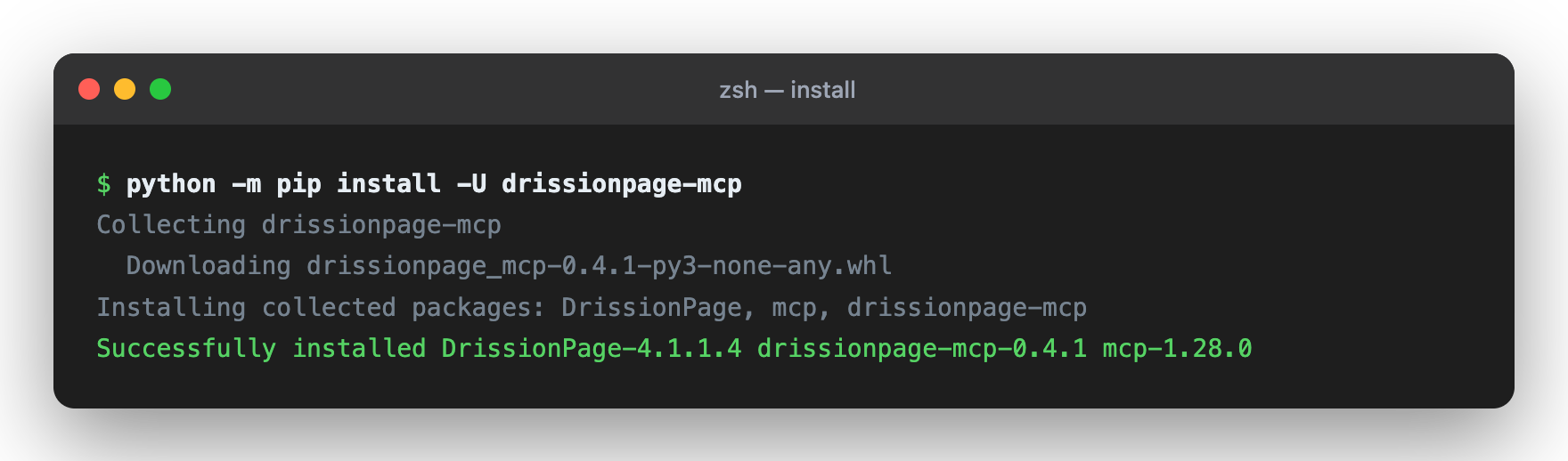
# Install from PyPI
python -m pip install -U "drissionpage-mcp>=0.8.5"# Verify package and environment
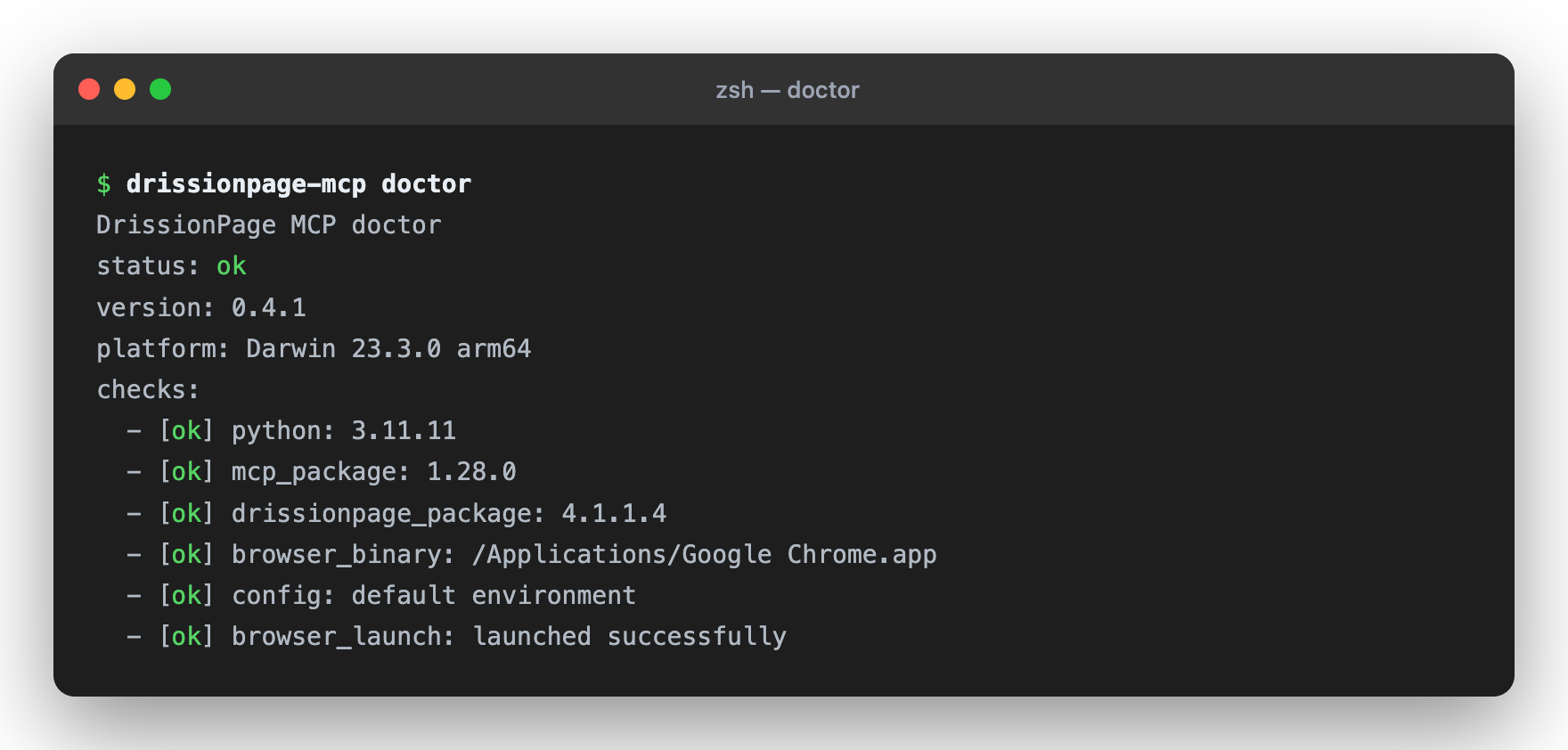
drissionpage-mcp --version
drissionpage-mcp doctor
Then add the Codex or MCP client configuration below and restart your client.
📦 Setup in Codex CLI/IDE (30 seconds)
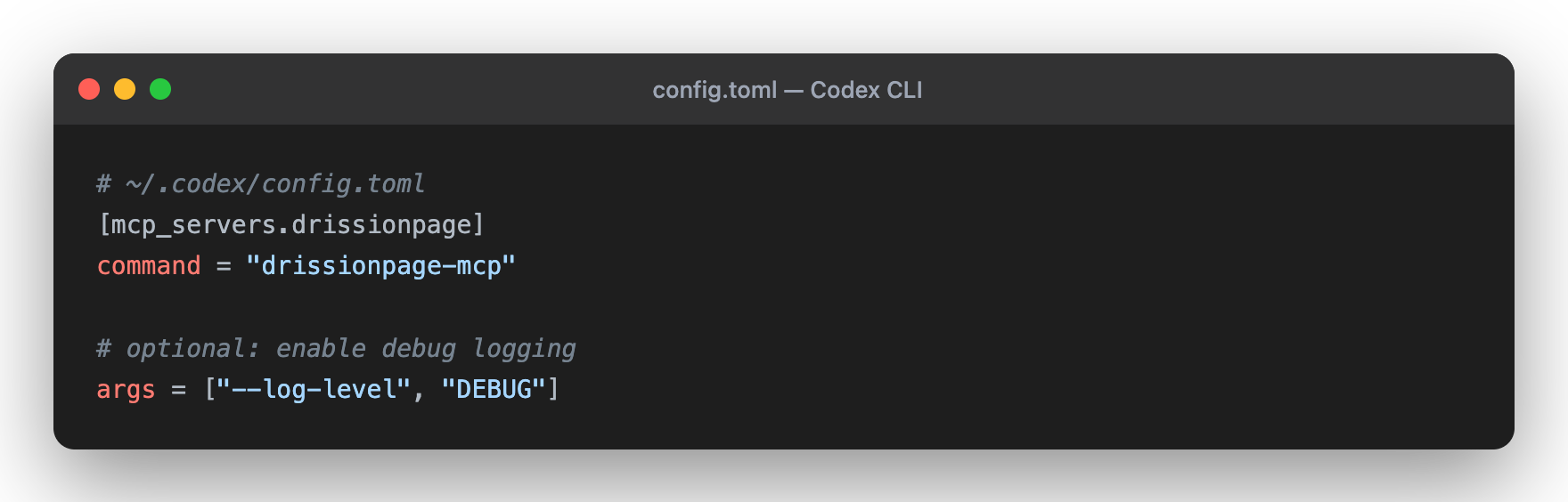
Codex supports local stdio MCP servers through config.toml; the CLI and IDE extension share the same MCP configuration.
Edit Codex configuration:
User-level: ~/.codex/config.toml
Project-level: .codex/config.toml inside a trusted project
Restart Codex. In the TUI, run /mcp; from a shell, run codex mcp list.
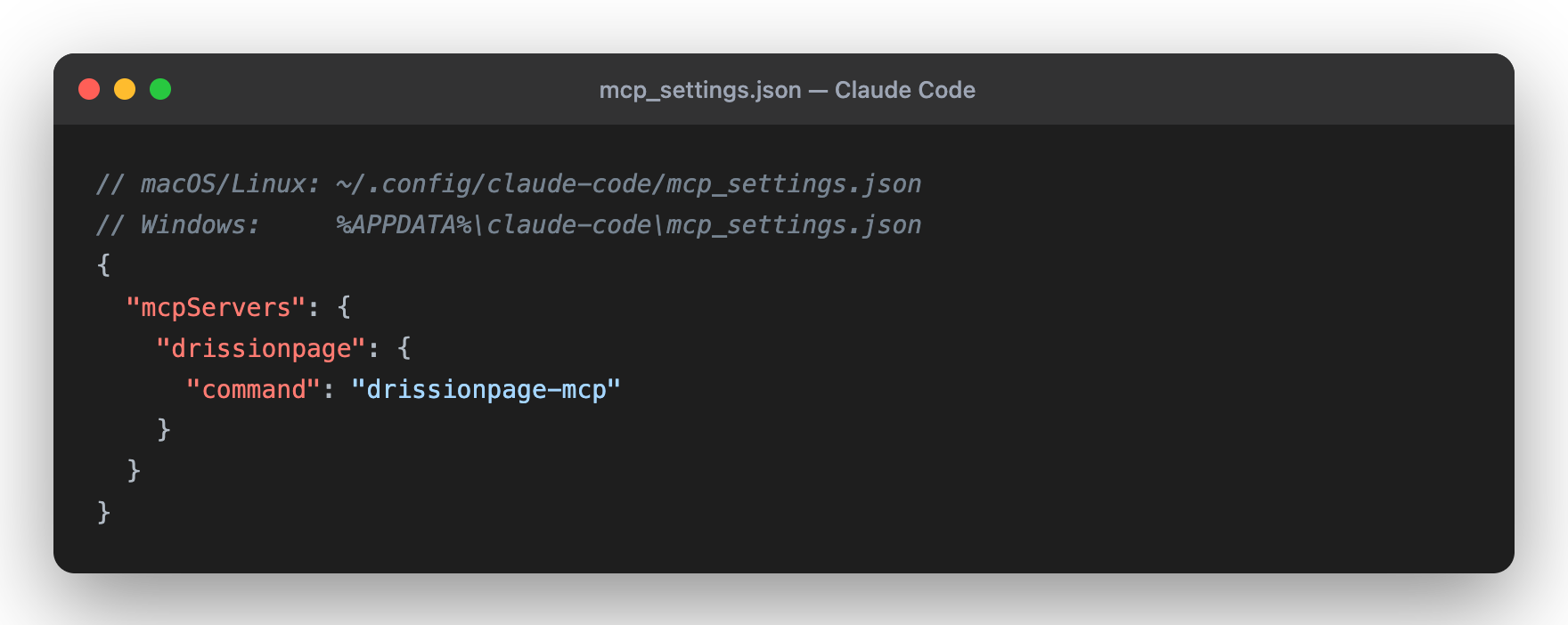
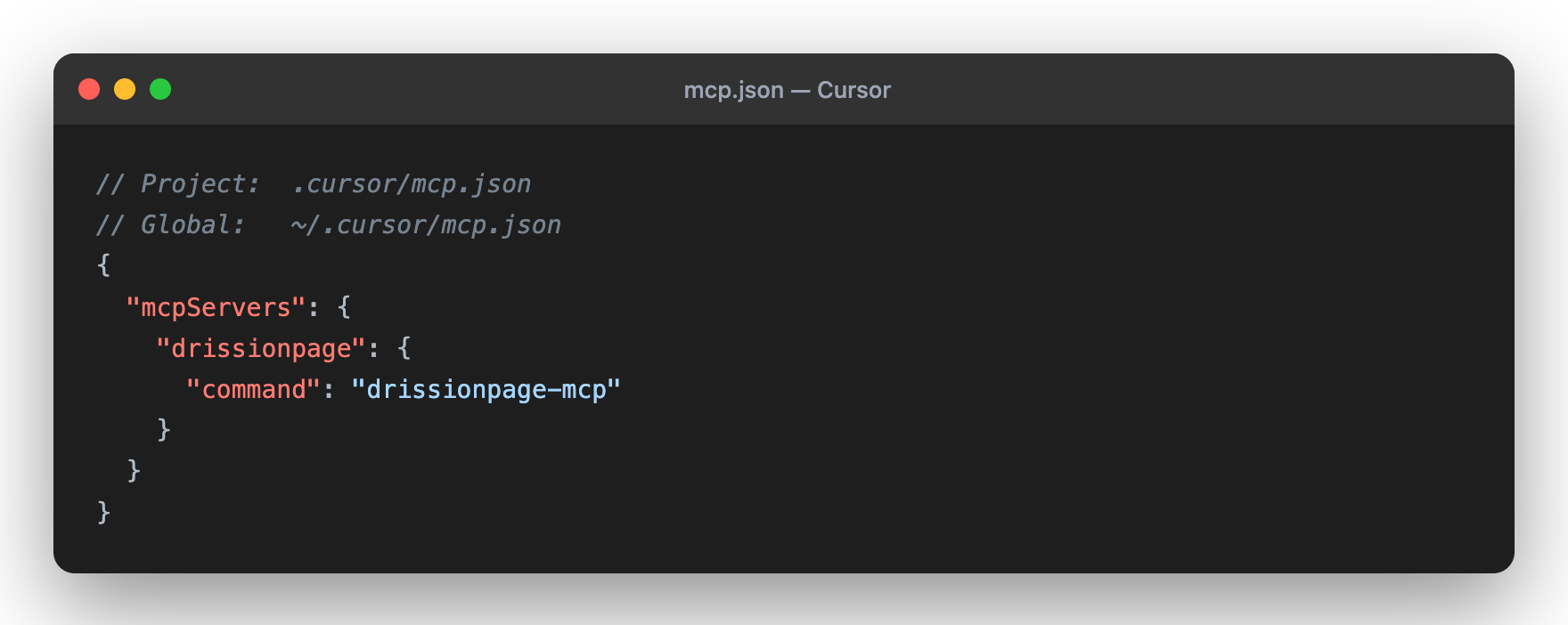
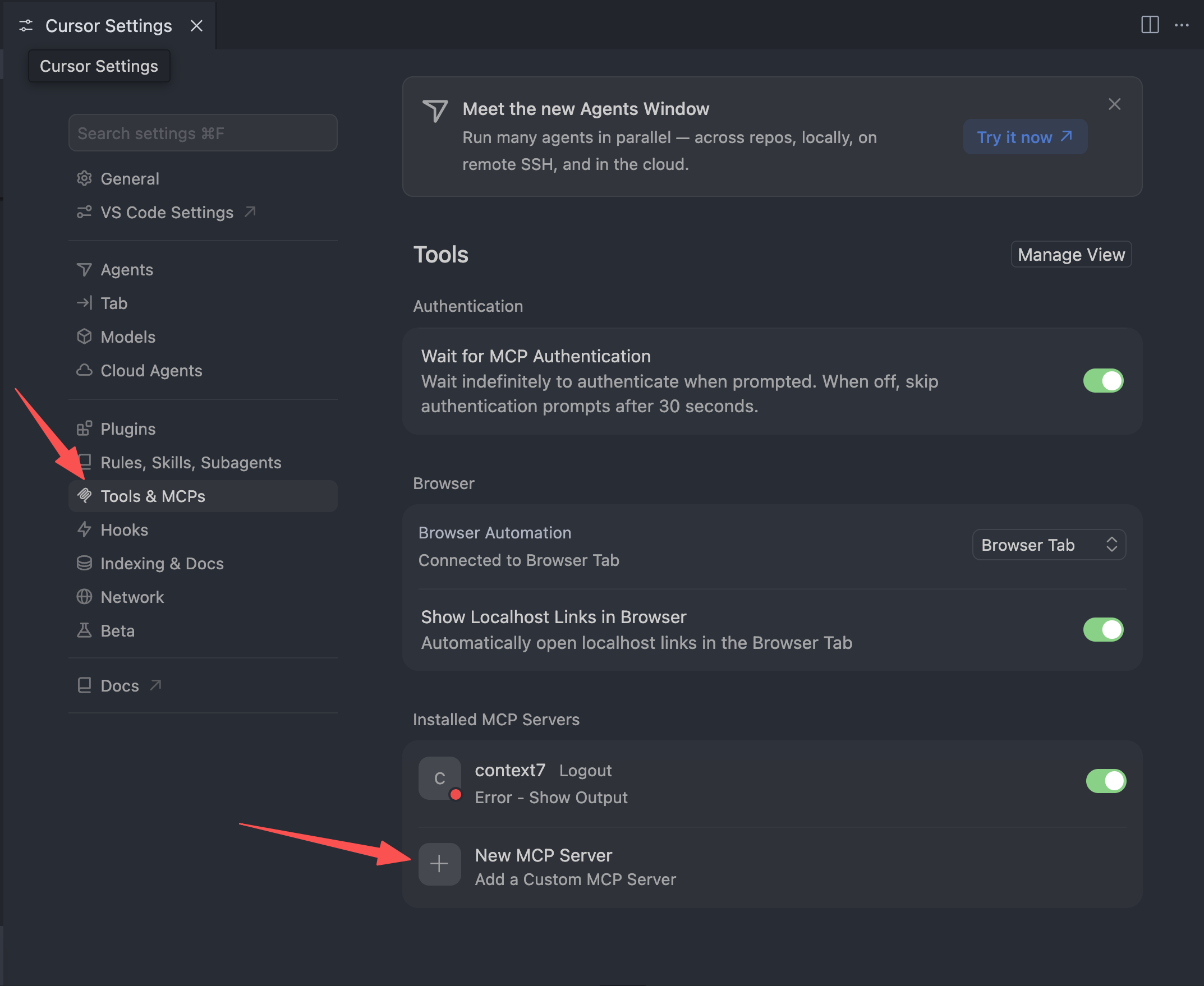
For Claude Code, Claude Desktop, and other JSON-based MCP clients, see Integration Examples.
🎯 Quick Examples
Navigate and Screenshot
"Visit https://example.com and take a screenshot for me"
Search and Extract
"Go to Wikipedia, search for Python, and get the first paragraph"
Form Automation
"Fill out the form at https://httpbin.org/forms/post and submit it"
Data Scraping
"Get the top 10 news headlines from news.ycombinator.com"
🛠️ 69 Typed Browser Tools
🌐 Navigation (5 tools)
page_navigate - Navigate to any URL; optionally open it in a new tab with new_tab or return an observe change summary
page_navigate_with_http_auth - Navigate through a scoped HTTP auth challenge in a dedicated disposable Chromium context without returning credentials
page_go_back - Navigate backward in browser history
page_go_forward - Navigate forward in browser history
page_refresh - Reload current page
🗂️ Tab Operations (3 tools)
tab_list - List open browser tabs with stable MCP tab IDs
tab_switch - Switch to a tab returned by tab_list
tab_close - Close one tab without closing the whole browser
🎯 Element Interaction & Extraction (16 tools)
element_find - Find one element by CSS selector or XPath; bare selectors like h1 are treated as CSS
element_find_all - Extract bounded repeated elements with text, attributes, and recommended selectors
element_click - Click any element with additive left/right/middle and single/double-click semantics
element_click_and_download - Correlate one selector, coordinate, or keyboard trigger with one integrity-checked artifact under DP_MCP_DOWNLOAD_ROOT
element_type - Input text into elements
element_upload_file - Use element_upload_file(paths=[...]) to upload files from DP_MCP_UPLOAD_ROOT to input[type=file]
element_click_and_upload - Arm Chromium's file chooser, click its trigger, inject approved files, and clean interception without an operating-system picker
element_scroll_into_view - Bring an element into the viewport before acting
element_hover - Hover an element to trigger menu/tooltip states
element_select - Select an option by value, text, or index
element_check - Check or uncheck checkbox/radio controls
element_get_text - Get element or page text
element_get_attribute - Get an HTML attribute
element_get_property - Get a live DOM property such as an input value
element_get_html - Get element or page HTML
element_state_get - Read live DrissionPage state flags and document/viewport geometry for one element
📸 Page Operations (18 tools)
page_screenshot - Capture an inline full-page or viewport screenshot
page_screenshot_save - Save a screenshot under DP_MCP_SCREENSHOT_ROOT
page_export_artifact - Generate a managed PDF or MHTML artifact under DP_MCP_ARTIFACT_ROOT with SHA-256 and receipt evidence
page_snapshot - Return a bounded page outline with headings, links, buttons, inputs, forms, and selector recommendations
page_accessibility_snapshot - Return a bounded Chromium accessibility tree for the page or a scoped element, with field values redacted unless explicitly requested
page_observe - Return a compact page fingerprint with URL, title, counts, visible text samples, active element, and recent console summary
page_evaluate - Run bounded JavaScript in the current page and return a JSON-safe result
page_scroll - Use page_scroll(pixels=...) for relative scrolling, or pass x/y for an absolute position
keyboard_press - Send keys to the active element/page without echoing the input in results
page_resize - Adjust browser window
page_pointer_move - Move to exact viewport CSS coordinates with direct or bounded deterministic natural motion
page_pointer_drag - Perform one failure-safe coordinate drag through up to six optional ordered waypoints with the selected profile
page_pointer_drag_element - Resolve source and destination geometry immediately before dragging; supports CSS/XPath in the top document or one same-origin iframe, plus CSS paths through nested open Shadow DOM hosts
page_click_xy - Move with direct or natural motion, optionally wait for an explicit delay, then press and release at the exact target
page_close - Close browser
page_get_url - Get current URL
page_dialog_observe - Wait for and inspect a pending native alert, confirm, or prompt without handling it
page_dialog_respond - Use page_dialog_respond(action="accept") (or "dismiss") for one pending alert, confirm, or prompt
🧱 Frame / Shadow DOM (5 tools)
frame_list - List iframe/frame contexts without changing global frame state
frame_snapshot - Use frame_snapshot(frame_selector="...") or frame_index to inspect one iframe with bounded outline data
frame_find - Find an element inside a selected iframe
shadow_find - Find one element inside a shadow root exposed by the current supported DrissionPage runtime, including tested closed roots
shadow_find_all - Extract repeated elements from a DrissionPage-exposed shadow root
🌍 Browser Environment (6 tools)
browser_headers_set - Replace extra request headers and echo the accepted values; an empty object clears them
browser_user_agent_set - Override the user agent and optional platform, returning both the accepted and previous user agents
browser_cache_clear - Clear HTTP cache while preserving Cookies, localStorage, and sessionStorage
browser_permission_get - Query one browser permission for the current document origin without opening an OS prompt
browser_permission_set - Use browser_permission_set(setting="granted") (or "denied"/"prompt") for an exact origin/current Chromium context
browser_permissions_reset - Reset permission overrides for the current Chromium context
🍪 Cookies & Storage (7 tools)
browser_cookies_get - Read normalized cookies with values redacted by default
browser_cookies_set - Set up to 100 cookies in one call and echo values in the successful result by default
browser_cookies_delete - Delete one named cookie with optional URL/domain/path scope
browser_cookies_clear - Clear all browser cookies
storage_get - Read localStorage/sessionStorage by key or as a map, with values redacted unless include_values=true
storage_set - Set one localStorage/sessionStorage item without echoing the value
storage_clear - Clear one storage key or an entire storage area
🧪 Debug / Observability (1 tool)
page_console_logs - Read bounded browser console messages with level filtering, cursor pagination, and limits
⏱️ Wait Operations (4 tools)
wait_for_element - Wait for element to appear (with timeout)
wait_for_url - Use wait_for_url(url_pattern="...") until the current URL contains the supplied text
wait_until - Use wait_until(condition="text_contains", value="...") or another documented condition/value pair
wait_time - Delay execution
🌐 Network Control & Observation (4 tools)
network_listen_start - Start bounded HTTP/XHR/Fetch observation through DrissionPage
network_listen_wait - Wait for bounded packet metadata with optional redacted headers or body excerpts
network_listen_stop - Stop observation and optionally clear queued packets
network_blocked_urls_set - Use network_blocked_urls_set(urls=[...]) to replace blocked URL patterns; an empty list clears them
🧩 Optional Skills Discovery
Resource: drissionpage://skills/catalog
Prompts: none
Repository examples: cross-origin-iframe-probe, turnstile-testing, and xiaohongshu-content-research
Entry point: skills/<skill-name>/SKILL.md; catalog schema v2 includes Skill/MCP versions, required tools, fixture, fixed v0.8.4 source revision, verification status, and SHA-256
Skills are Markdown procedures for the MCP host. They are not Python modules, are not executed by the server, and are excluded from wheel/sdist packages.
Validate a source checkout with python playground/validate_skills.py --json.
Install the fixed catalog release from
skills-manager@v0.8.4
with python install.py install --client codex --json or
python install.py install --client claude --json.
📖 Skills and Reusable Procedures
The MCP core exposes atomic browser operations. Skills provide reusable,
reviewable procedures outside the server:
Bounded read-only note research and the deterministic social-notes fixture
Stop on robots, login, captcha, safety page, or rate limit
Read the full Skills guide before publishing a new procedure.
Skills must use existing typed tools, collect fresh evidence, verify
postconditions, redact secrets, and state unsupported cases. They do not add
new MCP tools or override the server's navigation and safety policy.
Any MCP-compatible client: Codex CLI/IDE, Claude Code, Claude Desktop, Cursor, VS Code, etc.
🧪 Testing
Verify Installation
# Environment diagnostics; add --launch-browser for a browser startup check
drissionpage-mcp doctor
drissionpage-mcp doctor --launch-browser

# Source checkout tests
python -m pip install -e ".[dev]"
python -m pytest tests/

# Coverage report (CI enforces the current 95% floor and uploads coverage.xml)
python -m pytest tests/ --cov=drissionpage_mcp --cov-report=term-missing --cov-report=xml

# Browser-backed MCP Lab scenario checks
DP_HEADLESS=1 python playground/run_mcp_lab.py --all --json
GitHub Actions runs lint, unit, protocol, package, browser integration, and
coverage jobs. Codecov is configured through codecov.yml and the CI workflow.
Try It Out
# No-browser MCP registry check
python playground/run_mcp_lab.py --case registry

# Local deterministic site check
python playground/run_mcp_lab.py --case site

# Browser-backed form inspection scenario
DP_HEADLESS=1 python playground/run_mcp_lab.py --case form-inspect
🚀 Use Cases
✅ Automated Testing - Test web applications
✅ Data Scraping - Extract structured data from websites
✅ Form Automation - Fill and submit forms
✅ Monitoring - Check for updates or changes
✅ Screenshot Verification - Capture and verify page state
✅ Content Analysis - Analyze web content programmatically
🐛 Troubleshooting
Tools Not Loading?
drissionpage-mcp --version
Should output the installed package version, for example drissionpage-mcp 0.8.5.
drissionpage-mcp doctor must also report both mcp_supported and
mcp_server_wiring as ok; package-version output alone does not prove that an
MCP client can initialize the server.
✅ Strict unit/protocol/schema checks plus browser-backed scenarios
Documentation
✅ Setup, compatibility, troubleshooting, and public tool contracts
Package
✅ PyPI metadata and build checks
Status
🟡 Beta; real browser behavior depends on local Chrome/Chromium and target sites
Version: 0.8.5 | License: Apache 2.0 | Maintained: ✅ Active
🗺️ Roadmap
Current (v0.8.5)
69 atomic navigation, tab/frame/shadow, accessibility, observation, interaction, browser-environment, network, Cookie/storage, wait, and console tools, all loaded by default
stdio MCP server integration
Doctor diagnostics for local setup
Stable JSON mirror, structuredContent, and typed per-tool MCP outputSchema
Structured recovery hints in error.details.hints for common failures
Sanitized browser failures with DIALOG_PENDING/DIALOG_NOT_FOUND recovery and strict standards-compliant JSON for non-finite JavaScript values
Balanced page_snapshot output so link-heavy pages still expose controls and forms
Atomic type, select, check, click, keyboard, upload, wait, and state-read tools cover native controls and framework-driven widgets without library-specific branches
Tab management with tab_list, tab_switch, tab_close, and page_navigate(new_tab=true)
Observable actions with page_observe, page_evaluate, wait_until, and optional observe=true changes on navigation, click, and type
Console observability with page_console_logs, console summary in page_observe, and console change fields in observe=true
Form, component-library, challenge, and convenience workflows remain outside the MCP core
Repository example Skills for cross-origin iframes, authorized Turnstile fixtures, and bounded Xiaohongshu-like research are discoverable through the static catalog and excluded from wheel/sdist packages
Capability-probed page_dialog_respond, additive double/context click behavior, and selector/coordinate/keyboard download correlation with safe ArtifactRef metadata
Secret-bearing Web Storage values require include_values=true; keyboard and keyboard-download results expose redacted metadata only
Per-tab download trigger locking, shared deadlines, cleanup/replay guarantees, and a 250ms fail-closed late-mission guard
Reproducible W01-W08 public-tool benchmark with ten isolated runs per workload, machine-readable evidence, and zero duplicate side effects
Network listener beta with network_listen_start, network_listen_wait, and network_listen_stop for HTTP/XHR/Fetch observation
Browser-only request environment control with echoed header, user-agent, and blocked-URL writes plus cache-only clearing that preserves Cookies and Web Storage
direct and deterministic bounded natural profiles for page_pointer_move, page_pointer_drag, and page_click_xy, with exact endpoints and failure-safe release
Optional bounded page_pointer_drag.waypoints for one held multi-segment canvas, map, box-selection, or visual-editor gesture
File upload, scrolling, hover, select/check, keyboard, iframe, shadow DOM, cookie, and storage tools for DrissionPage 4.x
Pure browser Cookie set/get/delete/clear flow, including bounded batch writes whose successful results echo values for MCP callbacks
Ten-cycle controlled and validation input replacement through native DrissionPage input on the supported browser matrix
Cross-origin OOPIF reads through frame_* and closed Shadow DOM lookup through DrissionPage-backed shadow_*, with narrower pointer targeting documented separately
Frame boundary/document-access classification plus outer presentation, top-level viewport coordinate, scroll receipt, and coordinate-actionability evidence for production challenge workflows
Local challenge-surface and opt-in official Turnstile test-key benchmarks with parent-page postconditions, screenshots, and token-safe evidence
Backward-compatible string or structured selector/accessibility targets across element reads, actions, waits, uploads, and click-download correlation, resolving ordered frames first and then ordered Shadow DOM hosts
Bounded accessibility snapshots, non-handling native dialog observation, and live element state/geometry for autonomous locate-act-verify loops
Browser permission observation/set/reset, managed PDF/MHTML artifacts, automatic file chooser interception, and credential-redacted HTTP auth isolated by disposable Chromium context
Chrome sandbox remains enabled by default; DP_NO_SANDBOX=1 is reserved for restricted container/root environments
No retained action history, generated code snippets, or absolute screenshot paths in public results
Opt-in local safety policy for navigation and screenshot paths
One optional-Skills catalog resource with repository example metadata, zero prompts, plus Skills, eval, compatibility, and troubleshooting documentation
PyPI distribution
Official MCP Registry package metadata and tag-gated publishing workflow
Ready to automate your workflows? Install now: python -m pip install -U drissionpage-mcp
🆕 Latest Version: v0.8.5
Released on 2026-08-21. This release makes the existing PyPI package discoverable through the official MCP Registry without changing the browser capability contract:
Adds the Registry ownership marker to the PyPI package README and a typed server.json for the stdio PyPI distribution.
Adds a tag-gated GitHub Actions release chain: trusted PyPI publishing first, then GitHub OIDC publication to the MCP Registry.
Documents the post-publication discovery paths for Cursor Directory and TRAE installation links.
Keeps the public surface at 69 tools, zero prompts, and one Skills catalog resource. The external Skills catalog remains pinned to skills-managerv0.8.4.
Professional browser automation for Codex, Claude Code, and MCP clients powered by DrissionPage
We found that drissionpage-mcp demonstrated a healthy version release cadence and project activity because the last version was released less than a year ago.It has 1 open source maintainer collaborating on the project.