Swagger 2.0 











This project contains a golang implementation of Swagger 2.0 (aka OpenAPI 2.0).
It provide tools to work with swagger specifications.
Swagger is a simple yet powerful representation of your RESTful API.
Documentation
https://goswagger.io
Features
go-swagger brings to the go community a complete suite of fully-featured, high-performance, API components to work with a Swagger API: server, client and data model.
- Generates a server from a swagger specification
- Generates a client from a swagger specification
- Generates a CLI (command line tool) from a swagger specification (alpha stage)
- Supports most features offered by jsonschema and swagger, including polymorphism
- Generates a swagger specification from annotated go code
- Additional tools to work with a swagger spec
- Great customization features, with vendor extensions and customizable templates
Our focus with code generation is to produce idiomatic, fast go code, which plays nice with golint, go vet etc.
More details.
Project status
This project supports OpenAPI 2.0. At this moment it does not support OpenAPI 3.x.
go-swagger is now feature complete and has stabilized its API.
Most features and building blocks are now in a stable state, with a rich set of CI tests.
The go-openapi community actively continues bringing fixes and enhancements to this code base.
There is still much room for improvement: contributors and PR's are welcome. You may also get in touch with maintainers on our slack channel.
Installing
go install github.com/go-swagger/go-swagger/cmd/swagger@latest
go-swagger is also available as binary or docker releases as well as from source: more details.
Try it
Try go-swagger in a free online workspace using Gitpod:

Licensing
The toolkit itself is licensed under an Apache Software License 2.0.
Just like swagger, this does not cover code generated by the toolkit. That code is entirely yours to license however you see fit.
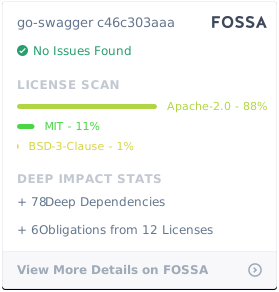
Licence scan on dependencies